

As Valentine’s Day draws closer, we’ve picked out some of our favourite photo books about love, featuring Sophie Calle, Nan Goldin and Hajime Sawatari
As February fills with red-and-pink declarations of love and romantic gestures are urged in every form, the opportunity to look the other way arises. The other way is understood not so much as an outright rejection of sentimentality, but as a survey of alternative manifestations: through quieter, more singular articulations. The photo book is a particularly meaningful medium – the photo album, its amateur protoform, has long been, after all, a repository for images of loved ones. Plus, photo books also make excellent gifts, for lovers or otherwise.
Below is a selection of titles that explore the many registers romantic photography can take, from routine to celebration, closeness to solitude, and the voyeuristic to the confessional.



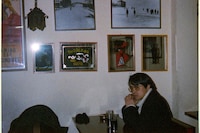
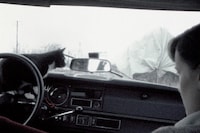

First Trip to Bologna 1978 / Last Trip to Venice 1985 by Seiichi Furuya
From the moment Japanese photographer Seiichi Furuya met Christine Gössler in Graz in 1978, he began documenting her. Only a few weeks into their relationship, they travelled together to Bologna. Seven years later, they returned to Italy for what would be their final trip – shortly after, Furuya-Gössler took her own life. This publication bookends the relationship, tracing the arc from beginning to end by juxtaposing both journeys, attempting to decipher the questions raised by loss. The project emerged after Furuya rediscovered the Super 8 films from the initial trip in his attic and forms part of his ongoing effort to disseminate the couple’s life and work. Its most recent extension is Photographs 1978-1985, the first photobook devoted to Furuya-Gössler’s images, which offers her perspective on their shared story.



Couples and Loneliness by Nan Goldin
Nan Goldin has established an indesputable blueprint for contemporary representations of intimacy. Her best-known series, The Ballad of Sexual Dependency, is an ever-growing body of work documenting her life and that of those around her through questions of desire (currently on view at Gagosian in London). This 1998 title is a lesser-known publication that distils Goldin’s central subject matter, published by the Japanese Korinsha Press under the revealing title Couples and Loneliness. “Relationships are a constant struggle for intimacy while trying to maintain one’s autonomy”, she writes. From the bedroom to the bar and the family living room, her subjects appear together and alone, candidly depicting that struggle.






Chloë and Harmony ‘94 by Kevin Hatt
Published last year, Kevin Hatt’s zine of his portraits of Chloë Sevigny and Harmony Korine offers a rare glimpse of two people in love before their lives would change forever. Shot ahead of the release of Kids – the film that propelled them into stardom – the images resulted from a chance encounter between Hatt and Sevigny in downtown 90s New York, and Korine’s spontaneous decision to join the session. Rendered in black and white, the images are tentative and unguarded, yet the subjects’ magnetism is already palpable. The zine reads as a tender parenthesis between private life – a teenage romance – and the public impact both would soon have through their work.
Read our interview with Kevin Hatt here.

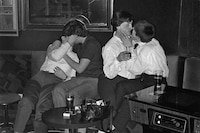
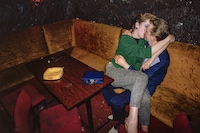

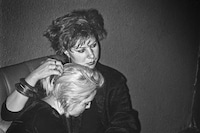

Hello, I Love You by Derek Ridgers
Documenting what he describes as a “private moment in public”, British photographer Derek Ridgers spent decades building an archive of anonymous displays of affection. Originally released as three self-published zines and now collected in a single volume, the photographs – shot across the 70s, 80s and 90s – trace subcultures in flux. From punks and metalheads to mods and ravers, couples appear on streets, in nightclubs and at festivals, set against changing fashions and cityscapes. The sociological interest remains only secondary to the images’ immediacy: bodies locked together mid-kiss, lushly surrendered to one another.



The Eye of Love by René Groebli
A honeymoon offers a fertile subject for photography. Among the earliest explorations of this theme is The Eye of Love, a series by Swiss photographer René Groebli, first published in 1954. During a stay in a Parisian hotel, Groebli photographed his wife Rita, drawing on the clichés of their surroundings: “I tried to convey the typical atmosphere of French hotel rooms. There were so many impressions: the poor-looking furniture in a cheap hotel, the ‘Amors’ embroidered on the curtains. And I was in love with the girl, the girl who is my wife.” Playing softly with shape and shadows, the images portray Rita’s body, at times nude, in a quiet exploration of sensuality, highly controversial upon release.






Max by Sam Penn
“She sees in me what she sees in herself, and I see possibility in her recognition,” writes Max Battle of photographer Sam Penn. Their love is at the centre of Max, Penn’s most recent project, which took shape as a lauded exhibition at New York Life Gallery last year and as an accompanying book. Together, they lay bare the dynamics of the relationship, shaped by their experience as a trans woman and a trans man. Their bodies become the device for determined expression, with portraits interspersed with nudes, close-ups and landscapes. Battle’s writing traces, almost like a journal, their story – an intimate negotiation of power marked by meetups, breakups, sexual longing and creative exchange. Max’s vulnerability is radical, made possible by the trust they both have in one another, and, generously, in each other’s art.



Take Care of Yourself by Sophie Calle
Sophie Calle’s work centres on her own intimacy, examined with a near-researcher’s precision – her first American monograph, revealingly called Overshare, is currently on view at the Orange County Museum of Art. One of her pivotal projects is this artist book, the response to a break-up email from her lover. Unable to make sense of the unilateral ending, Calle asked 107 women of different professions and skills – from a schoolgirl to the artist’s mother, including a clairvoyant, a judge or a philosopher – to interpret the message: “To analyse it, comment on it, dance it, sing it. Dissect it. Exhaust it. Understand it for me.” The resulting volume becomes an archive of these responses. Each interpretation reframes the letter, transforming it from romantic rejection into a shared, collective experience. In the end, Calle describes it as a game. “This was all about a letter,” she writes. “Not the man who wrote it …”
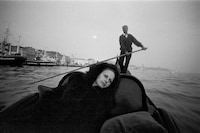

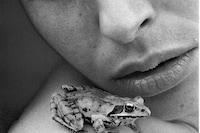

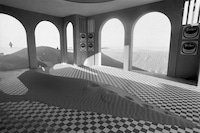
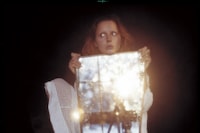
Nadia by Hajime Sawatari
Japanese photographer Hajime Sawatari is known for his fantastical, near-surrealist style – most famously in his controversial series Alice, a visual reinterpretation of Lewis Carroll’s tale. In the 70s, while working in fashion photography, Sawatari began to develop the distinct aesthetic that shaped both his commercial and personal work. A key example is Nadia, begun after he met and fell in love with the Italian model Nadia Galli in the early 70s. Travelling together through Italy and Japan, they blurred the line between commission and documentary, reality and fiction. The series became Sawatari’s first breakthrough and marked a new approach to the female body in Japanese photography.
