
For her latest exhibition of paintings, the rising art world darling accesses the bygone myths, histories and romanticisations of the British countryside through the country’s poisonous plants
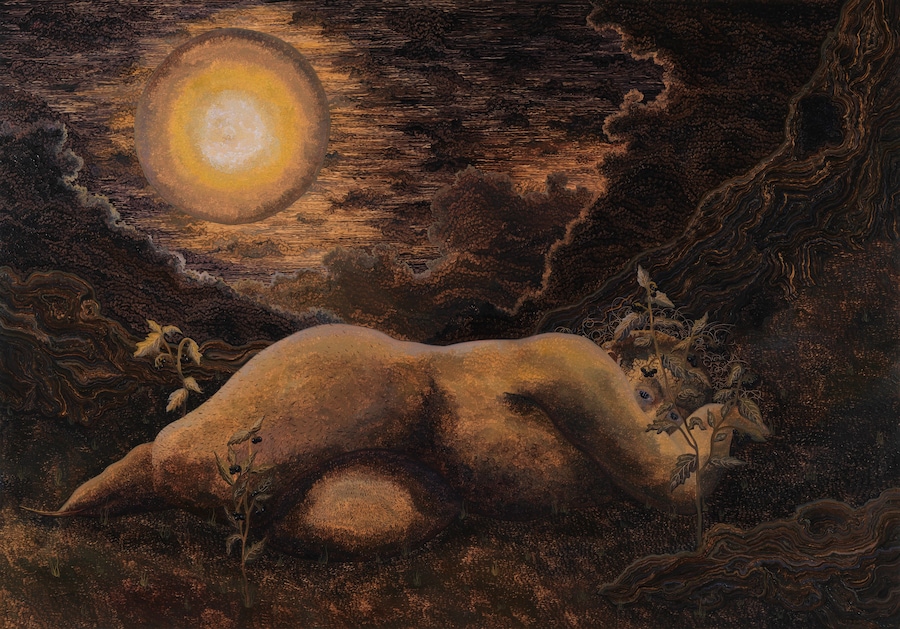
Georg Wilson’s paintings are incredibly intoxicating. Like half-remembered dreams, her curious pastoral visions displace familiarity in search of wilder fantasies, where humans are nowhere to be found. Against Nature, the London-based artist’s second solo show at Pilar Corrias, establishes Wilson at the helm of a flourishing artistic engagement with the para-pastoral in contemporary painting. Hers is an altogether strange, uncanny variant of the British countryside that resists the canonical entrapments of a bucolic idyll. No rolling hills and manicured hedgerows to be found here. Instead, we’re resolved to dwell in the eldritch shadows of prickly fronds, bury our toes in the peaty soil, and wait for sunrise.
In her latest body of work, Wilson accesses the myths and histories of the British countryside through uncultivated poisonous plants – henbane, thorn-apple, cuckoo pint – species that grow across the UK at its margins, inhabiting wastelands and roadsides, and bearing long, oft-forgotten histories in folklore and medicine. “The presence of nature has become more central in my life and practice over the past couple of years,” she says. “Compared to previous paintings, the plants in this exhibition have far more detail. They’re undoubtedly the protagonists.”
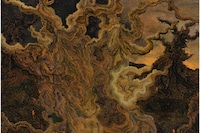
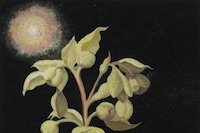
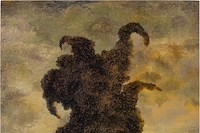
Taking her leave from horticultural and botanical texts, Wilson’s portraits of noxious flora are informed by direct observation and a deep engagement with the landscape, a fascination that has carried her beyond the familiarity of London. Struck by the austere sparseness of Neolithic sites in Avebury and Orkney, she was compelled to treat the plants as cogent, ancient entities set against crepuscular skies, in possession of a vast perception of time.
The nightshade henbane, which inspires the largest painting in Against Nature, embodies the balance that Wilson pursues across her practice. Historically used in medieval tinctures such as the so-called witch’s flying ointment, henbane could induce powerful, trance-like states – sensations akin to flight – when administered in controlled doses for pain, spasms, or insomnia, even as it remained lethally toxic. “I’m drawn to these plants as something both monstrous and magical,” Wilson says. “In a landscape where truly deadly species are rare, the plants introduce a tangible sense of threat.” Often self-seeding and growing in uncultivated areas, they stand as the last bastions of wildness, an untamed presence evading human control.
Wilson contends that the history of landscape painting has failed to speak to the truth of England’s rural countryside. Rather than places of uncomplicated refuge – a narrow conviction she regards as tied to the fraught history of land ownership – she paints landscapes charged with unease. “I never want my work to feel inaccessible,” she says, “but I don’t want it to be Disney-fied or fetishised either.” Walking through the countryside, even on a bright summer’s afternoon, she finds herself gripped less by enchantment than by fear. “I can’t shake this sense that this is not made for us, and we are not entirely welcome.”
, 2025)
Olga Tokarczuk, whose fecund prose settled in my mind while speaking to Wilson, laboured under a similar apprehension, writing in Drive Your Plow Over the Bones of the Dead that “on a Wednesday in January, at seven in the morning, it’s plain to see that the world was not made for Man, and definitely not for his comfort or pleasure.”
Wilson’s Against Nature inhabits a comparable climate and condition. She paints seasonally, and with this series, depicts the year in its bleakest register; hostile and macabre. “This body of work marks the arrival of winter in the darkest way I’ve ever explored,” she says. “Over the past year, my work has become more detailed, and I finally felt ready to pursue an idea I’ve been circling for years: the depiction of low light, when you’re walking at night and colours become uncertain, slipping out of focus as the eye searches for meaning.”
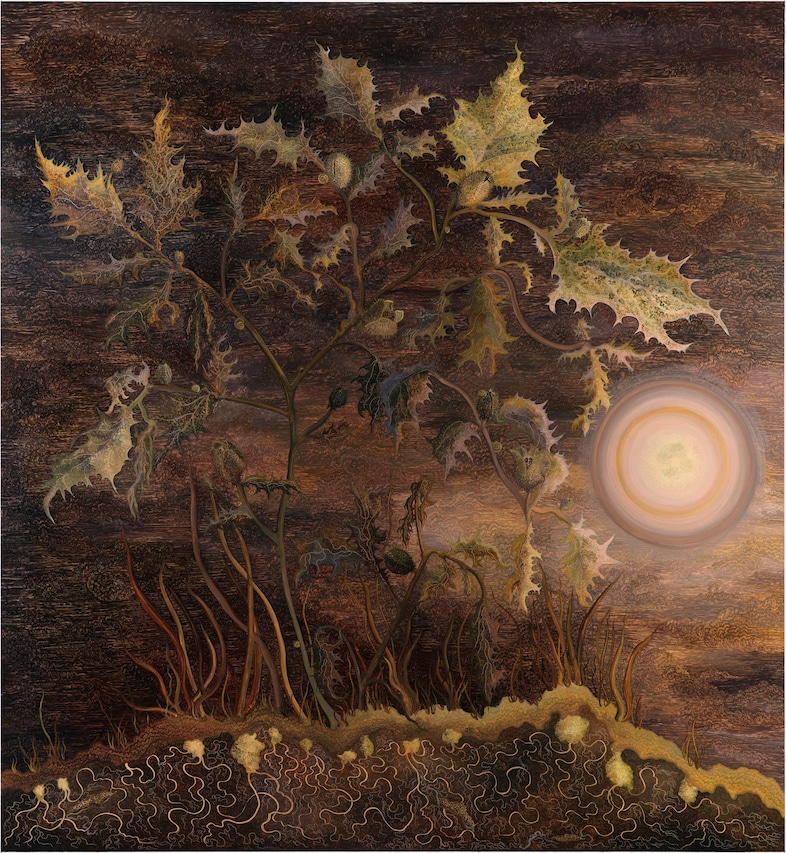
She vividly realises this approach in the painting Vespertine (Thorn Apple). Aside from the soft illumination of a hollow, Af Klint-esque moon and the glow of a mycelium network worming its way beneath the surface, the contrast is deliberately muted, a murky melange of mauves, browns and phantom blues. “Conceptually, I wanted this twilight palette to also suggest a hidden realm,” she explains. “Humans rarely experience the countryside at night, and that absence mirrors a broader loss of intimacy with the plants themselves, and with the knowledge they hold.”

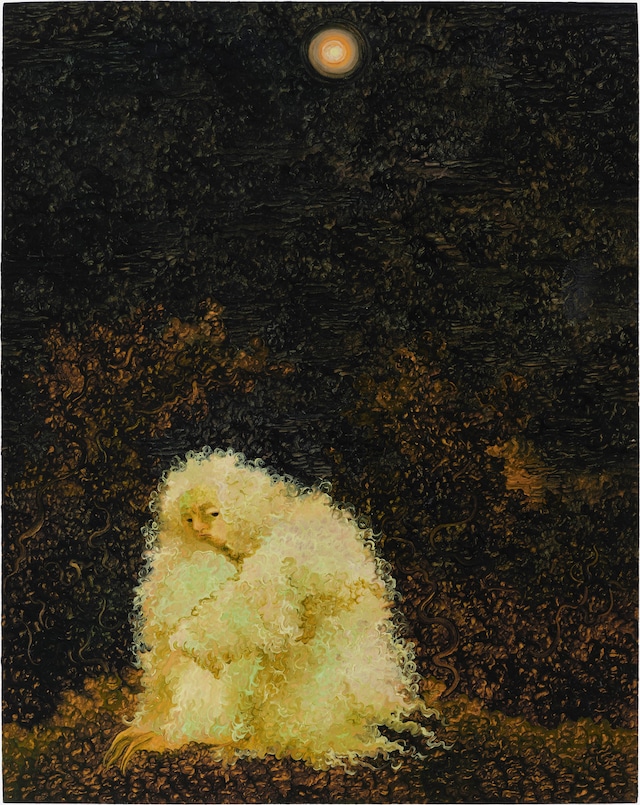
Although Wilson describes her paintings as “free from humanity,” we are not alone in our wanderings through them. Born of and among the elements, her species of weird and wonderful creatures populate the terrain, as native to it as the plants themselves. “In a practical and symbolic way,” Wilson explains, “the sinister and seductive qualities that I’ve drawn out in the plants – whether a hairy stem or the bristled leaves of a thorn apple – mirror the physical qualities of my creatures,” from their gossamer-like arm hairs to their sharp chela. Described as “more animalistic in nature”, these beings are unburdened by human anxieties, hierarchies, and paradigms. “They exist entangled and entwined with nature,” Wilson notes. “Where they take from their surroundings, it’s not extractive, it’s in the knowledge of their part in this symbiotic ecosystem.”
Against Nature leaves us not with solace, but with a productive discomfort, an invitation to reckon with the knotted relationship humans maintain with the natural world. By decentering the human altogether, Wilson’s paintings refuse the comforting fiction of nature as something purely idyllic or restorative, lingering instead in a space of disquiet where beauty and threat coexist. What emerges is a vision of Britain’s countryside that does not ask to be owned, consumed, or soothed by, but one that asserts its autonomy: ancient, indifferent, and alive.
Against Nature by Georg Wilson is on show at Pilar Corrias in London until 7 March 2026.
