
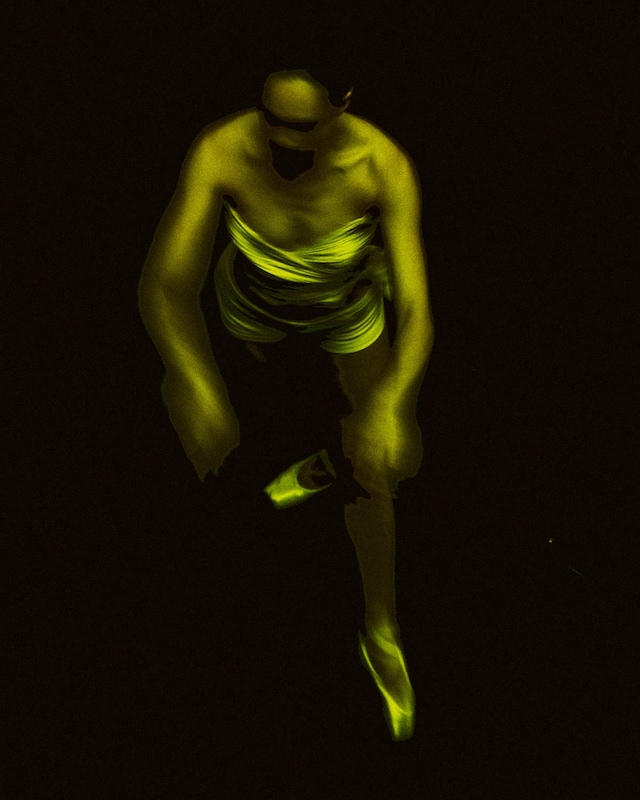
As the latest New York City Ballet Art Series resident, Thibaut Grevet’s photographs reckon with what dance has long come to terms with – innate ephemerality
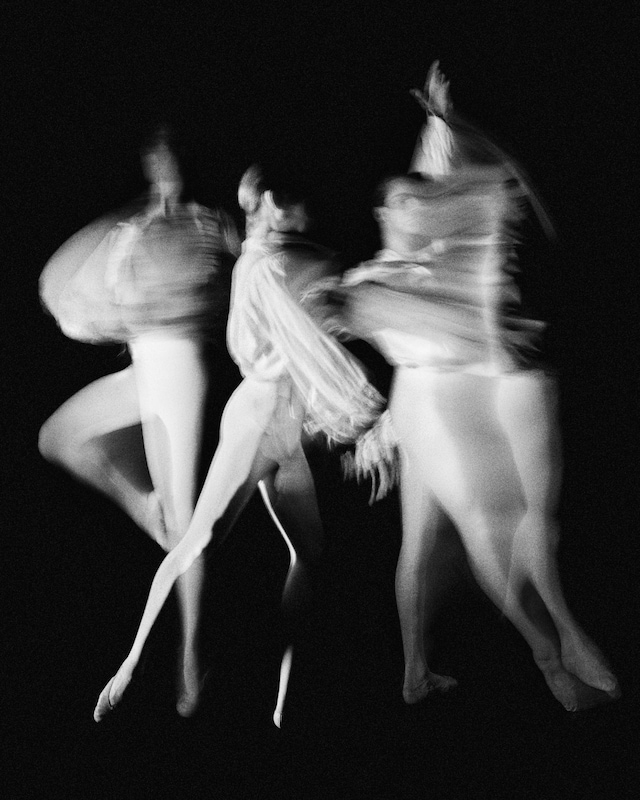
In photographer Thibaut Grevet’s New York City Ballet Art Series commission, the images are structured in phases – “as a dance is” – moving through preparation, repetition, performance, rest. Each has its own visual language; close crops of a dancer’s focused face; full-lengths of soloists beating limbs; group shots with breezy serpentine asymmetry; and, when colour enters, bodies absorb the chemical yellow of mercury lamps.
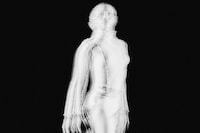
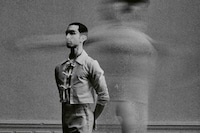
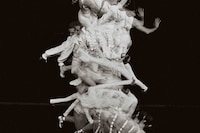
13 years into their annual series bridging visual artists and dance, the NYCB’s decision to invite Grevet makes sense. Although he’d never worked with ballet dancers before – his subjects include BMX riders and Formula one cars, A$AP Rocky and Kim Kardashian – many of his ‘stills’ hold movement within them. Movement, then, is his subject. But of course, movement is also that which, for the photographer, troubles the limits of their medium, a medium that necessarily captures and freezes.
Photographers recognise and pull the decisive moment from the wash of time. Sometimes, the moment is conspicuous – take skateboarding: Grevet explains, “I don’t want to compare [skate videos] to ballet, but at the same time, you need to catch an instant, you need to be able to react and understand the way to position the camera to get the tricks properly. There are rules.” The trick is the photograph. But in order to see the trick – itself a series of minute gestures, realignments and negotiations between board, feet, surface and air – the photograph must signify what came before and will come next. Too early and you won’t know if they landed it, too late and you miss its raison d’etre.

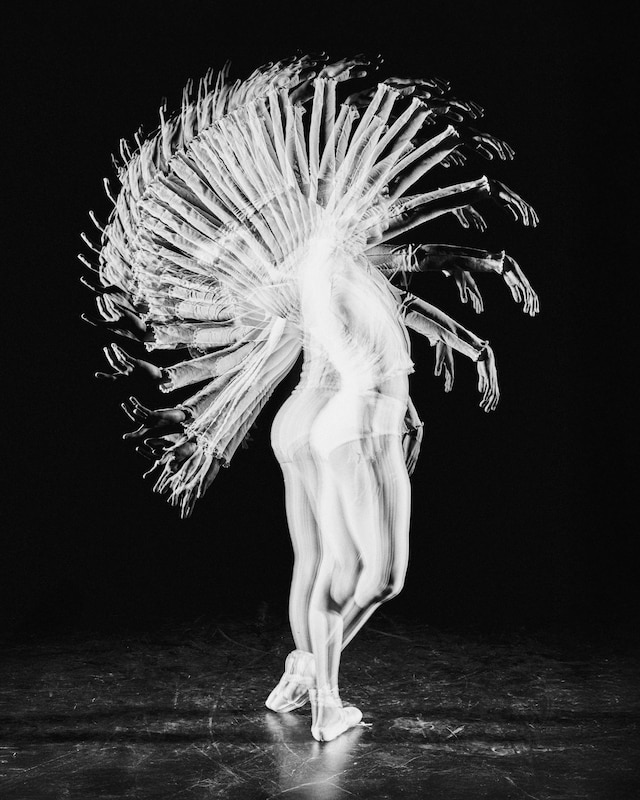
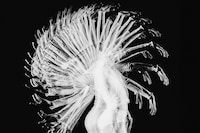
Enumerable strategies have attempted to fuse image and movement, representation and reality. They include Eadweard Muybridge’s 1870s automatic electro-photographs – from galloping horse to ambulatory woman – and Étienne-Jules Marey’s 1890s multiple-exposures of birds in flight and more walking women. In conversation, Grevet notes the influence of Gjon Mili, one of the first to explore the aesthetics of electronic flash and stroboscopic light in the 1940s. The relationship between Grevet’s images – with ballet dancers’ legs successively layered like spokes on a spinning wheel – and this history is palpable. But, in truth, his process was unplanned. “We were flashing several times when they were dancing, incidentally, creating these kinds of crazy sequence images. It worked because there was a deep black background, the dancers were in white”. And while acknowledging “chrono photography, all these kinds of black-and-white flash images”, Grevet’s real interest lay in what “it means to take that approach into 2026”.
Grevet studied graphics, and here the body reads as a system of lines and points in space. It was a pleasure to work with dancers, “the way they use their body, place their hands, the way they gesture – it becomes graphical straight away”. But it was important that the images “were real”. Grevet used “an incredible digital camera made in 2025” and was wary of post-production. “When I started, I used to go with my backpack and shoot skaters. They’d be in their real environment, trying their own stuff. Nothing was fake. What I love about the ballet is that they are doing what you see – everything in front of my lens was real.”

We talk about the film he produced alongside the photographs, which took over nine months to complete. Nodding to Muybridge’s proto-cinema, the film plays with stop-motion as dancers scuttle backwards and forwards. “We wanted this frame-by-frame sensation in the film, and stop-motion is how they used to do video back in the day.” And if the photographs capture the real, the film tips into the surreal with distortion warping and bending the ballet studio architecture.
Grevet’s 2023 book, Blurred, brought together photographs from art, fashion, music and sport. His NYCB photographs are being collated into a second book, Ballet, saving them from being “sucked into the algorithm”. With a book, “the picture becomes an object, whereas nowadays you post a picture and the next day it disappears.” Photographs are reckoning with what dance has long come to terms with – innate ephemerality. Grevet’s work for the NYCB, and the NYCB’s Art Series as a whole, embrace the potential of this enduring tension – how to recover gestures from time, hold movement in image and reconcile the irreconcilable; if not forever, then at least for a ballet season.
Thibaut Grevet’s work will be on show at three special New York City Ballet Art Series performances on January 28, 31, and February 6. The evenings will include a ballet performance, viewing of the installation, and a post-performance afterparty.
