
Hard Feelings, the first solo show from rising Palestinian-American photographer Dean Majd, is a piercing portrait of young manhood in Queens, New York
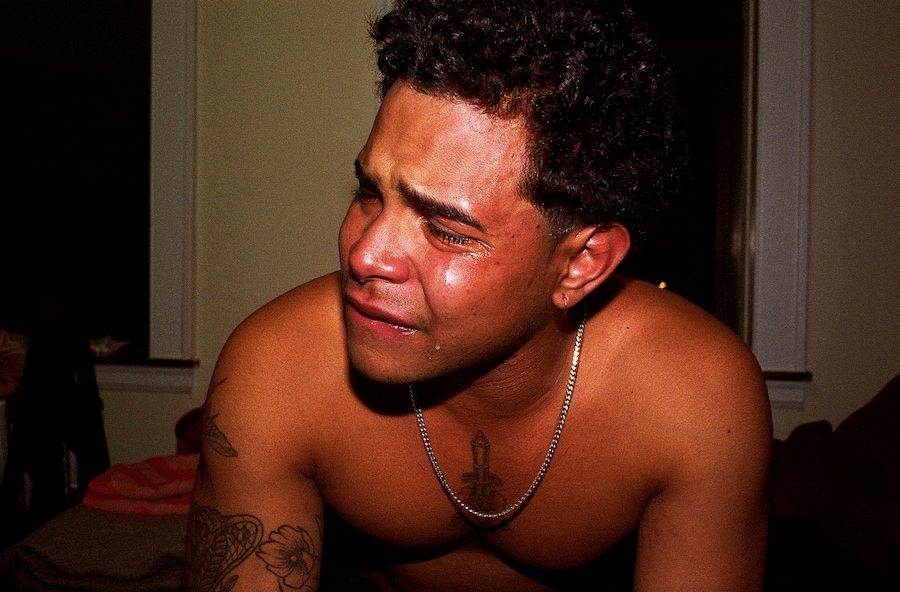
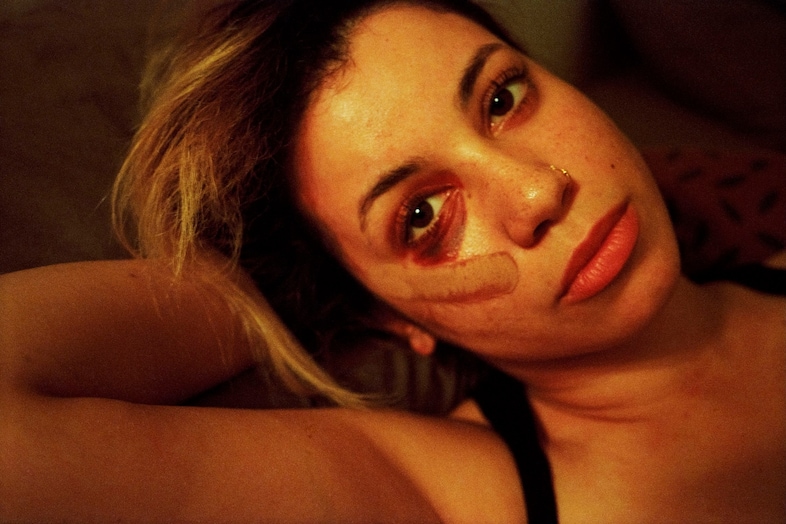
A shirtless man flexes his muscles Popeye-style, his eyes and stance directed performatively towards the camera. Another man, also shirtless, is viewed in close-up in a bedroom. Tears stream down his face, which is illuminated by an unseen light source like a Caravaggio come to life. A young woman reclines upon her bent arm, her gaze cast upwards, one eye and cheekbone accentuated by deep purple bruising. This is the world of Hard Feelings, a searing, decade-long photo series captured by ascendent photographer Dean Majd, documenting life among his inner-circle: the skating and graffiti communities in Queens, New York.
A self-taught image-maker, Majd was born to Palestinian immigrants in the New York borough, which remains home and has long served as a subject within his work. “My mother gave me a camera when I was seven,” he tells AnOther. “My parents were working when we were young, so they left me and my brother to our own devices. I was shy growing up, so I used the camera to connect. I’d take photos of my friends skating, doing graffiti, sneaking into parties. This is early 2000s New York.”

Majd is reflecting on his path into photography ahead of his first solo exhibition, curated by Marley Trigg Stewart, at Baxter St at the Camera Club of New York. There, he is showing a selection of just over 20 works from Hard Feelings, a series he describes as “the foundation of my practice”. The project began in 2015, the year that Majd, who’d taken a break from the skate and graffiti scene to work and attend college, decided to pursue photography seriously. “I had never seen anyone succeed in photography who looked like me. I didn’t go to school for it, never had a mentor, never interned or assisted. So [at that point] I was like, ‘You know what? I’m going to take this seriously for myself.’”
In a local skatepark, he encountered an old friend, James, snapping an impromptu portrait with his point-and-shoot camera. A week later, James died suddenly – an event that prompted Majd to reconnect with his former community, now all the more united in their grief. “It’s an insular graffiti crew in Queens,” he says, “and they were the first ones to really encourage me to make images.”
Before that, Majd notes, photography was an entirely self-motivated endeavour, inspired by his admiration for the unflinching, diaristic work of Nan Goldin and his love of film (favourite directors include Andrea Arnold, Gaspar Noé, John Cassavetes, Gus Van Sant, Claire Denis). Now, he had an entire community cheering him on – “I think a bit of it was the id, or the ego; they wanted to be photographed” – and a determination to create what he terms a “record of truth” for himself and his friends. “I went from taking a hundred rolls a year, if that, to 300 rolls per year,” he laughs.
, 2018)
By the end of 2016, Majd’s friends had given him “all access to their lives” – and a full spectrum of moments and emotions, from celebration to mourning, from boredom, bonding and creativity to passion, substance misuse and violence. “Similar to how I’d never seen someone succeed in the arts or photography who looked like me – being Palestinian-American, being from New York – I’d never seen a predominantly male friend group, and predominantly men of colour, be represented in this way,” he says.
As the series progressed, a natural visual language evolved. “The style was really defined by the lifestyle – the fact our world took place at night, that it’s a very kinetic, on-the-fly, interpersonal environment.” The raw and soulful nature of the pictures is almost always heightened by the effects of electric lighting, for instance, which at times bathes subjects in a golden glow, as in Rissa (Battered) or Ivan Crying in My Bedroom, or casts a neon haze over the scene, as in Hyper Dark or Self-Portrait (Hard Feelings). “My love for colour goes back to cinema,” Majd says, “and in terms of dramatic lighting, I’m deeply inspired by Baroque painters, specifically Caravaggio.”

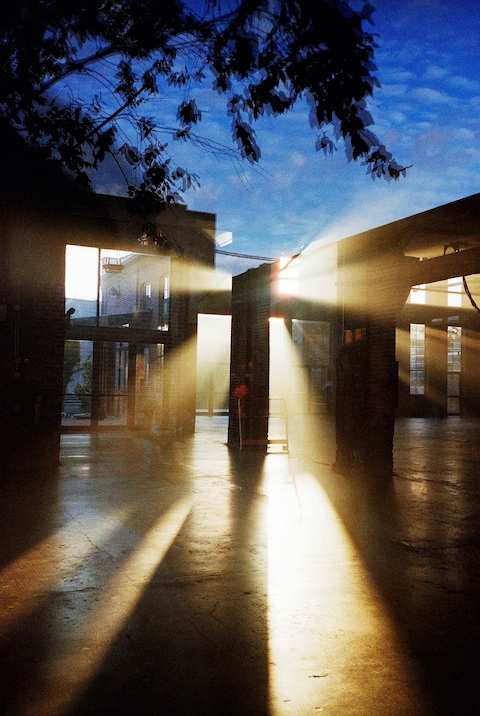
Much like his hero Nan Goldin, Majd also cites mythology as a key reference. “I really frame Hard Feelings around the idea of an odyssey, a ten-year hero’s journey,” he says. “And that mode of storytelling allows me to mythologise the stories of these young men of colour, which we have been told don’t matter, to this elevated space of high art.” His distinct vernacular – “the surreal, truer-than-true embodiment of a moment” – while candid and impromptu, is a deliberately non-photojournalistic, anti-voyeuristic approach, he notes. “If it were photojournalism, viewers would be detached from what’s occurring and would not truly connect to it.”
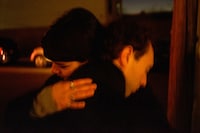
Indeed, as with so many great works of art, it is the intensely personal nature of Hard Feelings that makes it so piercingly universal. As a viewer, we are right there at the party as sobriety descends into hedonism, lounging on the bed, hugging through grief, or experiencing the different faces of masculinity, so often masked or suppressed in a world where vulnerability is branded a weakness.

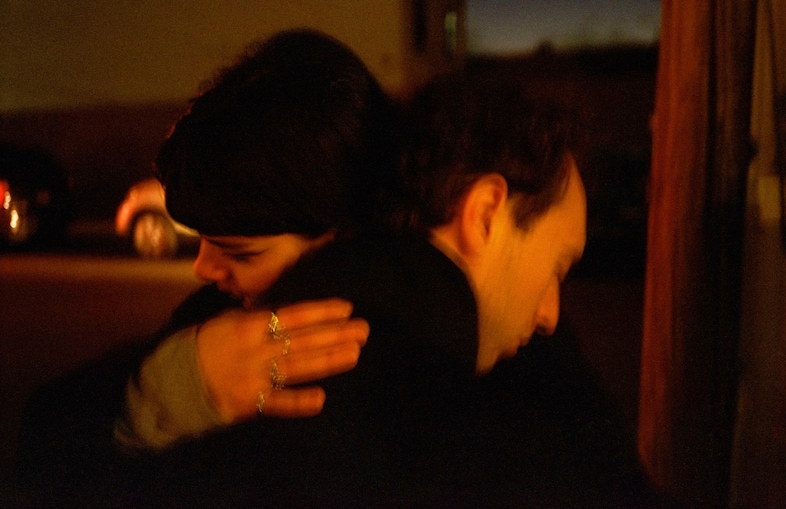
At the show, Majd has varied the size of the prints to further enhance the viewer’s connection to the works. “There are some larger-scale images that really consume you in emotion, to mimic the highs and lows I was consumed in while making the work. Then there are smaller images that people can go and get close to because of the intimacy and the vulnerability within the work itself.” In all senses, he hopes that by creating the most direct dialogue between viewer and artwork possible, people – especially people who have been historically underrepresented, as per the subjects of his work – will be able to learn from the coming-of-age journey that he and his friends experienced.
“With Hard Feelings, I created a space for myself, for men of colour, for the people I’ve been photographing, to face their own shadows. To face their grief, their pain, their traumas or addictions, their darkest selves. And I hope that by reflection, by engaging with the work, that viewers can also do the same and find hope and healing.”
Hard Feelings by Dean Majd is on show at Baxter St at the Camera Club of New York until 2 April 2026. Aperture will publish a photo book of the series in 2027.
