

In her new photo book, Sarah van Rij presents a vision of the world “through a slightly surreal lens, as if another, dreamlike universe exists alongside the real one”
Every city has its own emotional and sensory character – and yet, despite the landmarks that make cities legible to us, they often remain mysterious, shifting landscapes.
It was life in large cities that first drew photographer Sarah van Rij to pick up a camera. “I’ve always been fascinated by their rhythms, contradictions, and the human stories within them – beauty, solitude, dreams, melancholy, chance. From early on, I wanted to elevate those street moments into something more cinematic, to find the scenes that already felt staged within everyday life.” She doesn’t think consciously in terms of psychogeography, but it definitely offers a perspective on her artworks. “My work connects to the emotional and atmospheric impact of the place. When I walk through a city, I’m drawn both to how spaces look and to how they feel – how architecture, light or weather can shift the tone of a moment.”


She may shoot on the streets but she’s not a street photographer in the conventional sense. Rij describes her new book, Atlas of Echoes, as “a map of my visual universe, images created over seven years, from many places, forming a poetic, parallel reflection of the world as I perceive it”. Her visions of street life are ingeniously composed vignettes that use shadows, thresholds, reflections, movement and unusual crops and perspectives to disrupt our understanding of what we’re seeing and elevate these everyday scenes into something surreal and cinematic.
“I’ve always perceived the world through a slightly surreal lens, as if another, dreamlike universe exists alongside the real one,” she says. “For me, it’s less about surrealism as an art movement than about a way of seeing, finding the uncanny or dreamlike within the ordinary. My images often balance between those two layers of perception.”
Her sense of composition comes from the silver screen; alongside painting, cinema is her biggest influence. There’s a heightened sense of mystery and drama about her work that recalls Hitchcock, Godard, Germaine Dulac and film noir. “Everything within a frame contributes to the story: colour, light, a corner, a gesture – each element carries meaning, just as in cinema. My mother used to show us arthouse films and old classics when I was a teenager, and that experience shaped the way I now see; in scenes and fragments.”

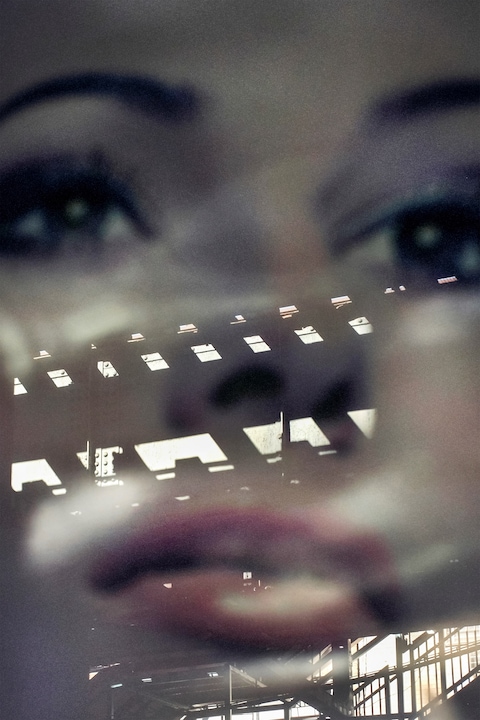
During lockdown, Rij’s work took a change of direction. Her gaze turned away from the life of the streets and towards her domestic space. She began shooting still lifes out of necessity, but this has now become an essential component of her practice. Later, during a time of “personal and artistic transition”, she began incorporating self-portraits and handmade collages into her work. “The self-portraits were a way to face myself, while the collages helped me process a more fragmented inner world,” she says. “I printed hundreds of photographs, laid them out on the floor, and began cutting and recombining fragments into new stories, a form of reinterpretation and recycling that transformed past work into something renewed. The physical act of cutting, layering, and building a one-of-one piece carries deep meaning for me.”
As well as recalling a deeply surrealist practice, collage also brings us back, in a suitably meandering full circle, to psychogeography and the exploration of cities. “I’m fascinated by the layers of time embedded in a place, its history, its ruins, the silent traces of what once was. Those layers shape the atmosphere I try to capture: the sense that the present always carries echoes of the past. My photographs often emerge from that intuitive dialogue between place, memory and time.”
Atlas of Echoes by Sarah van Rij is published by Note Note Éditions and is out now.
