
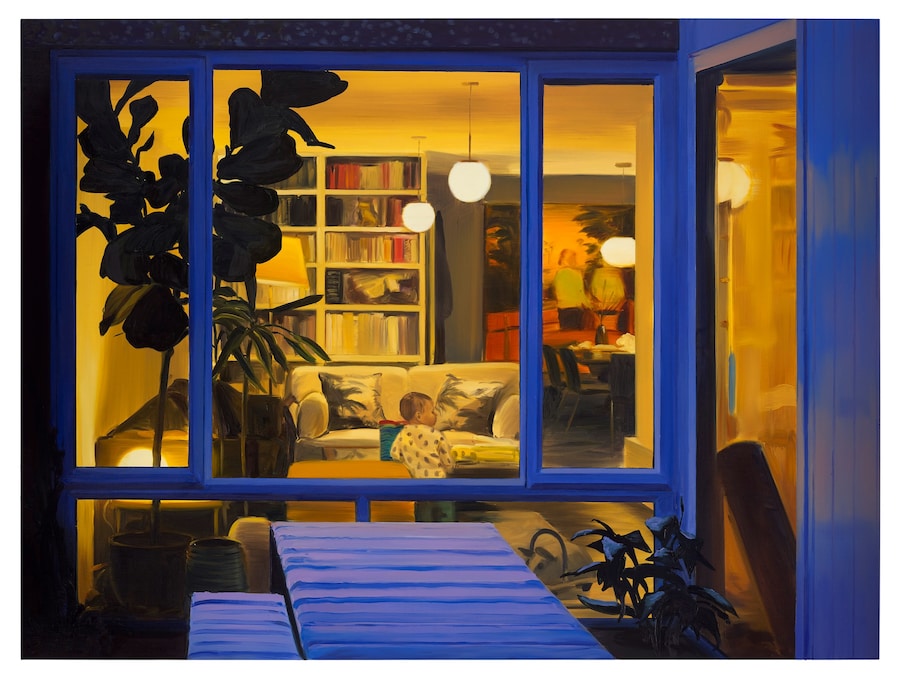
In her new exhibition, Caroline Walker elevates the quotidian rituals of motherhood and the countless forms that care can take
The value ascribed to so-called ‘women’s work’ has long held a fascination for Scottish artist Caroline Walker. In 2016, she began looking closely at London’s service industries – first nail bars, their rows of polish glinting like a painter’s palette, then tailors’ workshops, hotel corridors, hospital labs. In these quiet observations, Walker was privy to the largely invisible economic and emotional architectures that sustain the city and the subtle ways quotidian routines are valued, or rather undervalued both socially and economically.
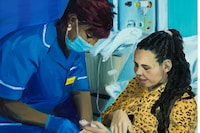
In her exhibition, Mothering at Pallant House Gallery in Chichester, Walker brings these concerns into sharper focus, underscoring the shared dialects of motherhood and caregiving. Mothering comprises five years of work – predominantly oil paintings and ink drawings – that shadow a wide range of female subjects as they undertake often overlooked jobs in hospitals, nurseries, holiday parks and domestic spaces.
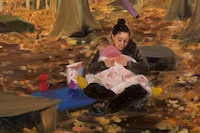
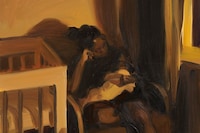
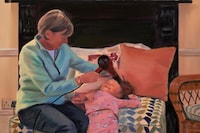
“In the past, I was often an outsider looking in. Much of the invisible labour I depict now is that which I engage with directly in my own life through the care of my young family,” Walker tells AnOther. “I was interested in Mothering as a title because it’s an action, a way of caring, rather than an identity prescribed to the person doing the caring.”
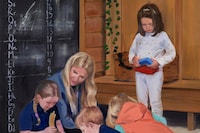
It was, in fact, a staff member at her daughter’s nursery who inadvertently coined the title, noting that ‘mothering’ the children was central to their training. Walker expands these pluralised definitions of motherhood in two new series: one depicting daily life at Little Bugs nursery, the other focusing on the distinctive labour ecology of a holiday park and its parallels.
It’s likely that when Walker took the photographs that would later shape the paintings in Mothering, the scenes were anything but serene: the metronomic heartbeat of a hospital ward, babies crying in the small hours, lungs announcing themselves to the world with gurgles and squeals, children padding and playing. And yet the works hold an indubitable stillness, as if life were briefly suspended; pauses pregnant with the quiet acknowledgement of a mother’s existence, expanding and contracting to make space for a new one.

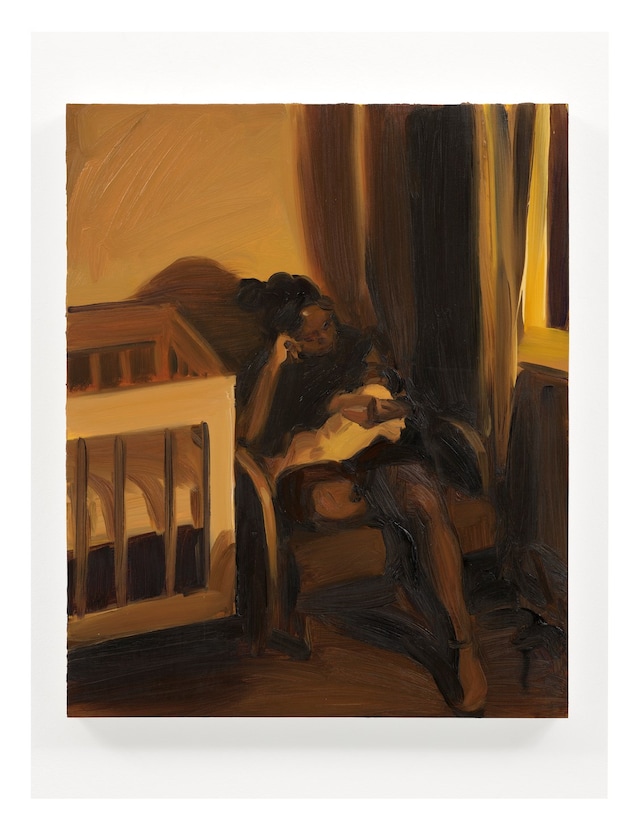
With the arrival of her first child in 2019, Walker’s observational approach to painting turned inward, becoming something far more intimate and autobiographical. “I was working on the paintings of my Mum when I became pregnant with my daughter,” she says. “Contemplating becoming a mother myself gave these paintings a new meaning, considering them in the context of generations of women performing the act of care in homemaking.”
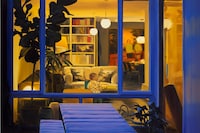
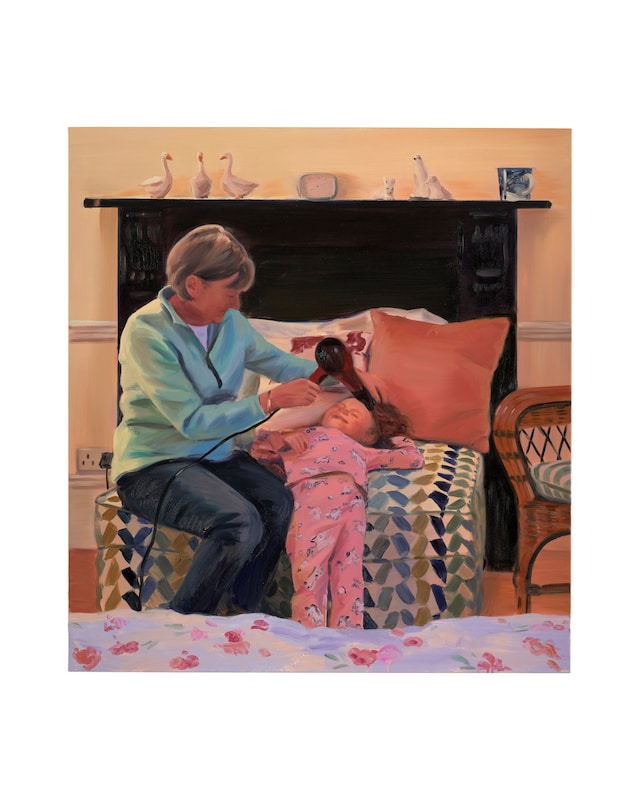
Throughout the exhibition, Walker’s own mother appears, as do her two children, Daphne and Laurie, who pass between frames, ageing before our eyes. In Daphne (2021), for instance, we see the artist’s daughter as a toddler through the window of the family’s London home, propped against a coffee table and cossetted in a warm glow. In one of the newer works, Granny’s Hair Salon (2025), she returns at five years old with her grandmother, who smiles and gently dries her hair as she squirms. A rare self-portrait depicts Walker cradling her six-week-old son, her reflected gaze – heavy with exhaustion yet softened by tenderness – meeting ours as she lays him down to sleep.
“The greatest lesson motherhood has taught me as an artist is to use my time well!” she shares. “It wasn’t intentional, but I think naturally the work has become more personal, not only because my subject matter has been running in parallel with my own family life, but also because it practically makes sense. My time is far more fractured, so the intensities of motherhood and my artistic life have inevitably become entwined.”

This synchronicity is perhaps felt most keenly in her Birth Reflections series, borne from the very hospital where her daughter was born. During Walker’s antenatal appointments, she moved through the maternity wards and began to recognise “a whole new world of women’s work opening up” – a continuum that linked the hospital’s labour rooms to scenes of caregiving closer to home: her sister-in-law with her newborn and memories of her mother in her childhood home.
“Knowing these subjects in a way that isn’t just from the objective viewpoint of an observer gave me a very different perspective,” Walker reflects. “The paintings are infused with a sense of what it felt like to be there and how I remember it.” Supported by the hospital curator and head midwife and guided by a midwife she had known through her own pregnancy, she visited the ward with catalogues and consent forms in hand, camera around her neck, gradually earning the confidence of labouring women and new mothers. “I felt very privileged to get an insight into these incredible, private moments in the way that I did,” she says, “and a responsibility to do them justice in the paintings.”

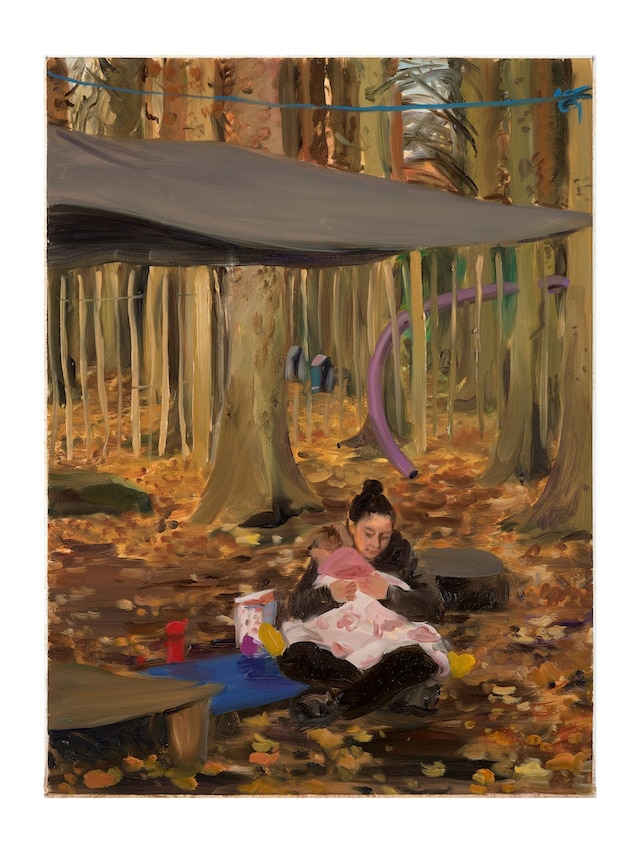
With many of Walker’s works measuring over a metre in height, the interiorities of life that occupy her canvases are afforded an eminence historically reserved for grand biblical, mythological, or historical narratives. Breast pumps, bottles, books and toys litter the canvas, the totemic debris of their subjects’ efforts. “I think there is an inherent political dimension in the choice to paint scenes of everyday life at this scale,” she reflects.
For all their honesty, Walker’s paintings are not brutal or grandiose, without nuance or affection. Her image of mothering is vital and complex, expanding our focus from the maternal to encompass the lived, multifaceted realities of caregiving.
Mothering by Caroline Walker is on show at Pallant House Gallery in Chichester until 26 April 2026.
