
As his new show opens at Guggenheim Bilbao, the British artist talks about music, William Blake and how modern technology is changing art
Mark Leckey makes magic of contemporary life. Since the late 1980s, the British artist’s stirring installations have channelled the power of music and pop culture, often using found video footage. His early works are a prophetic precursor to the internet’s mash-up mentality. Moving through analogue to digital editing techniques, he has maintained a keen curiosity about our accelerating online realm. There is also a rich spirituality in his work, which reaches back through the centuries to conjure a time before reason dominated our worldview. And the City Stood Still in Its Brightness, his new solo show in Guggenheim Bilbao’s mind-bending Frank Gehry building, begins this month.
“The first time I went in there I was terrified!” says Leckey when we speak ahead of the opening. “It’s almost like a grain silo, and it’s enormous. I haven’t worked at a really large scale before. My first impression was that I had to occupy the space.” Leckey has previously restaged older works for unconventional spaces. Most recently, his iconic 1999 video Fiorucci Made Me Hardcore was shown alongside Arthur Jafa’s equally pioneering Love Is the Message and the Message Is Death (2016) at a former electronics shop within a Croydon shopping centre.
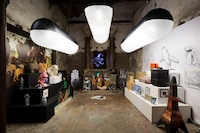
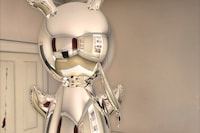
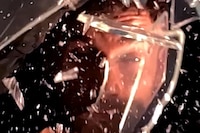
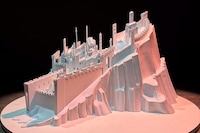
When Leckey visited the Guggenheim for a second time, the gallery was showing Refik Anadol’s ambitious audio-visual interpretation of Gehry’s legacy through AI. “That changed everything,” he tells me, soon deciding to fill the space with video and sound using Guggenheim’s impressive system of projectors. He was also inspired by Jeff VanderMeer’s 2014 book and the subsequent 2018 Alex Garland movie Annihilation. VanderMeer’s book mentions how the protagonist Lena first becomes disoriented in an alien landscape and can’t tell if a tunnel is horizontal or vertical. “I was trying to keep that idea in mind at the Guggenheim. It suits me at the moment, as I’m looking to create a feeling you might get in a church or chapel. I want all the senses to be invoked.”
The show includes new pieces which reach back through art history. One is inspired by William Blake’s intense colour monotype print Nebuchadnezzar (1795-1805), which features a muscular mix between man and beast. Leckey is also drawn to medieval artistic expressions, as the time captured the unique combination of an “enchanted miraculous world and a world of reason”. Now, he says, there is a feeling we’re coming to the end of reason. “The more ubiquitous technology becomes, the more it enchants the world in some way – even though the world does not feel enchanted! There’s a dark magic that comes with technological devices and a sense that you lose your physical groundedness or sense of being tethered. You are literally up in the cloud; this dematerialised space which invokes spirits.”

The Guggenheim show is also inspired by Tuscan painter il Sassetta’s 1424 painting City by the Sea. It was one of the first cityscapes in Western art to place the city itself as the subject – rather than the setting – and its geometric rendering is unsettlingly flat but also richly transportive. “It’s such a beautiful, gorgeous painting,” says Leckey. “Paintings in that period were just coming out of the Byzantine, which had these very formal ideas and icons. They were just loosening up a bit, but before it all gets too big and meaty for me with the Renaissance. I don’t like all that muscle!” He was drawn to the fact that il Sassetta was trying to “paint spiritually”, combining the physical world in front of his eyes with something more spectral.
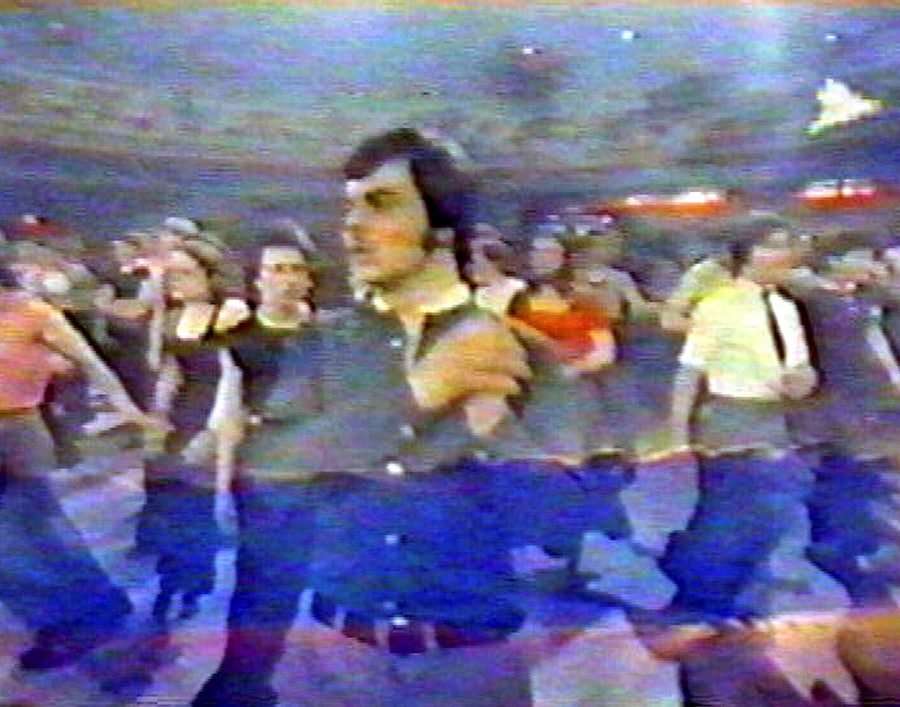
This duality is present in much of Leckey’s work. Over the years, music has allowed him to access an in-between space, linking the everyday with the transcendental. Fiorucci Made Me Hardcore features found video from the boom of UK clubbing, capturing the surreal and heightened experience of communal nightlife. His current NTS radio show, which plays an eclectic mix “from doo-wop to gabber”, helps keep him in touch with the magic of music. “Music has this ability to root itself in the local environment, but it also longs for transcendence. It’s always moving for something beyond. That’s where I want to make art from, instead of from ideas or concepts.”
Technology has changed radically since Leckey began making work. Physical, time consuming cuts that would allow him to think through different problems can now instantly be resolved with AI tools. He is “full of dread and wonder” at how fast things can be made now. Whereas the production of Fiorucci Made Me Hardcore required him to seek out archives and engage in esoteric knowledge, now ideas are fed to him en masse. “The modern era was all about things being in our grasp, but the scale is no longer human,” he considers. “It comes back to this God-like aspect [of technology]. We become diminished in comparison.”

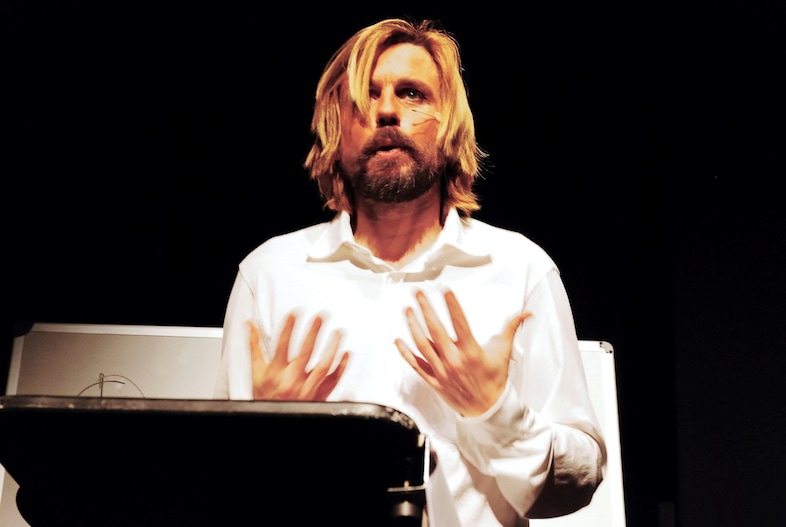
In recent years, Leckey feels that the art world has become too scared of technology, reverting to older, safer mediums such as painting. “Technology is devouring art,” he tells me. “The art world kind of got over post-internet art like it was just a moment. I think post-internet art revealed the porosity of the art world, and after that, it tried to shore up its borders with paintings. There’s a weird silence to it; all we can do is go backwards. I didn’t get into art to find safety. I wanted weirdness, to be challenged.”
While Leckey’s work delves into the realities of class struggles and a rapidly changing world, there is something inherently energetic and joyful about it. He is inspired by Blake’s idea to get “lost in the paradise of the work. Once I’m lost in the work, it’s ecstatic for me at times.” Growing up in the late 70s and early 80s in the North West of England, he left school at 15 and found a vibrant musical culture. “Industry was being dismantled around us. Out of that came a kind of reaching beyond. It’s not escapist; it’s to try and bring heaven down to Earth. Find some sense of being alive.” From an early age, he learned that despondency and love could coexist. “I’m in love with the world and it excites me.”
And the City Stood Still in Its Brightness by Mark Leckey is on show at Guggenheim Bilbao until 12 April 2026.
