
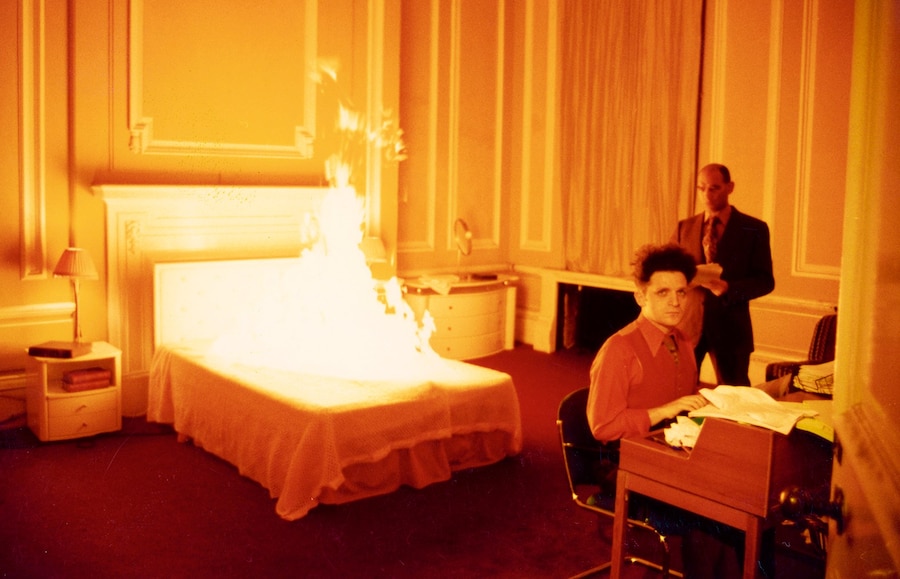
Featuring early work by Jonathan Glazer, Short Form offers a behind-the-scenes look at four decades of visionary short-form filmmaking that has affected our cultural landscape
Television adverts may be dismissed as ephemeral, but we all have an example of one that has altered our consciousness in some way, lodging itself into the fabric of our memory. Similarly, music videos – that potent mix of a song and moving image can live on in our memory for a lifetime.
From the hypnotic video to Radiohead’s Karma Police and the trio of cinematic turn-of-the-millennium Guinness adverts, all made by Jonathan Glazer, to Walter Stern’s iconic video for the Verve’s Bittersweet Symphony, some of the most memorable and enduring short-form films from the past four decades were created by renowned London-based production company Academy Films. A new book, Short Form: 40 Years of Music Videos, Ads, and the Art of Moving Images (published by Mack), surveys their extraordinary output, telling the stories behind the creation of their most iconic projects and contemplating the short-form films that have so profoundly shaped our cultural landscape.





“The book features works on an epic scale. For instance, minimal filmmaking, in terms of structure, alongside the most surrealistic and crazy moments that make you think, ‘What on earth was that?’” says Claire Marie Healy, the book’s editor and creative director. “Certain films simply represented these themes so strongly that we felt they deserved a closer look at how they came together.”
Both the magic and the limitation of a short film is its brevity. It requires a particular economy and ingenuity to distil what are often big ideas into the briefest of screentimes. “How do you truly move the viewer in three minutes, one minute, or even 30 seconds?” asks Healy. Turning the pages of Short Form, we encounter the pioneering music videos, adverts and idents that illustrate how a range of innovative filmmakers responded to that challenge.


One of the key presences throughout Short Form is that of Under the Skin and The Zone of Interest director Jonathan Glazer. Like Spike Jonze, Glazer honed his craft making advertisements before moving on to feature films. In the book’s foreword, he recalls the career-changing advice he received from his first producer and mentor, Academy’s Nick Morris. Unimpressed by the budding director’s showreel, Morris told him, “Make something from you. What’s your voice?” “No one had ever asked me that before. I hadn’t even asked myself that,” writes Glazer. “I think the way I’ve approached everything since goes back to that question he asked me – ‘What’s your voice?’”
He would find and define his voice in a captivating triptych of Guinness adverts, which would bear the hallmarks of his future style as a filmmaker with their dreamlike imagery, atmospheric scores and a sense of narrative ambiguity. Swimblack (1998), Surfer (1999) and Dreamer (2001) all elevated the genre to a new level, reconfiguring conceptions of what an advert could be. Inspired by the idea that it requires 119.5 seconds to pour the perfect pint of Guinness, each of the adverts in the series revolves around the slogan: “Good things come to those who wait.” Ambitious, mesmerising and grand, Glazer invokes Irish folklore, mythology and a deep, powerful sense of mystery and nostalgia to connect Guinness with a world of tradition and ritual.

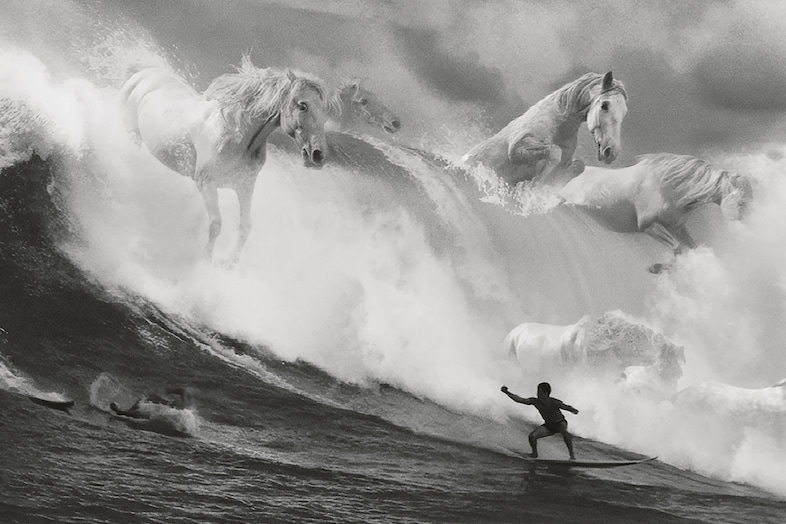
Surfer, the second in what Glazer thought of as a “set” of three, is widely acknowledged to be the greatest advert ever made. We open on a close-up of a man’s face in black-and-white – intent, focused. There is a pregnant silence that continues for an uncomfortably long time, far longer than we are used to encountering in an advert. Eventually, he’s revealed to be one of a group of surfers waiting for a wave. As they plunge into the sea, mounting their boards, the foam on the breakers becomes white horses galloping through the water. It’s majestic, poetic, and connects the promised perfection of a black-and-white pint of Guinness with the magnificence of the anticipated wave.
Tracing the past four decades of visionary short-form filmmaking across the pages of the book, it is impossible not to think about the evolving currency of moving image and how the ways we consume media have changed. In an age of TikTok and Reels, how is the status and the appeal of short-form films affected? “I think [the appeal] is infinite!” concludes Healy. “I’m dismayed sometimes at bite-sized TikTok culture and the devaluing of focused attention that it has created. But, making this book, I realised there’s a heritage to be found when it comes to short-form techniques that feels related. It’s given me a whole new appreciation for the skills behind the filmmaking happening on our phones every day.”
Short Form: 40 Years of Music Videos, Ads, and the Art of Moving Images by Academy Films is published by Mack and is out now.
