
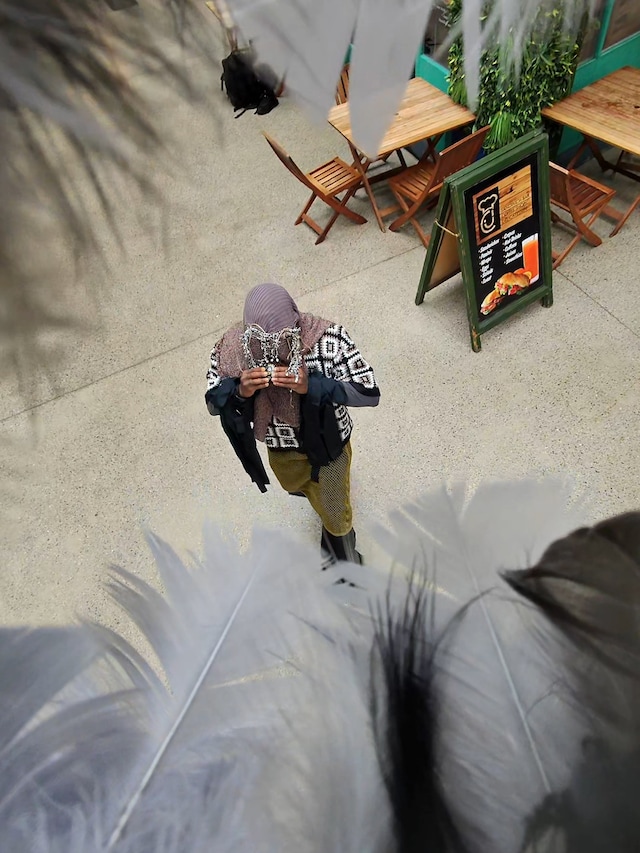
The poet and filmmaker’s latest work harnesses Ray-Ban Meta glasses to explore Caribbean carnival culture from the perspective of a mythic, stilt-walking spirit
Julianknxx is a poet of the in-between. Working across moving image, performance and installation, the Sierra Leonean artist channels the potent forces of memory, grief and migration. Rooted in poetry, his practice of creating what he has described as a “living archive” is set against shifting landscapes of London, Freetown, Amsterdam and more – each place carrying its own weight of history and longing. At the centre of his work is the Black body: not as fixed identity, but as archive, vessel, spirit in motion.

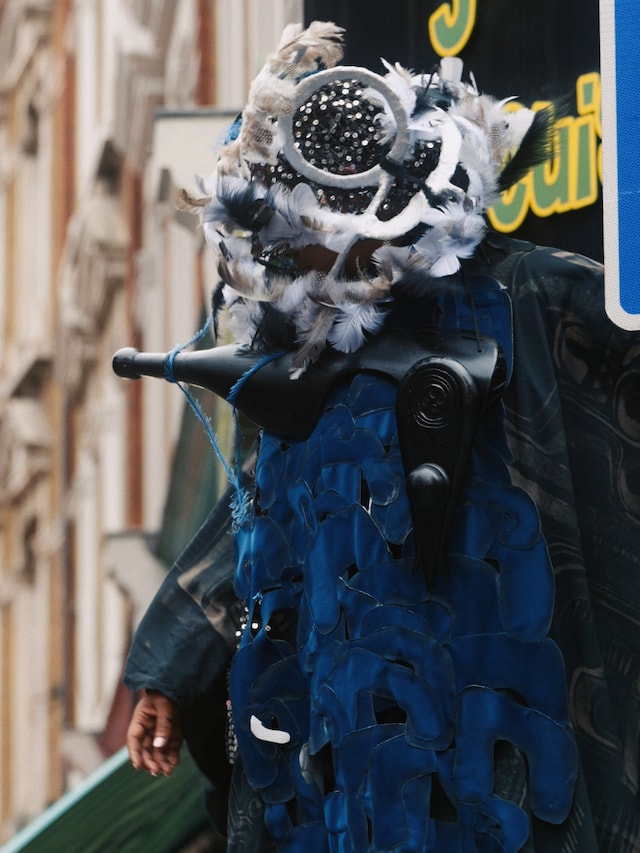
The masquerade – an ancestral presence drawn from West African and Caribbean traditions – is a recurring theme throughout his films, used to explore the liminal space between past and future, visibility and invisibility. As part of the major new exhibition Paradigm Shift: A New Dimension of Moving Image, currently running at 180 Studios and co-curated by Jefferson Hack, Julianknxx was commissioned by 180 Studios in partnership with Ray-Ban Meta to present a new work that adopts and harnesses the power of Ray-Ban Meta glasses and explores the alternative possibilities and perspectives through its 12MP camera. His film, ...M?, invites us to see as the masquerade sees: between worlds.
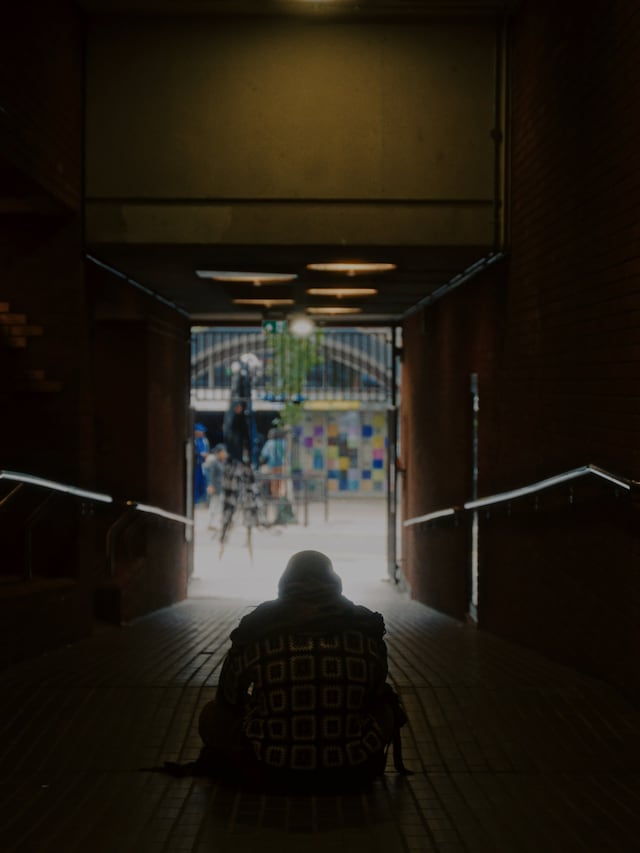
“This work thinks and looks at the idea of liminality,” the artist explains, “the in-between spaces, or space in which we, as Black people, can imagine ourselves, whilst rethinking our history and reimagining the idea of us. ...M? specifically follows a masquerade moving through Brixton Village and its surroundings.”
As with other works by the artist, ...M? pulses with a charged emotional undercurrent and the spectral, uncanny presence of liminal space – the elsewhere, the displaced, the unknown and the familiar, all existing in the same shared place. The masquerade functions as more than a spectacle; it’s an incantation of sorts, summoning creative forces in a way that has the potential to transfigure our experiences.
The artist tells AnOther, “Drawing on the long history of African and Caribbean traditions, the masquerade, for me, exists as a being that moves between worlds and timelines. It embodies all facets of creativity – theatre, dance, music, fashion – reshaping the everyday and transforming it into something otherworldly. For me, that’s pure creativity: where everything merges into one embodied idea. It’s about conjuring another image from another dimension into this one.”
Below, we talk to Julianknxx about translating poetry into moving image, his first transformative experiences with film, and incorporating Ray-Ban Meta glasses into this new body of work.

Emily Dinsdale: Please could you tell us about the guiding principle behind ...M?
Julianknxx: Often, we get to look at the masquerades, but we don’t see what they see. For this work, I’m interested in that perspective and encounters – what is the masquerade looking at? For …M? I was drawn to the Moko Jumbie, the stilt-walking spirit found in Caribbean carnival culture. According to folklore, these spirits travelled from West Africa, walking across the Atlantic into the Caribbean, following those who were forced to migrate to watch over and protect them in this new land.
Carrying that folklore forward, I began to think about contemporary migrations into London and, I guess, specifically Brixton, of both Caribbean and African culture, and how we might begin to think about a guardian spirit – the Moko Jumbie – when looking back. There’s a quote from Chinua Achebe that speaks to this idea that “in the masquerade, eternity visits us, reminding us of our place in time”. Conceptually, the masquerade shifts between space and time. Another well-known Igbo proverb of his says, “The world is like a mask dancing masquerade. If you want to see it well, you do not stand in one place.” That idea – that to see, you have to move; that the world, just like the masquerade, is constantly shifting. You can’t be stagnant in life; you have to keep moving, to change, and move with the time.
When the opportunity to work with Ray-Ban Meta came up, my first questions were: What do I want to look at? What do I want to see? How can I look differently in a speculative sense? For the masquerade series, this tool offered a way to speculate, to explore, and to see in a new way. It allowed me to imagine that in-between space – a perspective that isn’t quite here nor there, but somewhere in between.
ED: As an artist, what do you find alluring about moving image as a medium?
J: Like the masquerade, it can embody multiple art forms at once. You have to think about costume, colour, staging, sound – all of these elements come together as one moving image.
Most of my work begins with a poem or an idea to be explored. Poetry is my practice and how I first got into this space. As a poet, it allowed me to ask – how do you move a poem from the page into a visual space, give it texture, sound and emotion? In the same way, my performances encourage me to think across multiple forms, translating its movements, sound and presence.

ED: Can you tell us about your own relationship with moving image? Do you remember any significant moments when you first felt captivated by a screen and its possibilities?
J: I think one of the first moments that made me fall in love with moving image was watching Akira Kurosawa’s Dreams, or maybe Wong Kar-wai’s In the Mood for Love. I was particularly drawn to how Kurosawa mixed the contemporary with the traditional, opening up the possibility of sharing one’s own heritage internationally while still holding onto its identity and depth. There’s not a lot of talking in these films, but the cultural richness of it and the way in which silence carried so much tension really stuck with me. It showed me how much poetry and meaning can be conveyed with little to no words, and the possibility of telling a story across time and cultures. Another significant moment would be John Akomfrah’s The Unfinished Conversation, which really highlighted the power of moving-image and what it can do.
ED: What do you envision the possibilities of Ray-Ban Meta might be when it comes to making art? As a tool, how might they affect the future of moving image and filmmaking?
J: It really depends on how much of a cultural risk and impact a brand is willing to make, and how deeply they want to support and engage with artists on new forms of storytelling. There’s a huge potential for AI glasses like Ray-Ban Meta to expand how we see and experience moving image … used thoughtfully, these technologies could open up a totally new way of seeing.
ED: How could the glasses augment your practice as a ‘living archive’?
J: Like a camera, it’s a tool – and in the right hands, it can be used in the most unexpected ways. What is interesting is how a technology like Ray-Ban Meta can capture something from a more embodied perspective and from a viewer’s perspective.
Blending cutting-edge technology with iconic Ray-Ban design, the #1 selling AI glasses now come with longer battery life, a higher quality camera and an incredible range of features; ask questions about what you see and Meta AI will answer, capture content, listen to music and podcasts, even text on-the-fly – all without taking out your phone. You can even have a conversation with someone speaking a different language and translate it in real time. The next generation of Ray-Ban Meta is available to buy now on meta.com and Ray-Ban.com.
Paradigm Shift: A New Dimension of Moving Image, in Partnership with Ray-Ban Meta, is on show at 180 Studios in London now and until December 21.
