
As the Grand Palais opened its magnificent doors for this year’s Art Basel Paris, Miu Miu – as the fair’s public program official partner – took over the city’s modernist masterpiece Palais d’Iéna with a presentation of 30 Blizzards. Conceived by Turner Prize-winning artist Helen Marten, this vast, all-encompassing artwork is the latest in the fashion house’s series of commissions by Miuccia Prada, continuing with her raison d’être of engaging meaningfully with women’s stories and experiences through fashion and art.
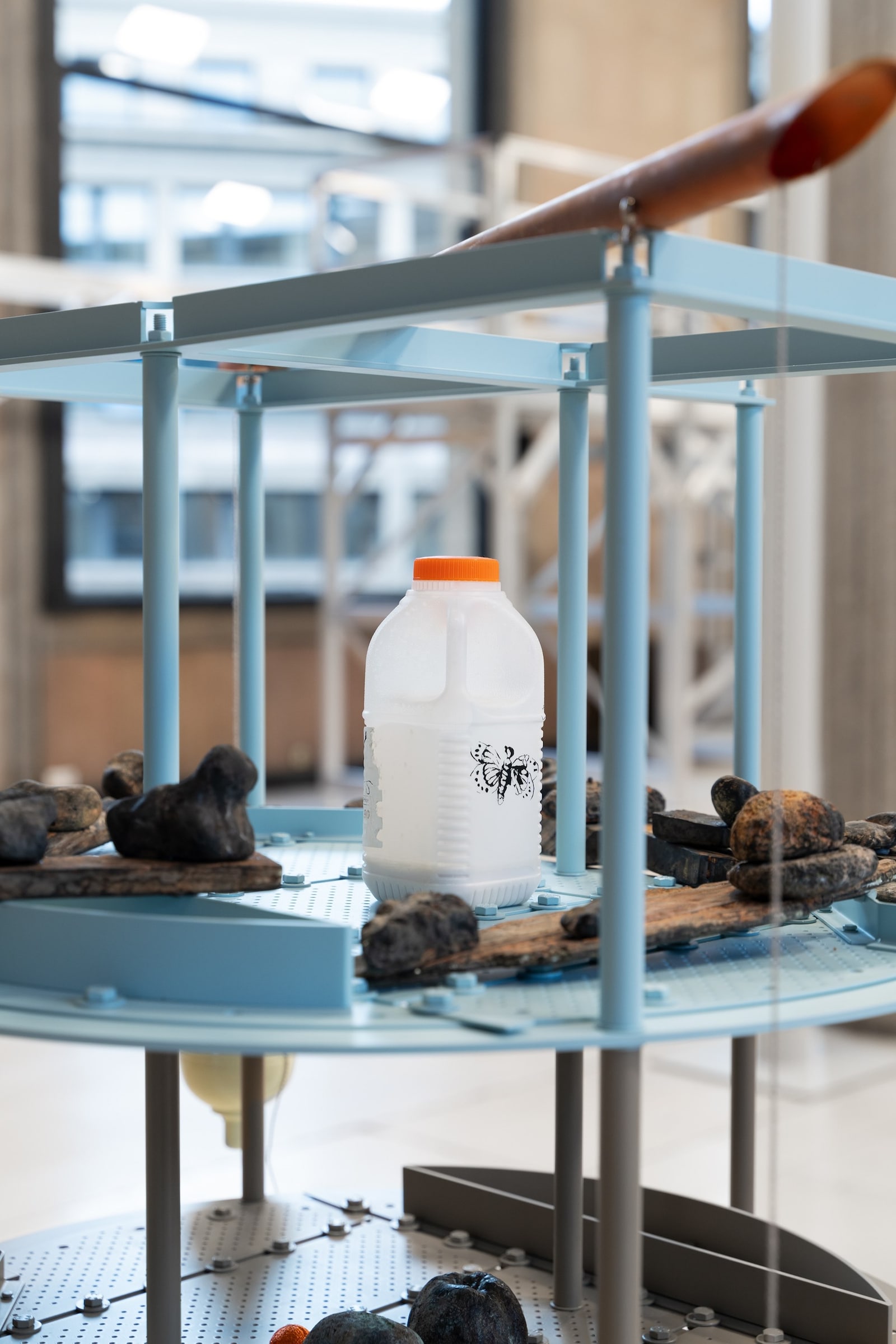
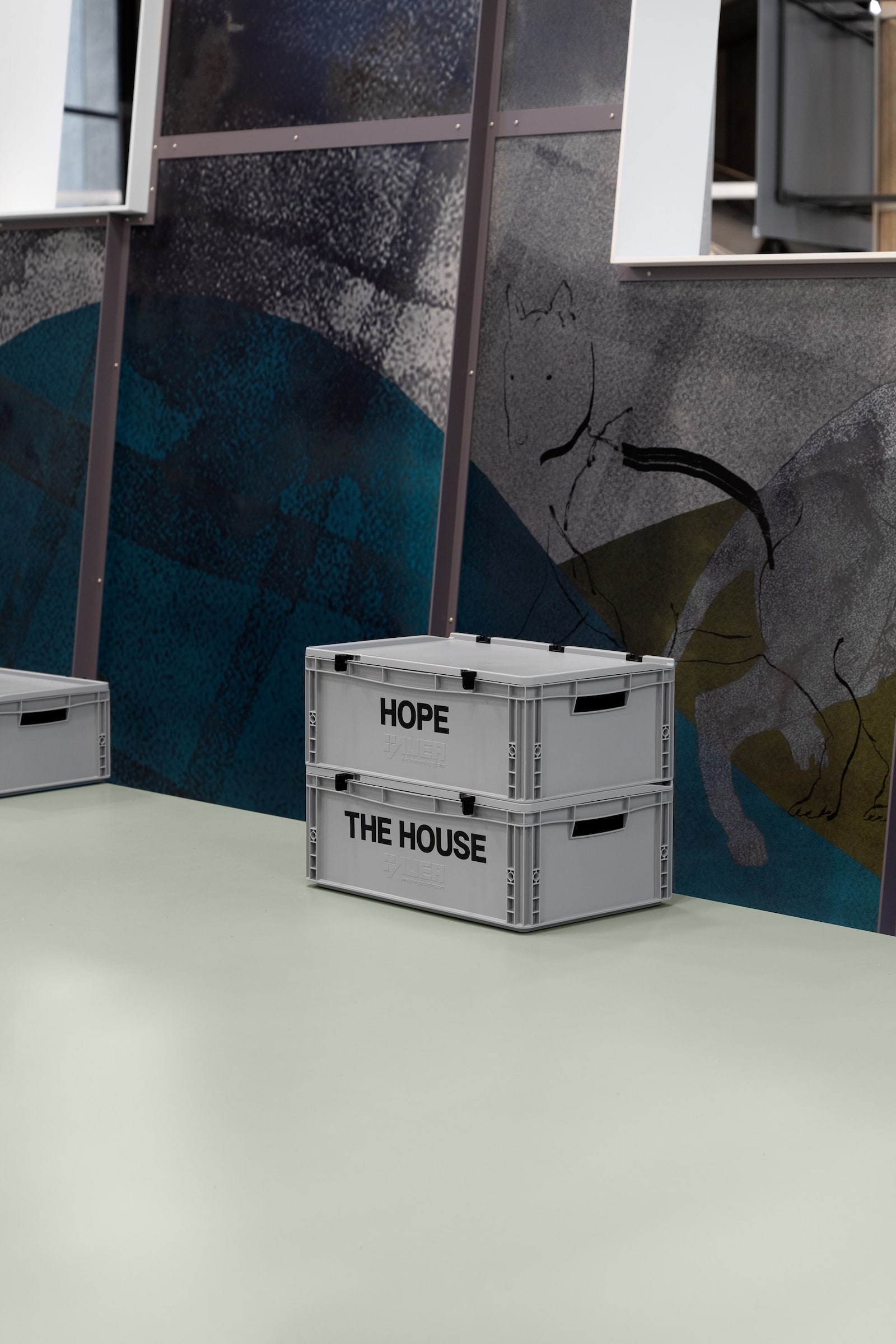
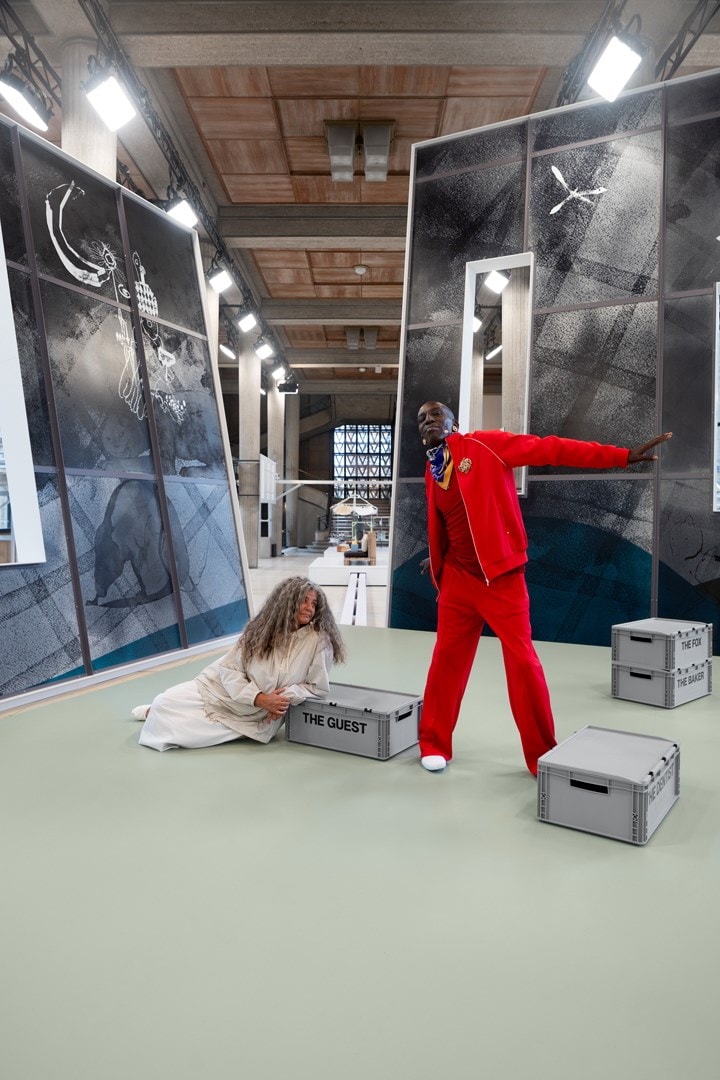
Blending film, performance, music, spoken word, installation and more, 30 Blizzards. is a complex choreography created in collaboration with opera and theatre director and set designer Fabio Cherstich, accompanied by a compelling soundscape and score composed by Beatrice Dillon. In the artist‘s own words, it’s an “avalanche of connected meanings”, with the 30 Blizzards. of the title referring to the 30-strong ensemble cast of characters who appear throughout, each inhabiting the space of the Palais with their own purpose and intention, generating a veritable blizzard of interactions. An industrial metal structure spans the space, moving around a series of crates labelled with significant, intriguing labels such as mother, asphalt, night, and more. In dialogue with this action, sculpture and moving image trace a chronological thread spanning a life’s seminal chapters. It’s immaculately executed with minute attention to detail, but succeeds in feeling amorphous and haphazard.
Below, Helen Marten talks to Alexander Fury about creating such an ambitious and nuanced vision, her own relationship with fashion, and her intention for 30 Blizzards.

Alexander Fury: How did this project originate? And what intrigued you about the proposal – why did you want to create this work?
Helen Marten: The invitation was relayed via a phone call with Fondazione Prada in Milano. It arrived, as all surprises seem to, as a wildly amorphous temptation – simultaneously risky, open and generous. Of course, I was honoured and intrigued to collaborate with Miu Miu, and the possibility to produce a work whose encompassing factor was a durational performance felt particularly special, given that it is something I have not explicitly done before. My work always involves both making and writing, which are activities that carry identities of mercantile touch, and this labour always retains productive syntax, but the physical bodies are never on view – they are figurative traces or narrative just out of sight. To activate speech and intention using choreography, song, music and gesture within a mutational timescale of exchange was a new challenge.
AF: I wanted to discuss the relationship between Miu Miu and art – also connected with Miuccia Prada’s own relationship with art. What has your experience of this been?
HM: I don’t think there are many true visionaries whose intent and generosity align in such a generative and influential way that it genuinely reshapes the cultural paradigms of a moment. Mrs Prada is one of those people, and it is humbling to be extended the trust to work on a project as expansive and intricate as this one. I do genuinely believe that fashion, with all its extensive tangents, is a mobile document of social intent, of social integrity, systems of visibility and communality. Art seeks a similar position, and the wonder is that there is no policing of fantasy, that through its making, the aliveness of the very real world around us – replete with pains and pleasures – is neither calcified nor diluted in urgency. The challenge is to respond to this world with a moral and ethical voice. The solitary idea is always hubristic, but diversity of thought inevitably unfolds productive dialogue, it speaks to fragility and forges new pathways of thinking. I think that is the type of encompassing proposal that Miu Miu and Mrs Prada offer through their collaborations and support. It is truly special.

AF: How would you describe what visitors are going to experience when they go into the Palais d’Iéna for the Art Basel Paris exhibition?
HM: In a literal sense, there are multiple levels and spaces within which to experience the work, all of them held within the brutally formulaic architectural logic of the Palais. It is interesting to think of these spaces as layers of aggregation, a metaphoric lamination of information from the ground upwards: sculptures are laid out on the floor in a single formal line from top to bottom; each of these are paired at eye-level with a new video vignette; and on a more macro scale there are two wider installation devices that harness the performance – a kinetic industrial track, elevated with tall platforms around the full periphery of the space, and an expanded diptych of walls that hold a central “civic stage”. All these elements exist within the larger framework of a performance devised in close collaboration with Fabio Cherstich for 30 characters, each of whom are scripted within the linguistic arc of a libretto and a full composed score by Beatrice Dillon. The scene will be intense with both image and language, with sound and movement, and a deliberate reflexivity or synchronicity between all parts.
AF: Where did the word ‘Blizzards’ come from to describe the piece, and what do you wish that to convey?
HM: Blizzards is of course a meteorological term, but it is also colloquial – we use it as a word to describe a deluge, or an over-abundance of information. The repetitive “zzz” might be like the thrill of electricity or conversely, the sedative of sleep: it is a beautifully onomatopoeic word: rushing and hypnotising. As a title, I intend it to feel like apparatus for defining the emotional weather of those that pass through and are held within. Adult feeling is a picture of nuanced intensities, like a weatherscape of experience: movements of light, sound, colour, texture. The cast en masse are the Blizzards in the most collective way – a composition of individual intensities and atomic forces, who move and vocalise uniquely, but within measured rules or parameters. Their forces are mutually lyrical and empirical, that is their beauty and their contradiction. Perhaps the 30 Blizzards motif becomes a meta model of the larger world, a fragmented system of interlocking lenses of criticality, domesticity and importance: the world, inside the world, inside the world. Each character is like a little planet dropping its own singular crumbs.

AF: What are your views of Miu Miu, of the meaning behind the brand and its aesthetic? And how are those views, in turn, connected to and reflected in 30 Blizzards?
HM: Fashion and clothing link into wider questions about the politics of visibility and dissemination. There is classic sartorial craft on the one hand, and a cosmic plurality of cultural and theoretical play on the other hand, both joining at the intersections of a ‘now’ and a ‘then’. I love that Miu Miu is seeking this innovation, whilst continuing looking back towards archival and cultural information. That is so inspiring to me.
I also love the mercantile craft or construction aspect of clothing – how a button or zip, for instance, belongs to a much wider tool history of machinic manufacture. Production has a historically patriarchal gaze, so it is wonderfully edifying to see that lens wholly shift via intelligence and deep ingenuity to a position of female, or human empowerment without compromise. The categories of gender and sexuality are so expansive, and that plurality is reflected in the attitude of the brand – it’s a confirmation of the idea that radicality is to simply be who you want to be.
Of course, we script clothing by virtue of being mobile beings. We eroticise it with language and language’s potential, its undoing. I love the idea of something known, like a shirt or a skirt or a pair of trousers, having a sense of also being a phantom landmark for something else. Within that, you can co-opt and recombine almost infinitely. All of this is a simple representation of thresholds, how we disturb them and how we permeate. This is the hope too, for 30 Blizzards.
AF: What do you want the audience to take away from 30 Blizzards?
HM: Curiosity. Pleasure. Hope.
30 Blizzards. by Helen Marten is on show at Palais d’Iéna in Paris from October 22 to 26.
