
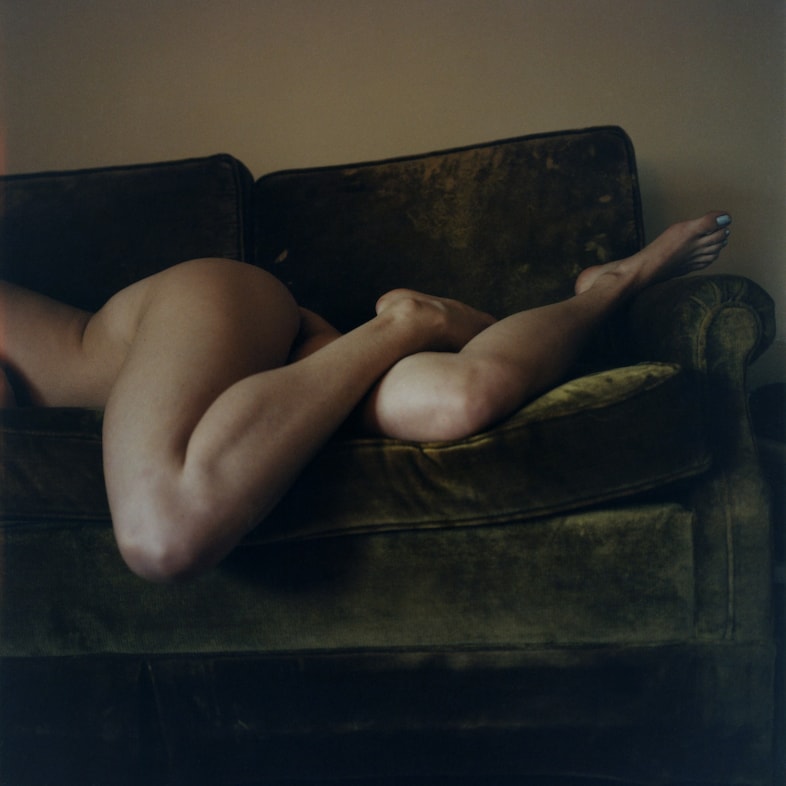
The Brooklyn-born photographer’s first monograph charts a course through her personal archive, from her early teenage portraiture to the present day
When photographer Zora Sicher saw an adaptation of Joan Didion’s novel Play It as It Lays, one particular phrase stayed with her: “the geography of the human heart”. She wrote it down and kept returning to it, consumed by the ideas it evoked of mapping feelings and place, and the correlation between geography and experience – a kind of emotional cartography. At the same time, she’d been thinking about psychogeography and the practice of exploring our environments guided solely by subjective impulses and the desire to generate chance encounters and uncover hidden histories and memories. All these ideas coalesced in the creation of her debut photo book, Geography, published by Dashwood Books.






“I wanted this grand title, which is such a vast, all-encompassing concept: how we make sense of space and distance. I kept coming back to the idea of geography as the study of people in their environments,” Sicher explains, talking from her New York home. “The book is a mapping of time, bodies and spaces. There’s no fashion work in here, there are no hired models, it’s all people that I was very close to, or am very close to.”
In the situationist spirit of psychogeography, the 168 photographs that comprise Geography – all from Sicher’s personal archive – are organised by intuition rather than chronology or any other kind of linear structure. “For example, one picture might be from 2011 taken in New York, and then the one next to it might be from 2024 in Brazil, and maybe it’s the same person in both places, or it’s following the narrative between these two different people,” the Brooklyn-born image maker explains.

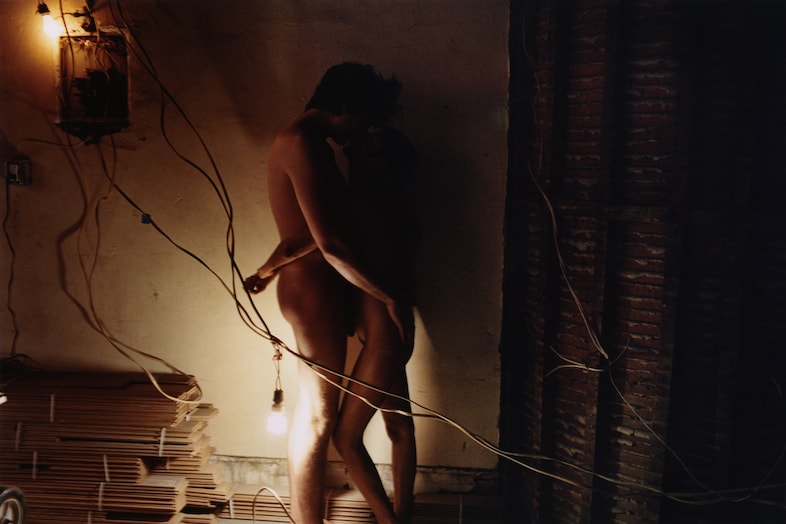
Known for her intimate and uncensored explorations of bodies and identity, Geography traverses her archive of tender, unflinching portraiture as well as her beautiful, almost mystical, landscape photography. The book spans 14 years of prolific image-making, including a few pictures taken when she was just 16, developed in her high school darkroom (though she insists she’s not quite ready to call it a retrospective). Thinking back to these first experiments with photography, Sicher recalls, “The early images were made the same year that Instagram came out, so it’s a really odd time for my generation. We grew up seeing a little bit of the internet, but it hadn’t completely infiltrated our minds as kids.”
From portraits of pregnant bodies to her “obsession” with decaying places, Geography contains many pictures of people and locations in transitional states. Throughout, there’s a recurring motif of “places manipulated by human touch”, whether it be in the form of graffiti, trash or other remnants. For Sicher, these signs of human intervention are another form of map-making, charting our territory and making our environments legible. “How do we control and submit to landscapes and spaces and make them our own?” she contemplates. “There’s such a human urge to mark things, and I find that really interesting.”


In art as in life, there’s a distinction between nudity and nakedness. Nudity is a kind of performance, an arched foot, a tensed stomach, a conscious presentation of the body in its best light. The undressed bodies in Geography are naked. Sicher has a gift for taking portraits of people unclothed and uninhibited. “There’s no one in the book that I don’t have a relationship of some kind with,” she says. “Most were already friends, but a few people I met because I wanted to photograph them, or they wanted me to photograph them. There’s one girl I met because I was supposed to photograph her boyfriend and she came along. I ended up being so uninterested in the boyfriend, but I just loved her and we became friends. [These are] actual close friendships or relationships that have blossomed through photography.”
This is the essence of what makes Sicher’s photographs so captivating; they invite us, as the viewer, into a shared moment of collusion. “There’s such an important place in the world for street photography and photojournalism, but I’m just not that kind of photographer. I’m not the kind of person who’s going to photograph some guy across the street. Save that for someone else to do,” Sicher says. “I’m more interested in someone coming to me with an idea, or in finding a person, a character. It always ends up being very collaborative.” Geography is a compendium of these intimate interactions between people and place, tracing photographic encounters from Sicher’s life aged 16 to 30 in a circuitous, indirect sequence that creates a poetic rhythm of its own.
Geography by Zora Sicher is published by Dashwood Books and is out now.
