
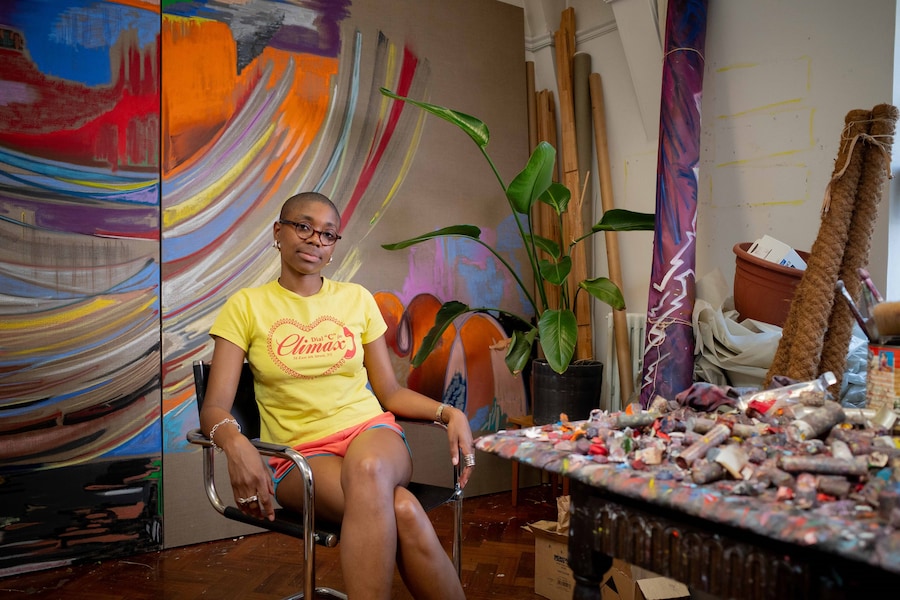
As her new commissions go on display at London’s Courtauld, the artist talks about colour, her obsession with mouths, and the importance of connecting emotionally with art
Rachel Jones makes monumental paintings. Expansive in scale, a riot of vibrant hues that bounce musically across the canvas, Jones’ work drew mass art world attention following her master’s at the Royal Academy in 2019. She has since signed with and left mega gallery Thaddaeus Ropac, designed a Brit award for the iconic music show’s 2024 edition, staged a live opera with suitably colourful costuming by Roksanda, and appeared in Jonathan Anderson’s famed Loewe campaign. For many artists, such intense industry observation might lead to suffocation. But Jones has found a unique path through it, recently returning to the roots of her painting practice and revisiting ways of working from childhood.
This year, two institutional shows are running in London, with the exhilarating Gated Canyons opening at Dulwich Picture Gallery over the summer and two new commissions soon to go on show at The Courtauld. Some highly recognisable motifs remain from her earlier work: abstracted mouths and sets of teeth reflect the connection between inner and outer worlds, while also riffing on the motif of grills and gold caps often associated with Black fashion and self-expression. Her new pieces feature bricks, another marker of the exterior-interior divide.

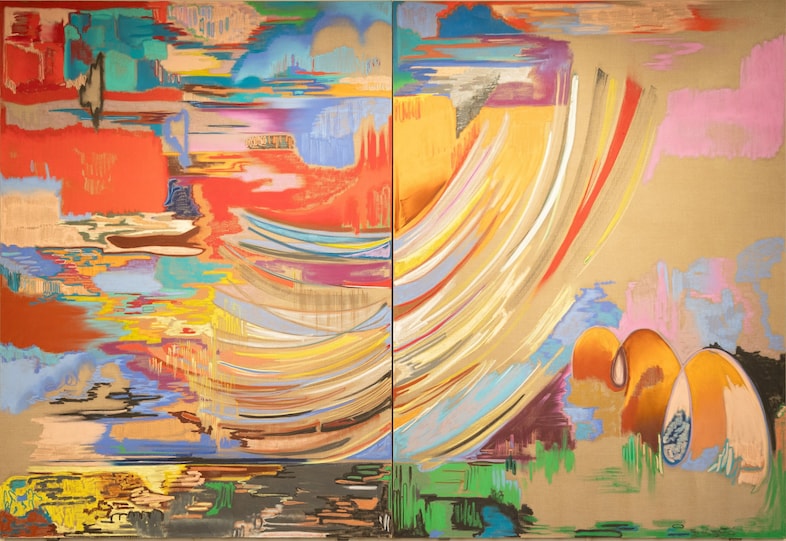
“I’m always trying to look at the structure of something in its most rudimentary, abstract, pure form,” the British artist tells me when we meet at her Ilford studio. Her recent work with brick patterns has, in part, been inspired by the Chinese-US artist Martin Wong, whose grimy paintings reflected on the Aids crisis and poverty in 1980s New York. “You can have an object so loaded with psychology and social context. You can feel all this tension, aliveness and mirth in how Wong paints a brick. It’s a simple form, but at the same time, you’re painting something that anyone can understand because it’s used to structure society.”
Jones’ recent pieces have more breathing room than her former paintings, though they are no less magnetic. She has started painting on linen instead of cotton canvas, with raw material showing through in sections. Zones of colour and patterns are more overt in these works, with less layering. The teeth and tongues are also more readable. “I’ve gained a lot more confidence making these paintings over the years,” she tells me. “It’s becoming a little bit more literal. There is this separation of space and boundaries in how I’m painting the mouths.”
There is a wildness to her new works. Some create the impression of a landscape whizzing by a car window, or an explosion caught in mid-air. Cartoons have been a big influence. “I became excited about bringing my early experiences as a child into the practice,” she says. “Cartoons establish this unconscious relationship between space and emotion. Things happen so drastically and emphatically in the world of a cartoon. That is presented as real and normal, but you also understand that it’s not. All of that happens in this confined space with a classical music soundtrack.” She hopes viewers can have an instinctive response to her works – feel them intuitively rather than intellectually. “I want people to connect emotionally to what they see and have their inner experience guide what they take away from the paintings.”

Music plays a key role in Jones’ practice, from her 2023 opera Hey Maudie to collaborative karaoke performances staged at galleries such as Harlesden High Street. She notes how colour and movement can create a similar feel to sound, which also has a visual aspect, triggering the mind to recall image-based memories. “The way I think about abstraction in painting is the same as when I’m working with sound,” she says. “I love to layer different sounds, draw on sound histories, and have things that are chaotic but also sweet, lush and satisfying. At the same time, they might be discordant or dysfunctional.”
Opera and karaoke come together in her combination of so-called high and low culture. Likewise, she draws on art historical paintings alongside cartoons. At Dulwich Picture Gallery, Jones’ intimately scaled works and sprawling paintings are shown alongside Pieter Boel’s 17th-century study of a vicious dog. In Head of a Hound, the animal’s disembodied face and tensed jaw fall away into abstraction. “I saw that painting and was so intrigued,” she tells me. “This is how I approach painting mouths. They exist in a very specific emotional space, but there is this disembodiment and ambiguity of what is happening or about to happen.”
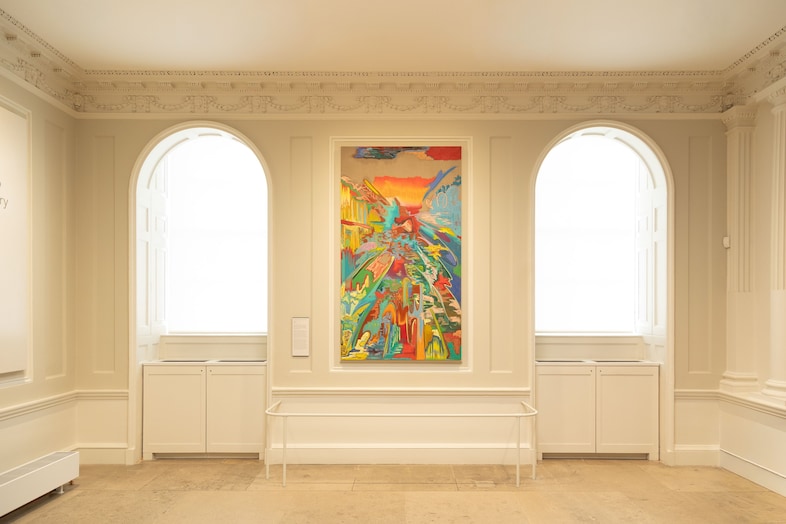
Two new paintings have been made for The Courtauld’s John Browne Entrance Hall and Ticketing Hall, sitting between a pair of grand windows and above the stairs. She has responded to the architecture of the space, thinking about how visitors move through both areas. The stairs invite a range of movements while viewing the work, which has a dizzying effect. For these pieces, she thought about “the impact of a body in space”, intrigued by how a place can “hold the tension of something that happened before. That is done so beautifully in cartoons. The way they describe speed, or the impact of a fall. The gravitational force of bodies is very present and intense.”

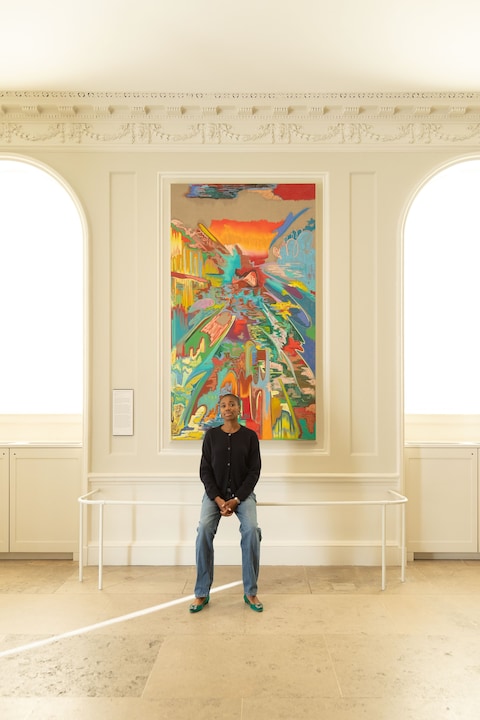
In keeping with her recent challenges to learned ways of working, Jones has chosen colours for these pieces that she finds difficult, such as turquoise, purple, orange and green. “I love all colours, but in terms of making a painting, those ones are hard to use together. There is an immediate tension because there is something I’m wrestling with.” She has also explored how children recreate the world around them, often with a simple skyline taking up half the page, the action large and centralised, with simple, rudimentary forms holding a lot of meaning. “My childhood drawings were very abstract as they lack an understanding of form, depth and space, but they express the core or root value of what it was I was trying to describe,” she tells me. “That’s sort of what I’m doing now, but with colour in a very layered and intense way. It’s trying to get to the absolute centre of an experience.”
Two new paintings by Rachel Jones will be on display at The Courtauld in London from September 25.
