
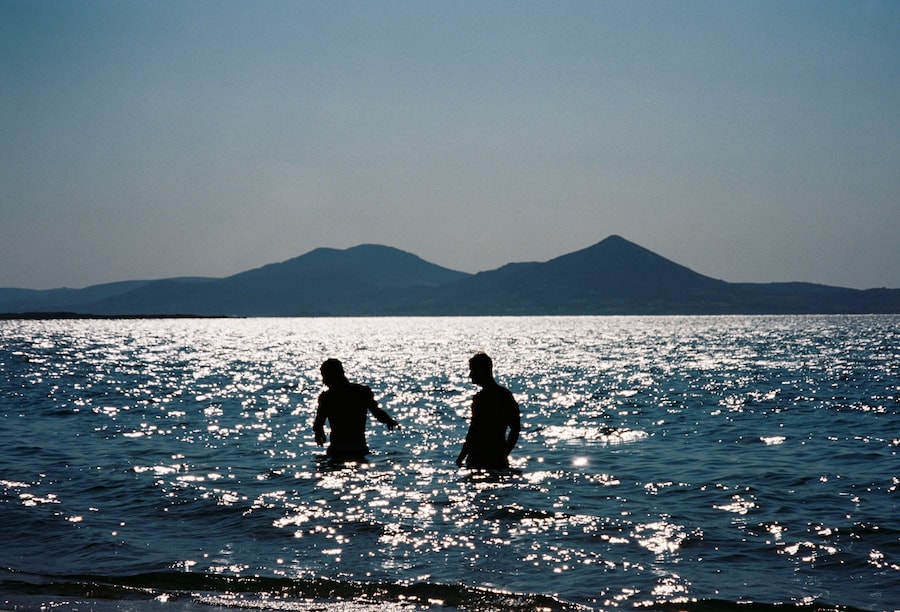
Underscoring beautiful bodies, sunsets, and lovers with undertones of melancholy, Davit Giorgadze’s ten-year diary documents his complex feelings toward his birthplace, Georgia
On the other end of the phone, through a crackling line, Davit Giorgadze has pulled over on the roadside in Tbilisi, Georgia, to talk about his new book. Rain hammers the roof of his car as a storm passes overhead; a fitting metaphor for the turmoil, both personal and political, that runs through All the Love and None at the Same Time, his new book published by They Said Books.
Known for his emotional photography that plays with bold colour and silhouettes in his editorial collaborations with publications and fashion houses like Gucci, Mugler, and Jil Sander, Giorgadze has made a global name for himself. But now, he’s returning to his home, launching his new book alongside an exhibition in Tbilisi. In a country currently gripped by political unrest, attacks on queer rights, and shrinking space for dissent, his decision to launch the publication in Georgia became a form of protest.

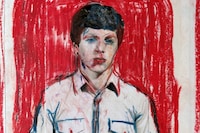

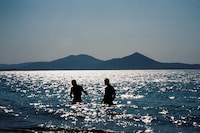
The book is expansive, spanning photography, painting, writing, and drawing: a ten-year emotional archive that reads like a visual diary. “I feel so lucky to be able to share my work in this medium,” Giorgadze says. “Sometimes we forget the importance of print, and what it means to work with extraordinary people who make all this possible.” The title itself, All the Love and None at the Same Time, is both cryptic and deeply revealing, evoking a duality of presence and absence, intimacy and alienation. “I think it describes Georgia,” he explains. “It’s everything at once – overwhelming love, but also the sense of being ignored or left behind. I grew up in a place where beauty and hardship constantly coexist.”
That coexistence has never felt more stark. Once a key agricultural state of the Soviet Union, Georgia has long pursued independence and closer ties to the West, but recent political shifts have raised fears that the country is drifting toward authoritarian rule. In recent months, Georgia has erupted in protest. The ruling Georgian Dream party has advanced a sharply pro-Russian agenda: stalling EU accession, criminalising LGBTQ+ expression through the so-called ‘Family Values’ bill, and cracking down violently on peaceful demonstrations. In the streets, students, activists, and artists have faced tear gas, arrests, and rising surveillance. “Just yesterday, I saw a 20-year-old kid get arrested during a protest,” Giorgadze tells me. “Accused of violence, without any real evidence. It’s terrifying. It’s like we’ve gone backwards by ten years.”

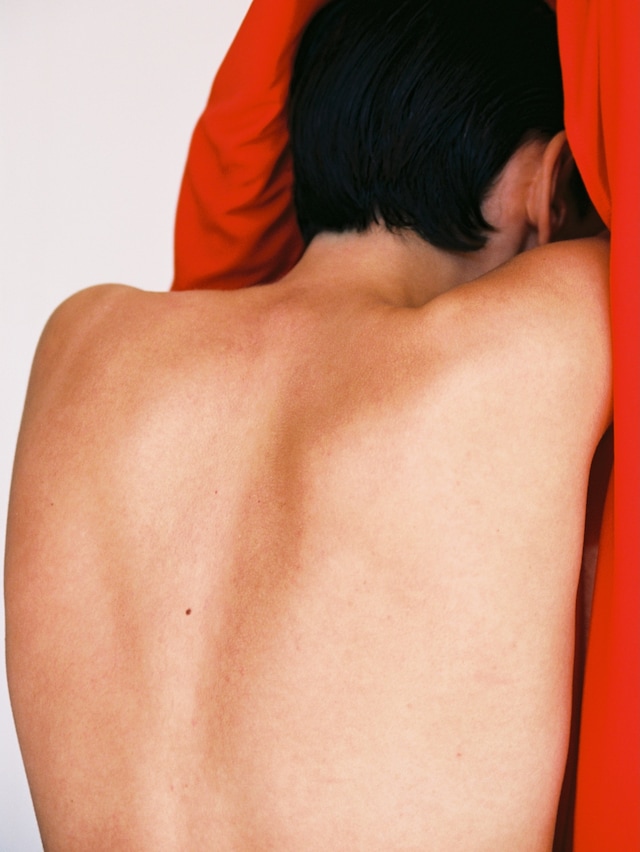
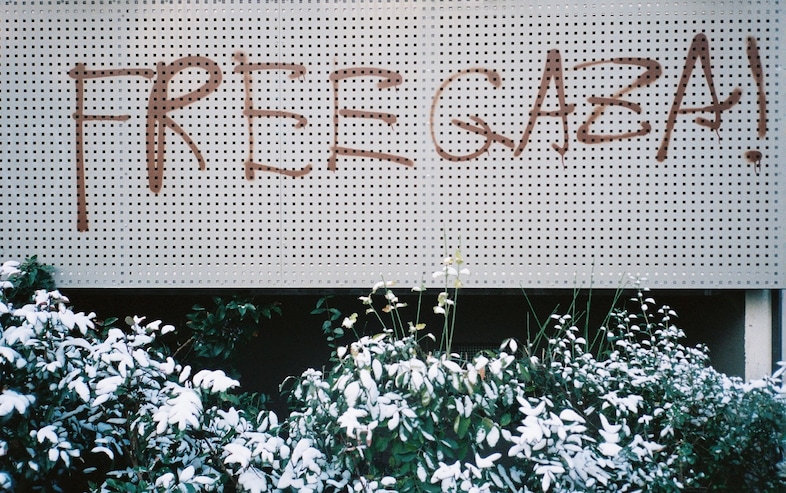
While Giorgadze has been based in Berlin since he was 18, Georgia has never left his mind. The images in his book are tender and unsettling. One image is of an older woman buried in blankets, frowning into the lens. In another, a red dress is draped over a cliff, water cascading from it as if the garment itself is weeping. In other images: an empty leather sofa is imprinted with the ghosts of past occupants; graffiti scrawl reads ‘Free Gaza’ on the side of a building, tying a quiet thread between Georgia’s struggle and other global resistance movements.
While his roots in Georgia are unmistakable, Giorgadze’s work resists borders. It resonates with youthful unrest and queer resistance from around the world. Many of his paintings are of male sitters of friends and lovers, rendered in bold outlines made up of red and blue paint. His diaristic approach of bringing together image, text and paint forms a visual language that holds an array of emotions, of beauty and loss, love and alienation, home and exile. “It’s not just about Georgia,” he says. “It’s about what it means to be seen. To make sense of your identity when everything around you tells you not to exist.”

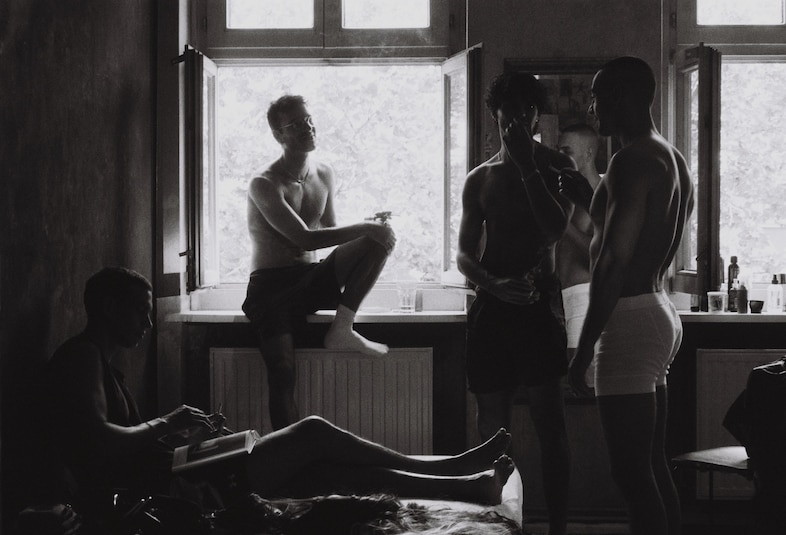
His aesthetic is intimate, and this is deliberate. “I think in images,” he tells me. “Even if a photo looks simple, it holds deep meaning. Every piece in the book is there because it matters to me. A person, a memory, a moment. It’s not just about pretty pictures – it’s about emotional truth.” He talks about rhythm and how melancholy is laced through beauty, how even light can carry solitude. “There’s sadness in it, but also reverence,” he says. “I try to capture people in ways that preserve their dignity, their complexity.”
That approach is political, even when it doesn’t announce itself loudly. “There were no queer role models when I was growing up,” he says. “No one who was out, making art, doing fashion, and visible. I want to be that for someone else. Even just one kid seeing this and feeling less alone; that’s enough.” For Giorgadze, the personal is the political. His identity as a queer artist has been shaped by both rejection and resilience. “Georgians have always fought for their rights,” he says. “Even if I’m not here full-time, I carry this place with me. It’s part of who I am.”

Giorgadze’s publication is more than a retrospective of his work, it’s a love letter and a protest. His decision to launch it now, in Tbilisi, is not coincidental; it’s urgent. Amid rising authoritarianism, Giorgadze’s work insists on visibility, and it demands emotional honesty. It asks us to look, and to keep looking, even when the story is hard to bear. “Among all the beautiful bodies, the sunsets, the lovers – there’s also this layer of sadness,” he tells me, as the rain slows. “Because that’s real too; that’s life. That’s Georgia.”
All the Love and None at the Same Time by Davit Giorgadze is published by They Said Books and is out now.
