
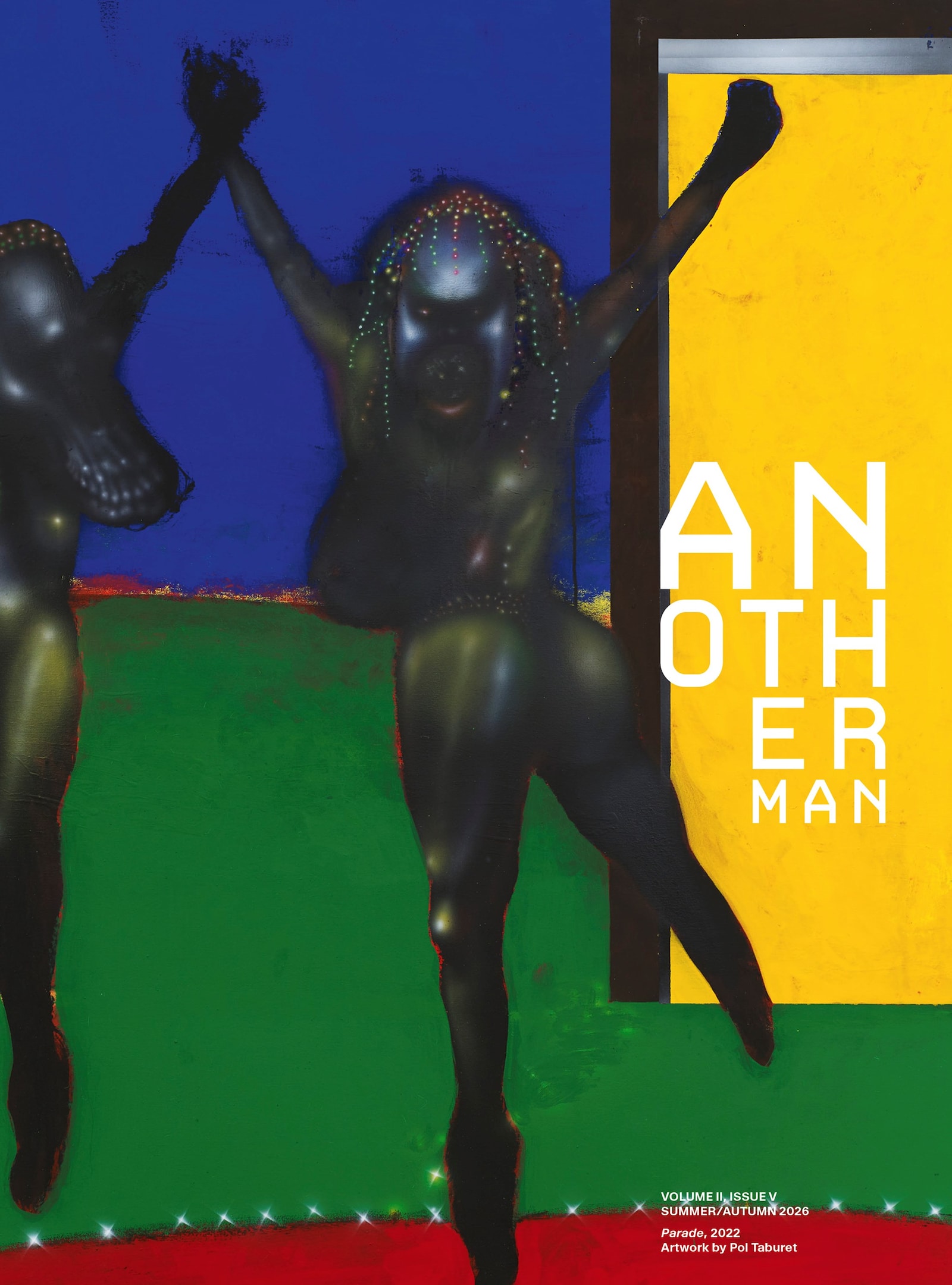
This story is taken from the Summer/Autumn 2026 issue of Another Man, Volume II, Issue V:
In Paris as a child, instead of TV, Pol Taburet’s attention turned to the faery tales his dad would read him, and the small-town superstitions his mum grew up believing in Guadalupe.
She told Pol of the swamp that churned with spirits near her family home, and the mountain devils playing mind games with travelers in the forests of Basse-Terre. Local gangsters were redrawn as characters from religious mythology in her sketchbook, revealing her ambitions as a professional painter.
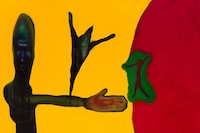
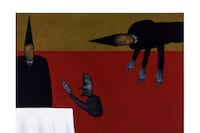
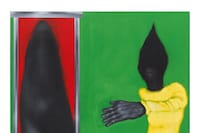
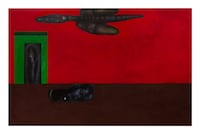
His childhood seemed to tune his mind into the frequency of mystery. In conversation, he talks of demons “growing” in his paintwork, as if the moment oil leaves his brush the psychogenesis of the moment takes over, and he is no longer in control of his storyline. In Taburet’s work, the ambiguity of the scenario is the truth of it.
When his family finally bought a TV in the 2000s, Missy Elliott had been turned into a cybernetic bee-keeper by video maker Dave Meyers and Michael Jackson was made of plastic. Pop had collided with grime, had collided with down-tuned metal, had collided with Timberland, had collided with Baltimore Club. The audiovisual culture of the era felt fantastical, with stories told by figures dressed in primary colours and diamonds.
Midway through our conversation, we seem to agree that the magic of Pol Taburet exists beyond one obvious medium or conceit. There’s an otherness to his work that’s louder than painting, sculpture, sketch and the sum of their parts. There’s a musicality to it, too. (I hear: brush strokes as orchestral strings plundered horizontally across the canvas, rusted French Horns and melodies blown through exhaust pipes).

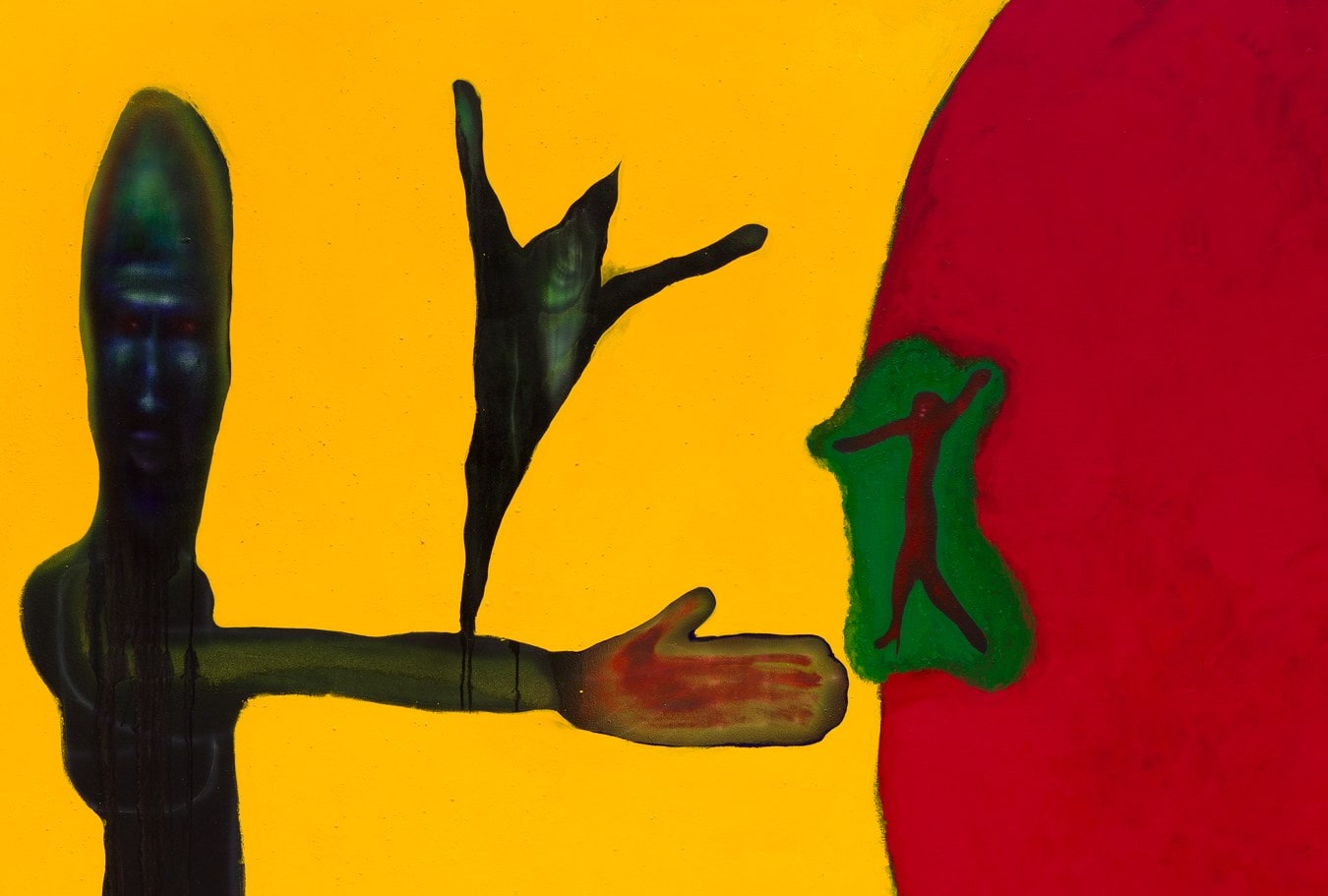
Taburet has increasingly drifted towards music and dissolving disciplinary binaries. His 2025 ended with a collaboration with Daniel Lopatin, who recruited him to create a pencil-drawn surreal short for “Cherry Blue”, the ethereal centrepiece of Tranquilizer, Lopatin’s eleventh record as Oneohtrix Point Never. In May, he will exhibit a series of arcane sculptures and artworks for his debut solo exhibition at Villa Medici in Rome. He is working towards a commission that via a live orchestra re-appraises his favourite songs by the likes of Alice Coltrane and Edward Skeletrix and, at the time of writing, will soon find out if he has won the prestigious Dorothea von Stetten-Kunst prize at the Kunstmuseum Bonn.
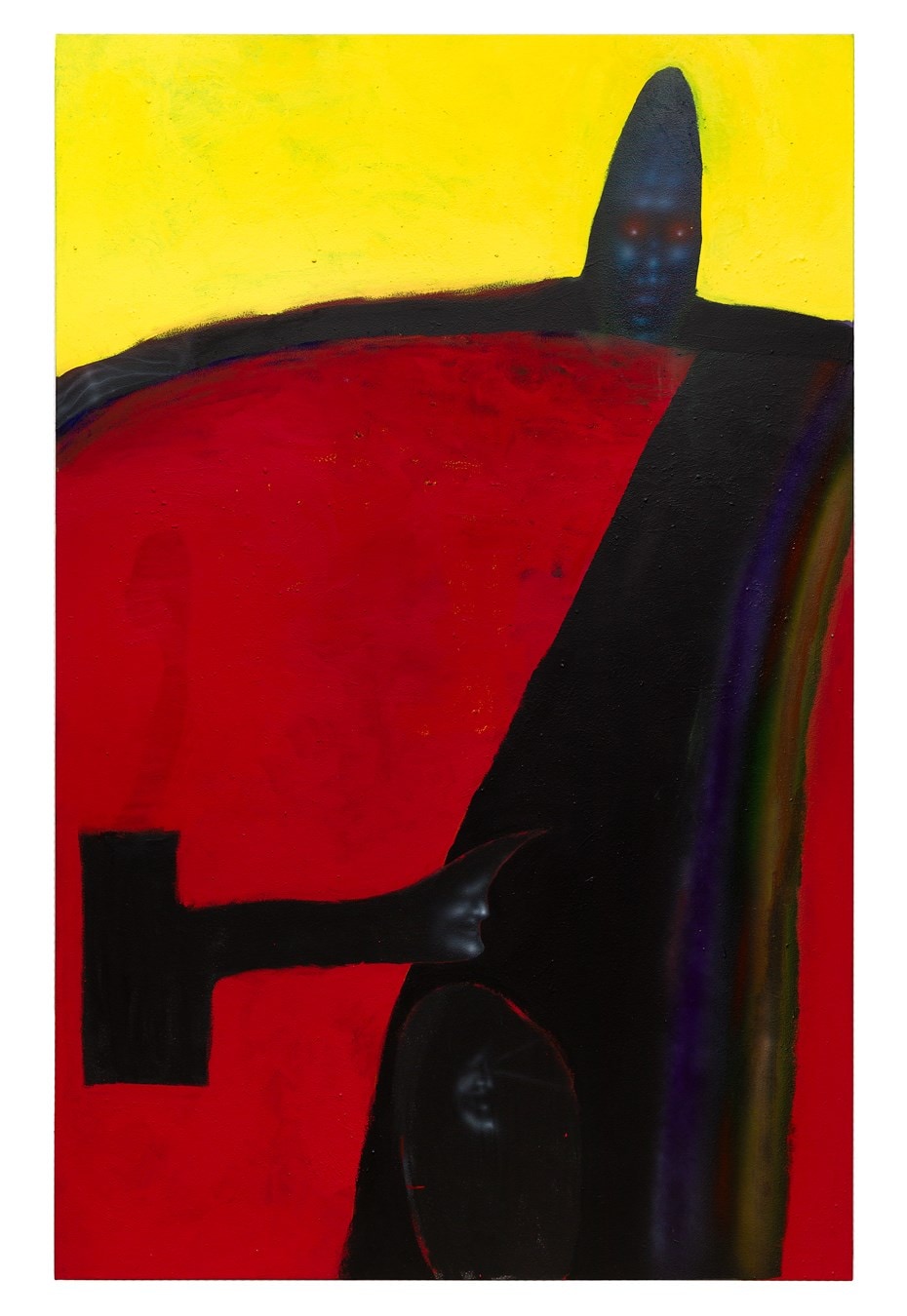
“This is the space I’m looking for, the moment where something is coming towards you, it’s a human shape for sure, but you don’t really understand what it is,” he says of his work, in which faeries with fire and ash for eyes don black capirotes and defy gravity, drifting across your vision even after you’ve looked away.

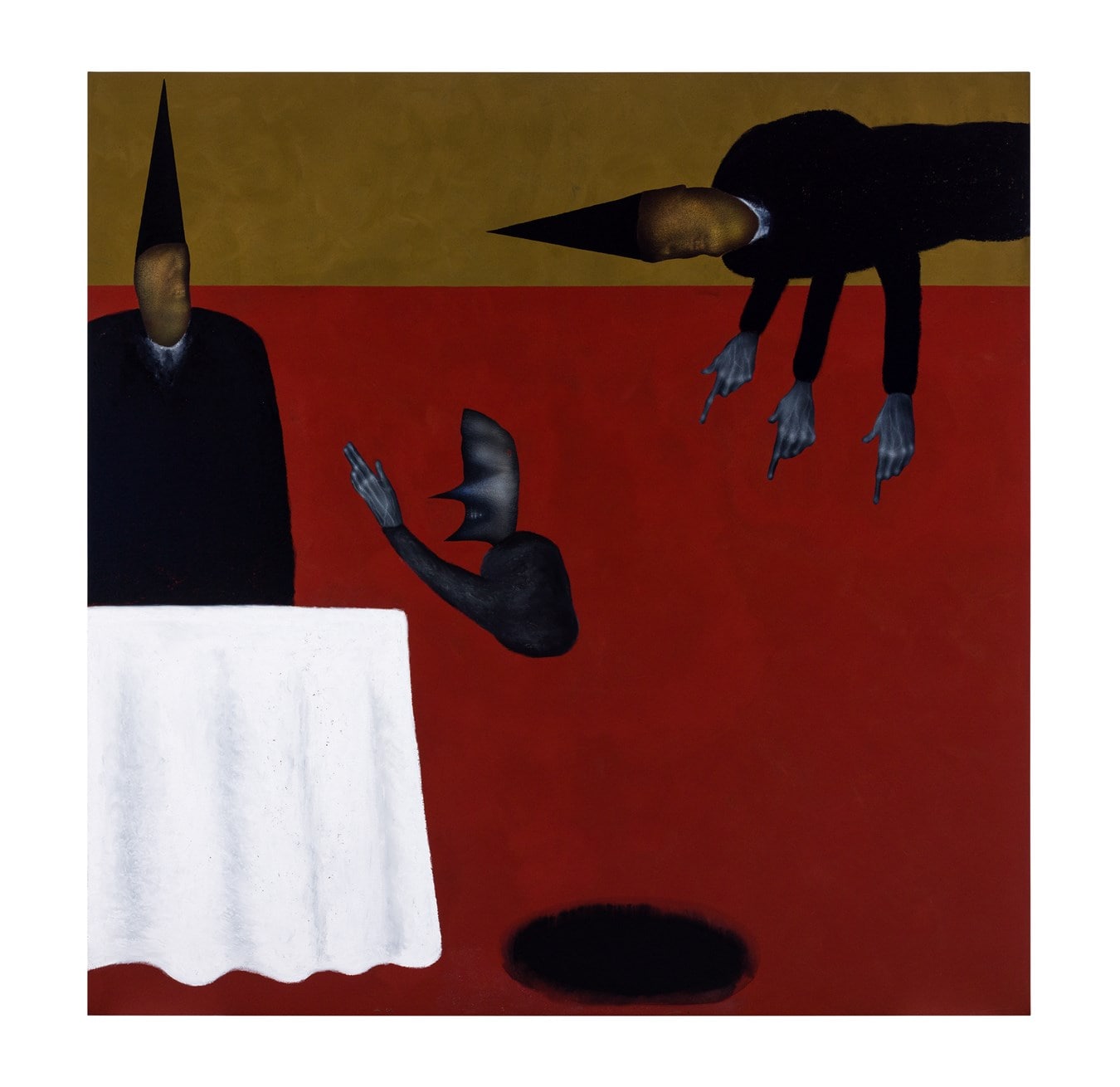
You have shown me a lot of your charcoal drawings – they are rarely seen in public. Will they be? Is this where things are going for Villa Medici?
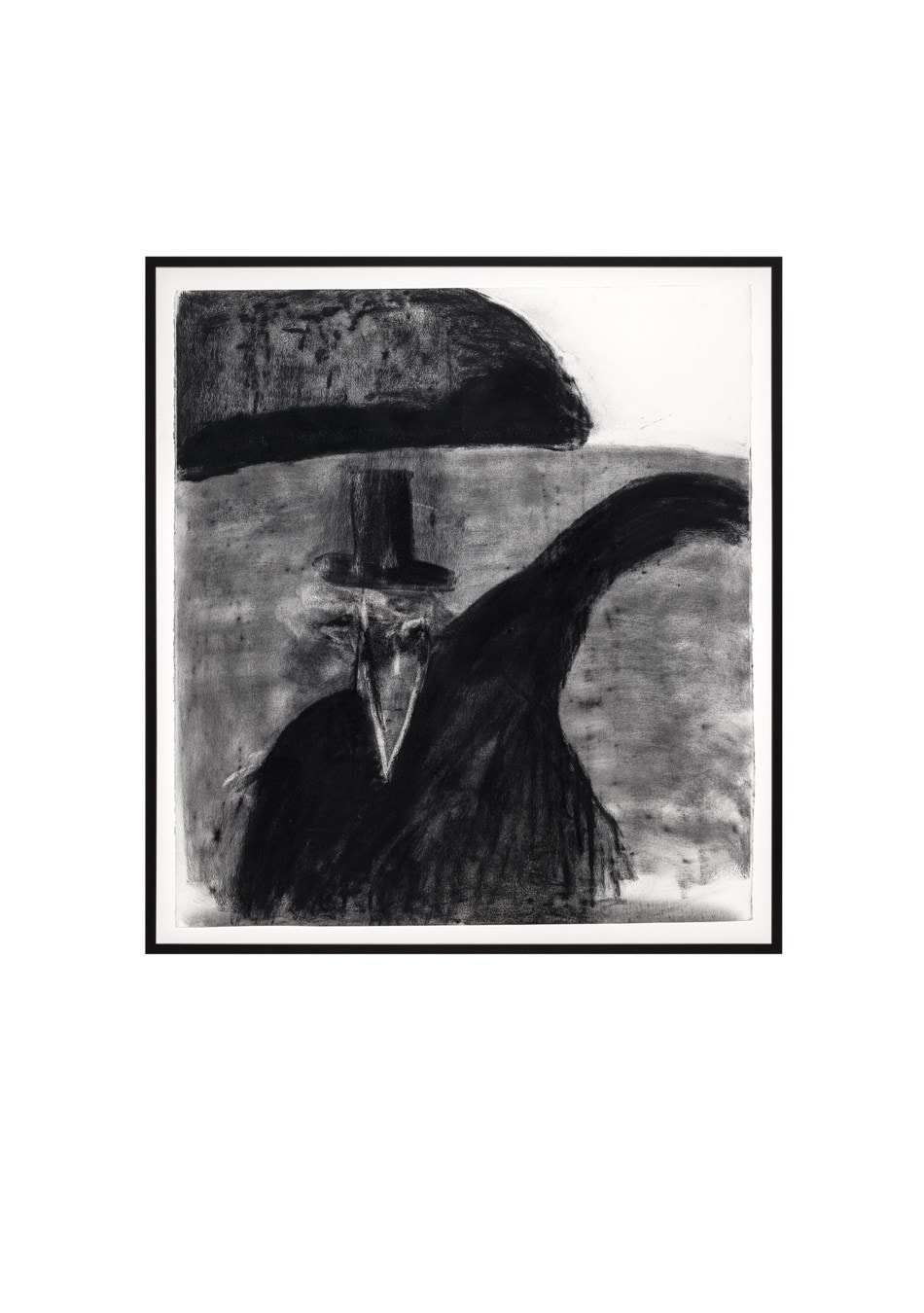
Pol Taburet: I see them more as an exercise. It’s more to get warm before painting. I don’t usually prepare a drawing for painting. So it’s a way to get the flow (going). I like using charcoal because of the deepness of the black that the charcoal produces, and the instantaneity of this medium. Even small gestures appear strong on the paper. The lithograph painting of an engraving on stone was made for an exhibition that was happening in Madrid. It depicts different scenes of hunting, the relationship between the prey and the predator – a beast waiting for its feast. You have a cloche, similar to one a server gives you in the hotel. I think my research now is going somewhere else for Villa Medici, which is a site specific project. I’m moving towards two ideas, which is the (cloche) and the legend of the Golem in the Prague ghetto. So that’s the two subjects floating in my head for now, and I need to find the poetic line between the two.
Your dad is a psychoanalyst and used to read you faery tales as a kid. Did the idea of putting storylines onto canvas and translating myths and legends in new ways start at this age?
PT: I think there are different ways to see that. The faery tales arrived quite early, because my dad was against having a TV at home when I was young and we were sometimes able to watch movies. But books were very present. A moment precious to my parents was gathering all of us together, reading to us, and every person in the room would have a different image in their head. It’s a very personal transcription of the words you receive, and you create your own narratives and even get a little afraid by your own interpretation of the stories, which I find very interesting. The images that you are afraid of, the image that you own, you produce by yourself. Then I became fascinated by movies with my brothers. My big brother is called Felix, and I relate to them in similar ways, in their mythology and stories. 2021 was my first show, and it was completely inspired by my grandmother’s tales from her childhood. She’s from Guadalupe, a region known for superstition and faery tales. Something that I’ve been thinking about a lot is how much people need tales; we need myths. Some people get obsessed with characters in popular culture and follow their lives like reality TV – we want to see myths like these, and I want to create them as well. It gives me so much freedom in my work. And just like in a soap opera, a character who dies in a painting of mine might come back in a later work.

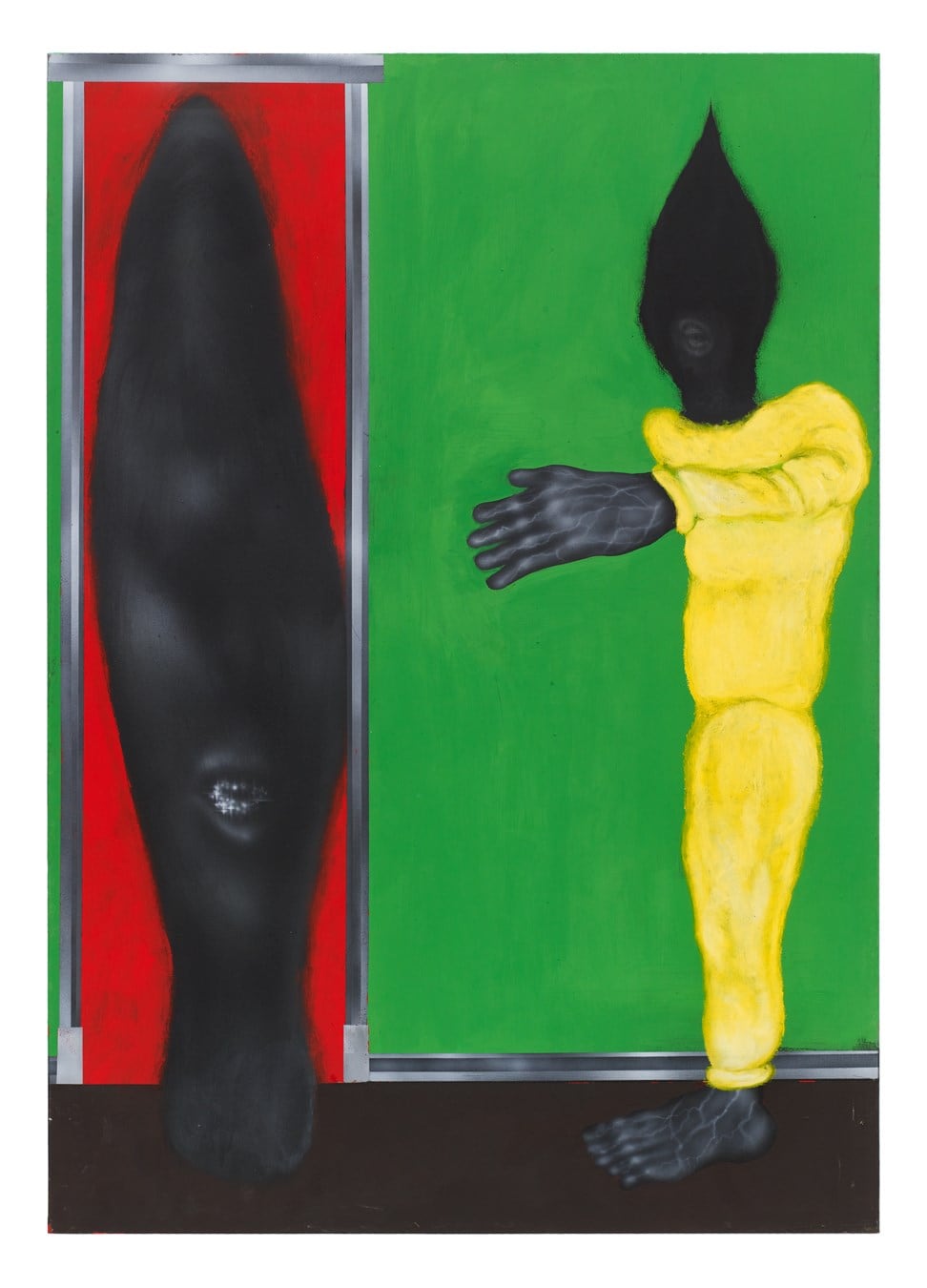
How would you describe your parents’ paintings? They both drew, but your mum was much more serious about it.
PT: I think my dad always had a certain sensitivity and intelligence regarding arts and mythology. He had books by (Jean-Francois) Champollion that described hieroglyphs and Egyptian deities. We were just so fascinated by that – all the drawings were so beautiful. I think if you kind of dig inside, you would also find a lot of... not my characters, but the way I compose paintings and how the narration is drawn from these hieroglyphs. He treated us as adults even when we were young. Our creative ideas were never blocked. When I spoke to him about my dream to become an artist, he encouraged it. My mum was more afraid (by the idea). She was a figurative painter. At some point she was working as a guardian at the Museum of Modern Art in Paris – she was the person to tell you to not get too close to a painting, basically. She really loved it, because she was also in the presence of masters, you know? This is how you train your eye, to be close to these pieces, to go back and to see them again. Every time you see (a painting), it’s going to change. You’re going to see things in it you didn’t realise, and the emotion of it might get stronger and stronger. I was assisting her painting process a lot. She would have the TV on, drink a glass of wine, and smoke cigarettes when she painted. She worked all night like that. The way for me to be able to watch movies was to stay with her. So I saw her paint so much, and I think she was very talented and quite contemporary without knowing it. She was painting hood boys as saints – (the Angel) Ariel wearing a huge puffer jacket and cap, with cans and smokes. Black Mona Lisa, as well. Her paintings of the Black body were very, very interesting. She was like a classical painter who would insert her own storylines onto canvas. It’s something I took from her; to look at the classics and create my own stories.
“The images that you are afraid of, the image that you own, you produce by yourself” – Pol Taburet
Were you mythologizing what you were seeing in music videos as well? In the 2000s music videos were fantastical and dark – the Timberland and Hype Williams stuff particularly.
PT: Completely. I think I was consuming more video clips than art itself at the time – there was something comic, dark and spectacular about them. I think of my work a bit as collage sometimes and the sensation of these clips was what I needed inside it. I was taking a lot of screenshots of all them and recreating moments (from music videos) in my paintings. It created something odd, that I like.

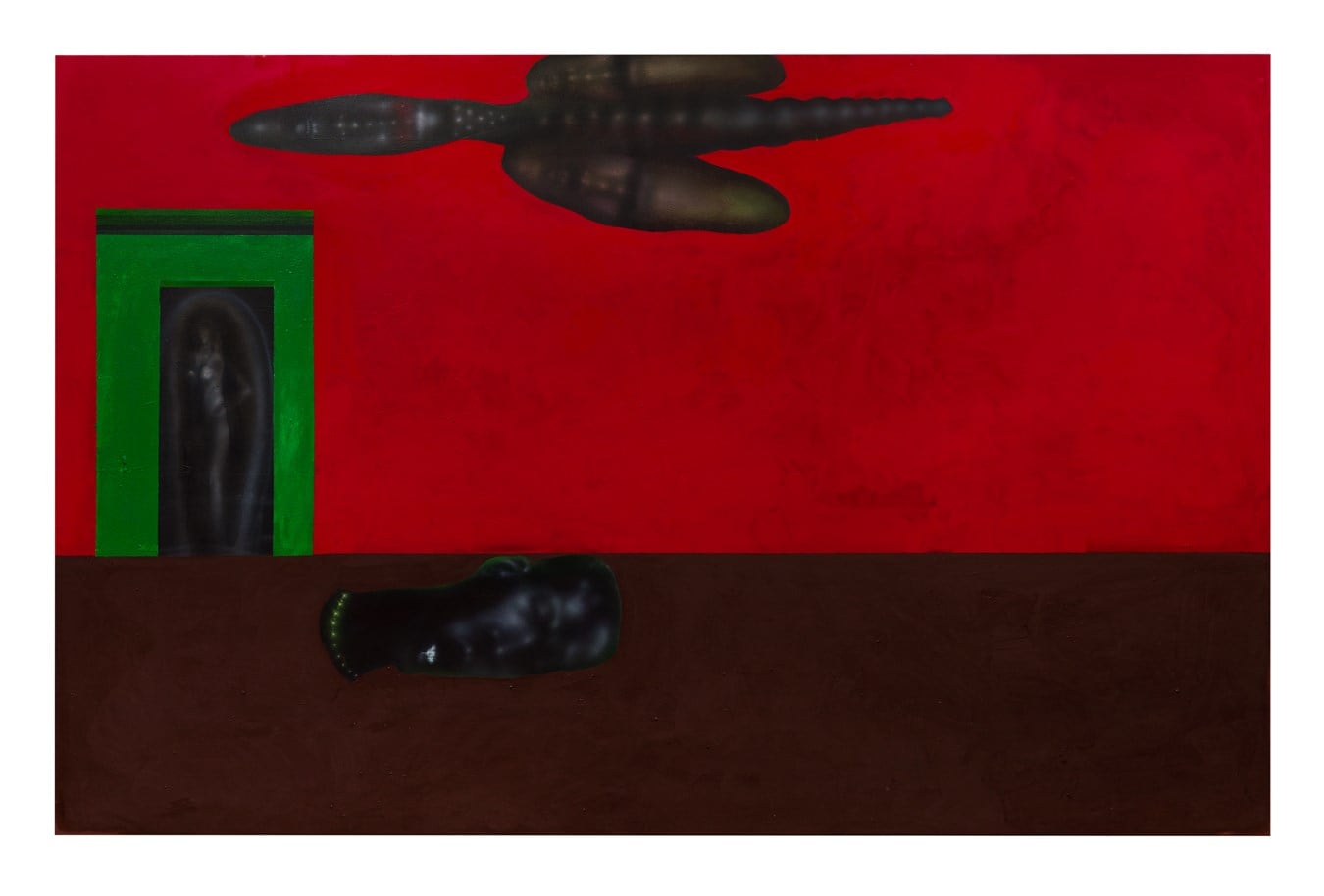
Do you hear music in your work at all? I hear industrial, even stripped-down classical sounds in your paintings. I wonder if you’re inspired by sounds as well as visuals – can you see a correlation?
PT: Yes. In my colour period maybe a year or two ago, unconsciously I think I wanted to be loud, to yell with my work – to make sure that the message gets received. I was working with oil, and it requires you to be patient. You can’t work too fast with oil. Then I went to a different medium, which dries very, very fast, and it allowed me to work with colour in a very pure way. This is why you have blocks of colour in previous paintings, because I could build architecture with colour. My work was influenced by trap music, and I would paint stripper bodies. Now I think I want something way more silent in my work. For my Schinkel Pavillon show (a sculpture and painting series called “The Burden of Papa Tonnerre” that launched in March 2025), I wanted to explore that sensation, a kind of religious silence, one that you would experience in a church. Before in my work, characters stared at you, and you had a conversation with these shapes. Now I want to create a distance, like looking at a scene from another world, from behind a window; something you can’t access. To create that feeling, you have to move through silence, through something more meditative and more posed, less electric.
The shapes you create feel very distinctive – they are recognisably Pol Taburet. I wonder what role shape plays in your work, and the way you anthropomorphize objects, turning sharp right angles and verticals into animals.
PT: I think the shapes are a way for me to work on the limit of abstraction; the in-between, the space between figurative and (speculative). To get (the viewer’s) attention, you create doubt or a questioning of what you are seeing. If you see someone coming towards you in the fog, you see that silhouette, you want to know what it is. This is the space that I’m looking for. It’s like the moment where you know there is something coming towards you: it’s a human shape, for sure, but you don’t really understand what it is, and it gets you inside that space, not of dream, but of hallucination, where you start to think and project. But this is why I work with the shapes – it keeps you in the blur-zone.

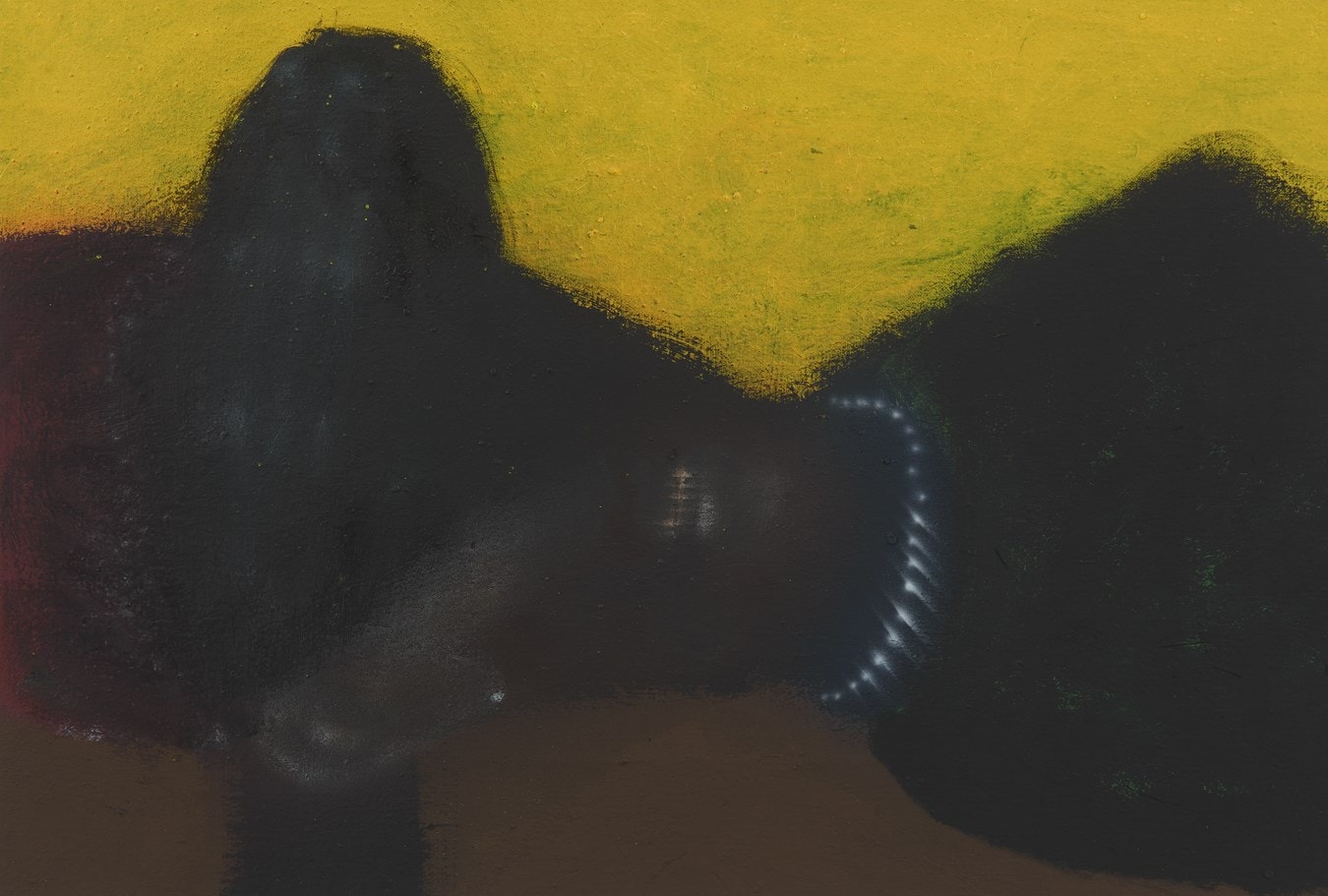
You don’t want to tell the viewer what to feel: The aim of your work, correct me if I’m wrong, is to tap into mystery rather than answers.
PT: Completely. The moment the painting is alive is when I work on it, because it has a beginning, but it also has many possible endings. The painting will tell me when it’s done. It’s the same with describing what you’re supposed to see, what’s happening between these characters – suddenly, all the different ways of reading it would die as well. I want to be able to come back to these works in a few years and be like, Oh, there is still something happening there.
“I want to create a distance, like looking at a scene from another world, from behind a window; something you can’t access” – Pol Taburet
You’ve tapped into a few figures from history – Samurais and plague doctors, for example. How do these characters find their way into your imagination?
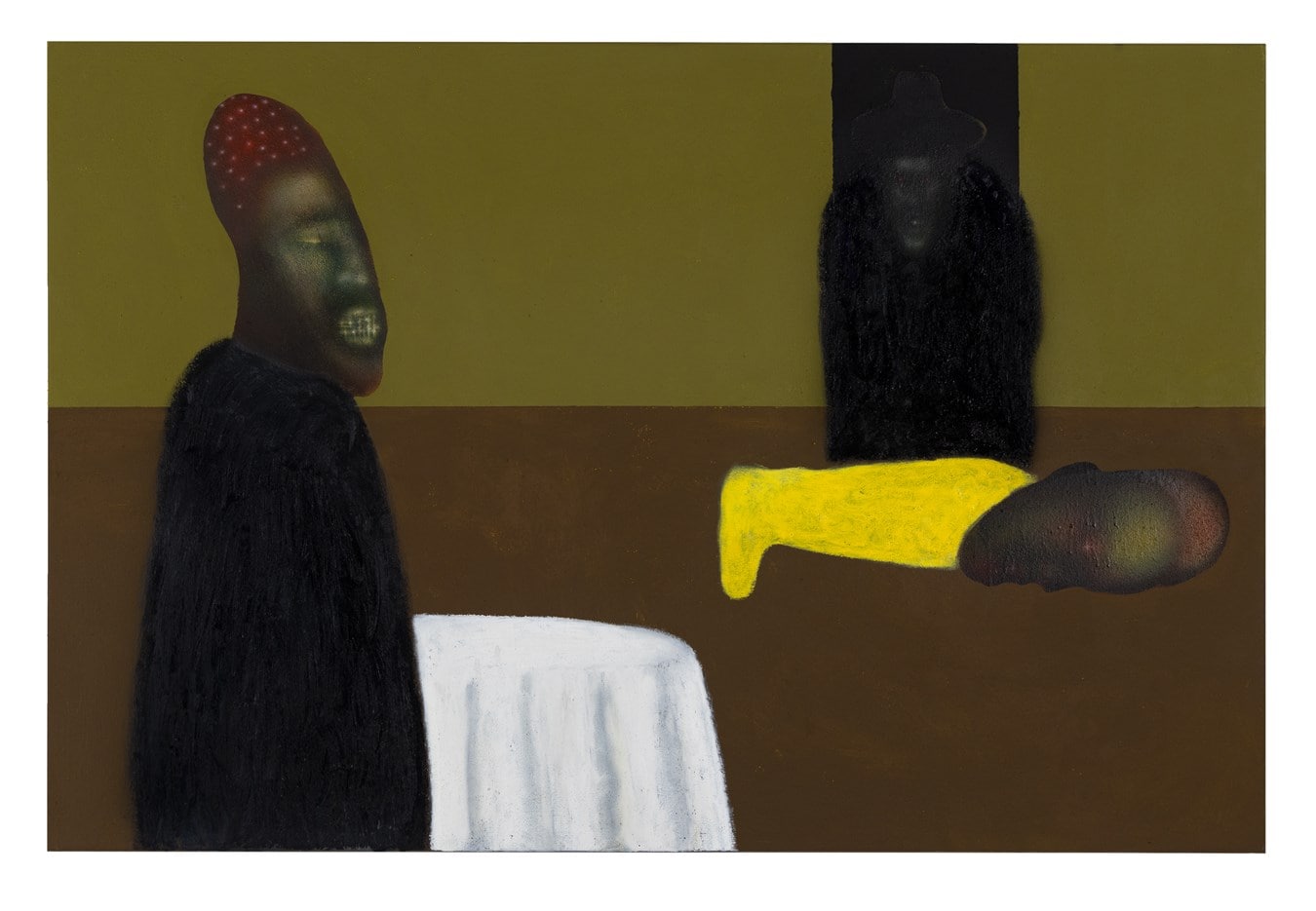
PT: My work isn’t influenced by dreams. When I’m with people I hear a word, or see someone’s behavior, or hear of a situation, and think, It would be nice to paint that. I look at different magazines – about ceremonies, masks, interiors, objects – and some images start to speak to each other. My last obsession was with table cloths. I find them very interesting because (tablecloths could be) hiding so much and showing so much at the same time. There’s a whole story that could be happening under the table and on top of it as well. I love this kind of Schrödinger’s Cat effect. The tablecloth arrived early in my work in sculpture. The first or second time was in São Paulo for an exhibition at Mendes Wood. I was thinking about the bourgeoisie, a way to communicate that the setting was (middle-class). My new obsession is with the cloche, and the server themselves. The Oneohtrix Point Never video was inspired by a cloche in a hotel that someone left near my door in Madrid. I love that thing, because its shape reflects the whole room and there’s a mystery to it. Before you open it, anything is possible. I was just fascinated by that. The servers are delivering a gift, almost like a religious missionary would in the Bible, and they seem to arrive from nowhere. Originally in the video, servers were supposed to drop cloches in front of every door – they were supposed to shine, and the city was supposed to shine too.

How and when did Daniel Lopatin get in touch?
PT: He texted me on Instagram. I was very surprised, because I’m a huge fan of his music. I listen to him a lot in the studio to work, it allows me to dream while I paint. It’s a very good thing for my mind. The musician Freeka Tet, who I met once in the rave in Paris, wanted to introduce me to OPN, and invited me to see him play. One day, Daniel texted me saying: Okay, I’m releasing my album. Would you like to work on it? He proposed to me two songs from the album (Tranquilizer), the first was “Rodl Glide”. The problem was it was already too visual – there was (such a rich) story happening in the song and I could not follow it. With “Cherry Blue”, there was something very romantic and dark there, something nostalgic. I listened to it I don’t know how many times – I had listening credits for the album and I burnt them out. At first the video was meant to feature real people, but the storyboard ended up becoming the video. “Cherry Blue”, the name, sounded like a beautiful poison-girl, the kind of girl that you love but is maybe a bit toxic and attracts you like a siren. The characters (in the video) were supposed to drop cloches for her – gifts, as you would do for a God. The scenes inside the apartments are inspired by soap opera-type scenarios; Daniel was very inspired by glossy images like that. When the characters come to the window, they are analyzing human drama and want to figure us out. Suddenly they get called by a kind of presence, which is so powerful it appears as a burst of light. That’s cherry blue.
There are bursts of colours and strobe effects at the end of the clip that leave impressions on your visuals. You start to question your own senses and perception. I wanted to ask about your debut show in May. Where is your head at for that?
PT: I’m fascinated that Rome has (both) changed so much and stayed the same. The sensation of being able to dig into the past, in the present, just by walking in the street. A lot of my work looks at fascism and how to express violence through art. Some of my characters are inspired by African masks, Japanese masks, and fascist art. What inspired me the most was an artist called Adolfo Wildt. For the Sao Paulo Biennale, the sculptures with trumpets were inspired by Bertelli’s Mussolini sculpture (Renato Bertelli’s Continuous Profile of Mussolini [1933]). Do you know my sculpture that displays a long face on the body of a train (Soul Train by Pol Taburet)? I wanted to provoke a certain type of dynamism in my work – you get a sensation from the essence of the sculpture and the shape, but you don’t know what it is. I think it’s tapping into a collective trauma. The idea for the residency, at the moment anyway, is about unveiling the fascism inside the grounds of Rome; its historical roots in the movement. Many of Mussolini’s government and fascist party headquarters are still here. I like the idea of breaking apart a city and starting again – but all those relics are still here, you know? If my work always moves toward ghosts, this project would be about the ghost of Rome. And like a zombie, (fascism) is coming back to life around us now.

“My work isn’t influenced by dreams” – Pol Taburet
Almost like the swamp your Grandmother obsessed over.
PT: This installation was supposed to be a sort of swamp; a dry swamp. You have this big swamp in Brazil called Pantanal, which experiences a dry season and a rainy season. During the rainy season, an ecosystem grows there. Fish come back, as do various water species that die off year after year, but the dry season attracts other forms of life.
Your paintings are so physical in a way–you can almost feel the sharpness of the angles you draw. It must be interesting to build out dimensional objects in a room with abundant space. This way, the violence of your work becomes more real, tactile.
You’ve been nominated for the Dorothea von Stetten‐Kunst prize – tell me about the show you put together for that.
PT: For that, a few past works will be redisplayed a bit differently. I want to create a different conversation with the sculpture. Depending on where you see these works, the aura and meaning of the sculptures change. For this, I want to present them as characters that you could imagine yourself talking to.
It’s a huge year for you. Your biggest. Tell me about the live orchestra project you are working on.
PT: There’re a lot of ongoing projects too – I want to work on a short animation film with OPN again. For “Cherry Blue,” I created illustrations from his music, and I would like to invert that process. For the live music project, I’ve been invited to create an environment inside La Rotonde at Bourse de Commerce (Pinault Collection, Paris.) I’d like to invite the Philharmonie to play particular songs and pieces that interest me. It’s a bit like making a playlist, but with artists in a live setting. I am creating sculptures to accompany – the stage would be created, there will be sculptures around the space and I will work with my photography team to make the live design of it too. I want the Philharmonie to play Alice Coltrane – it’s kind of my dream to see her play, but unfortunately it’s no longer possible. I want to invite Edward Skeletrix, OPN and other artists to play too. Because they will be day events, I want it to give it a kind of after-party feel: sculptures and trumpets, intermingling. A dream-like space.

Special thanks to Pol Taburet, Julia Muell and Pierre Lannoy at Mendes Wood DM. Images courtesy of and copyright the artist and Mendes Wood DM, São Paulo, Brussels, Paris, New York. Photo credits: Kristien Dae, EstudioEmObra, Phillip Reed, Loic Madec and Romain Darnaud
This story is taken from the Summer/Autumn 2026 issue of Another Man, Volume II, Issue V, which is on sale internationally from 30 April 2026.
