
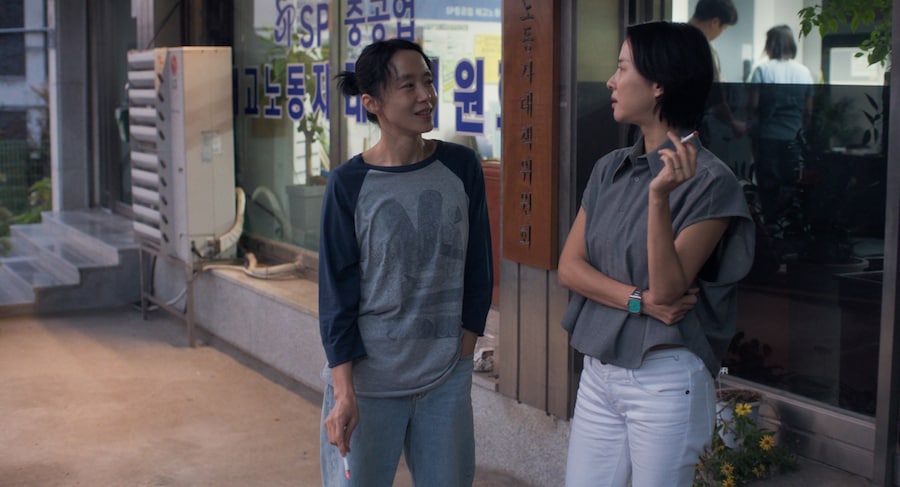
Eight years after Burning, Lee Chang-dong returns with a masterful fable of class envy, corporate trauma and hidden desire
Near the start of Lee Chang-dong’s searing chamber piece Possible Love – his Silver Lion Grand Jury Prize-winning follow-up to the 2018 cult film Burning – the wife of a laid-off factory worker and a dashing, married business magnate have what could be called a meet-cute. Mi-ok (veteran Korean actor Jeon Do-yeon), having lost weight due to stress, drops her wedding ring in a car park and Sang-woo (Jo In-sung) comes to her rescue. “I would love for it to be in a romantic comedy,” chuckles Jeon when we meet in a hotel during the London Film Festival. “You can really see in this scene the extreme degree her anxiety and fear of what it might be like to lose her husband and her family.”
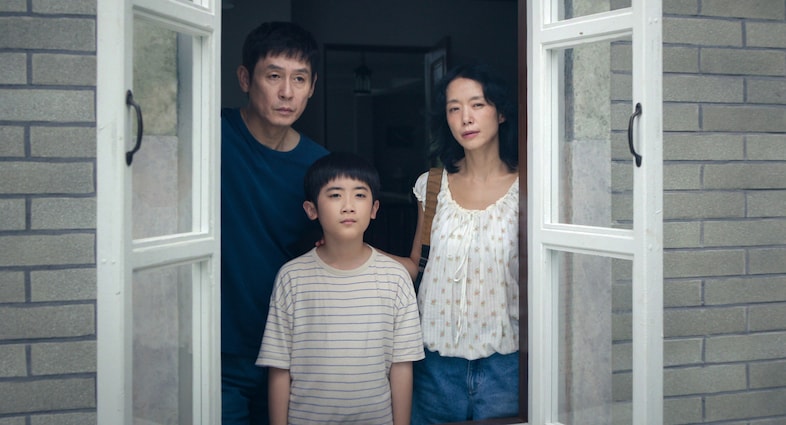
This encounter sets in motion the treacherous entanglement of the two couples. Co-written by Lee and Oh Jung-mi, the plot takes loose inspiration from the 2009 labour strike in Korea, which is increasingly familiar thematic terrain in Korean cinema. (Think Park Chan-wook’s No Other Choice.) Two years before the film begins, Mi-ok’s husband Ho-seok (Lee’s long-term collaborator Sul Kyung-gu) is brutally, traumatically fired amid mass lay-offs ahead of the company’s sale, leaving the family reeling and Mi-ok the breadwinner. When Sang-woo’s wife, filmmaker Ye-ji (Parasite’s Cho Yeo-jeong), asks to feature them in her documentary about dwindling labourers’ rights, the ever-optimistic Mi-ok leaps at the opportunity despite her withdrawn husband’s resistance, “trying to borrow the strength of Ye-ji and the strength of the documentary in order to get some help for her husband,” Jeon explains.

Opening with a title card bearing the Tenth Commandment, Lee’s film was initially conceived as an homage to Krzysztof Kieślowski’s Dekalog Ten. (Lee also tipped his hat to the late Three Colours director by naming Ye-ji’s dog Blue.) “‘Thou shalt not covet’ is about human desire,” says the director, “whereas all the other nine commandments are about the human act, and so I thought it would be intriguing to think about what it means to not covet in the capitalist society that we live in today.”
Through the slippery dynamics of this quartet, Lee probes the divisions of class, gender and wealth. “I wanted the discomfort and unease between these characters’ relationships to be naturally revealing the incongruence of our lives,” he says, noting the unexpected humour that arose from the chasms between his characters. “Going through many film festivals recently, I realised that audiences tend to laugh a lot more than I expected them to laugh – especially the bigger the screen.”
Though each feels deeply human, the four characters take on symbolic dimensions. Lee considers Sang-woo, for example, capitalism incarnate. Early on, Mi-ok likens the good-looking charmer, who married down and may or may not be financing his wife’s films, to Apple founder Steve Jobs. “The technological revolution that is symbolised through somebody like Jobs feels like it’s going to solve all of your problems, that it’s all-knowing, and that it’s going to liberate you,” Lee insists. “However, when the tech revolution is married with capital, the power that it gains is so immense that it will completely change all of our futures as well as our daily lives without us even being aware of it. However, Mi-ok continues to have that fantasy.”


However, when Mi-ok and Ho-seok are invited to stay in the rich couple’s mansion, reality hits. In one memorable scene, Mi-ok “protests” capitalism (aka Sang-woo) “with her entire body”. “There was a lot of fear around shooting that scene,” Jeon recalls. “Her desire is for freedom. When she’s younger, she’s spraying water on the car in order to clean it, and she’s told off and then restrained by her mum. She must have always dreamt of being free to do what she wants and hoped that that was what life was going to be like for her.”
In contrast to Sang-woo’s ‘new money’, Ho-seok embodies old-world values. “When I first encountered this story, I felt that Ho-seok was just like me – not as an actor, but just like a typical Korean male in East Asian society,” says Sul. “Many also commented that Ho-seok is just like my dad, who worked really hard for his family. Regardless of where you’re from and your nationality, I think he really resonates with a lot of men out there.”
That repressive masculinity carries over to the next generation in their ten-year-old son Cheol (Jung Seop). “You can see that his son doesn’t have a lot of expression on his face throughout the film,” explains Sul. “That was one way of signalling Cheol’s own pain and hurt that he experienced during this process.”
Possible Love spent decades in the pipeline, Lee hesitant about telling the story of those so different to himself. It was when co-writer Oh suggested the framing device of the documentary that things clicked into place. Cho herself was constantly filming: “I think it directly made me live in that character,” she reflects.


While many possible loves are explored in the film, the one between filmmaker and subject is the most poignant. Lee adds: “The character Ye-ji is closest to my own identity. I always find myself trying to love the people whose story I am telling through my work, and I always hope to be on their side. I always ask myself, is it possible to be on their side, and am I worthy of telling their story?
“This is something that I’ve always felt, not just as a filmmaker, but from my novelist days,” Lee continues, pointing towards the incomprehensibility of others’ pain. “Can I even say that I am close to them, or can I say that I truly love them? Is love even possible? I think these are questions that not only filmmakers but any storyteller or creators of a narrative that deal with others’ lives should think about.”
Possible Love is out on 23 October