

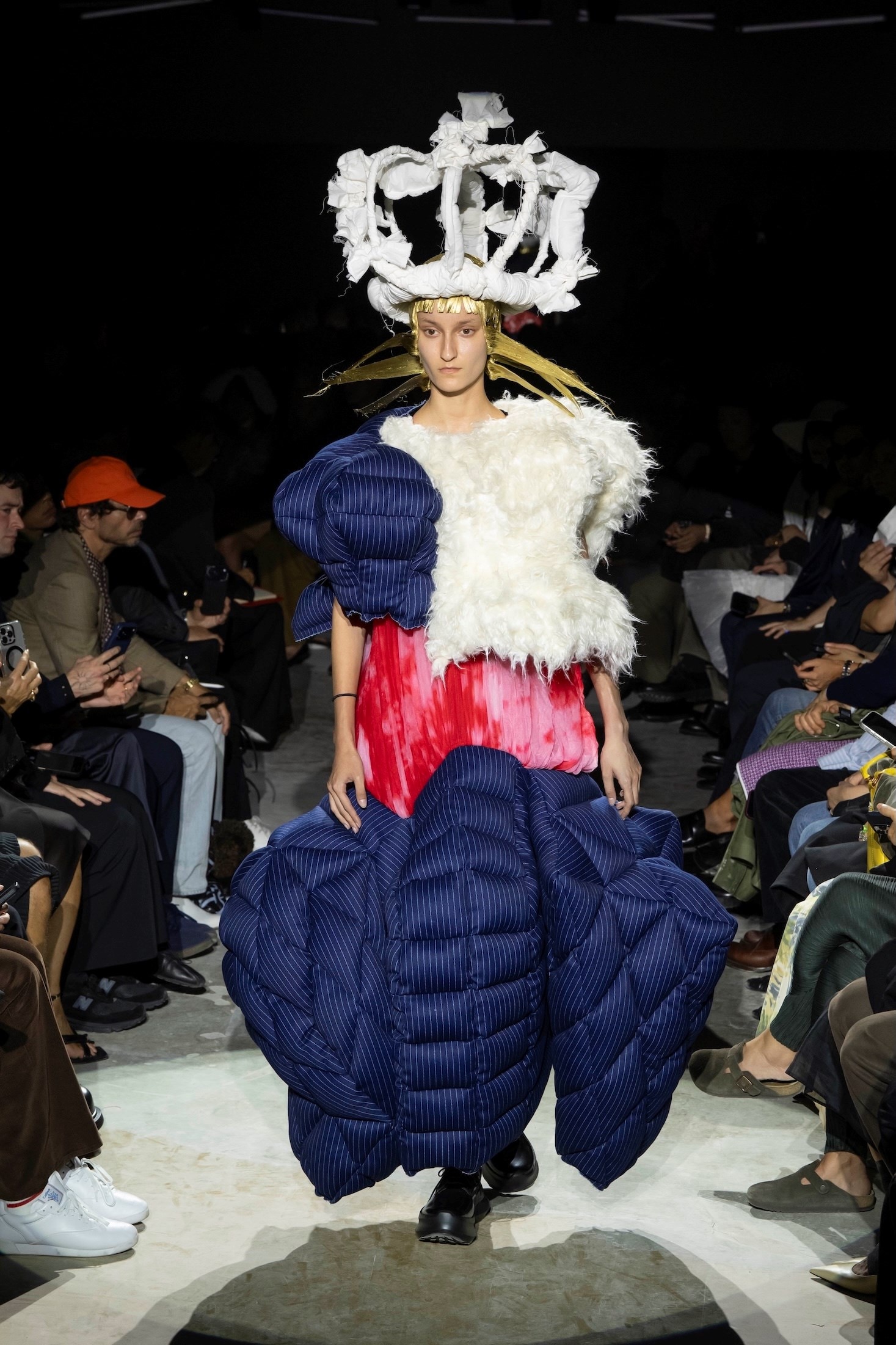
“When royal life and everyday life become one” was the big idea behind Rei Kawakubo’s Spring/Summer 2027 Comme des Garçons show. And although Kawakubo pushed it to a zenith of extremes, with globular clothes stuffed with wadding that transformed the models into abstract Rabelaisian, almost Henry VIII-like figures – each topped with a pinchbeck crown – there was something relatable there. Hear me out: think about the K-shaped economy, of rich people getting ever-richer, and the kind of gratuitous parades of grandeur and wealth that have become standard fare for celebrity weddings or birthday parties. They have all the pomp and circumstance of royal processions of the past, not archaic fairy tales but real life happenings. Royal life and everyday life fused, although mostly just observed through the windowpane of the Internet by us, the great unwashed.


Maybe Kawakubo was thinking about that. She didn’t expand on her notion bar that concise opening salvo, which gives no indication if she was interrogating these everyday happenings with a critical eye, or indeed was fantasising about something impossible. Certainly, her clothes often had all the trappings of royalty, with tassels and bullion fringe and rich feathers and furs – trappings of wealth, or maybe the animal kingdom? The show’s soundtrack was filled with clicks and trills and bestial calls of the wild as these beastly, bubonic clothes passed by. But sometimes the fringe was heavy and red, oozing from gashed fabrics like blood from a wound – a heroic king cut down in his prime? Or indeed one on a tumbril, in a country poised to become a republic – we were in Paris, after all. Namely, it seemed to be saying, you may wish for the life of a princess, but it’s not always all it’s cracked up to be. Even the crowns looked like spit-and-tissue imitations of imperial originals.


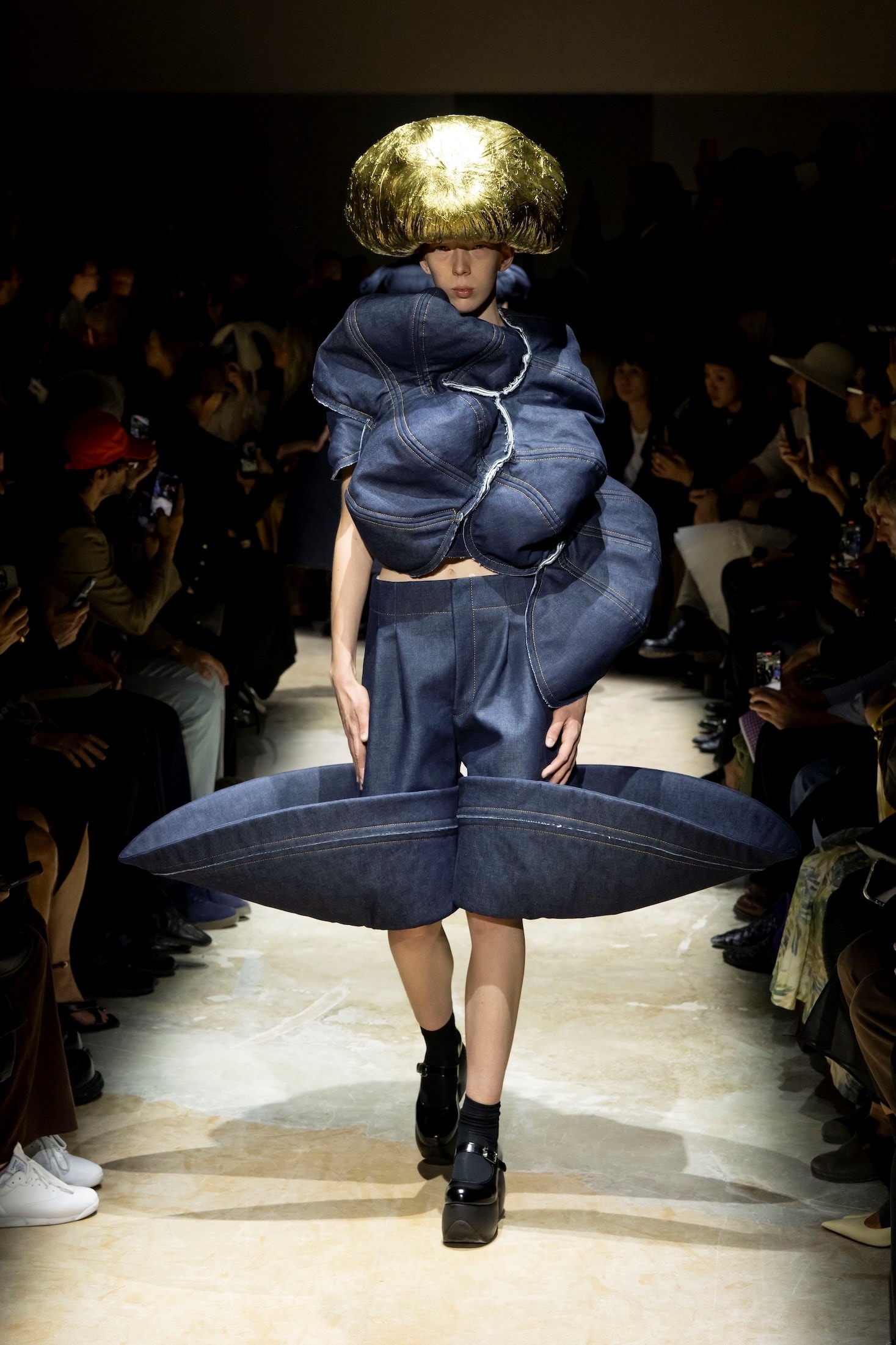
Supposition and hypothesising aside, the everyday thing was clear. The main fabric of this show was denim – a textile probably worn by more people in this (and any other) fashion show’s audience than any other. Its ubiquity is its draw. It is a material Kawakubo must have used previously – even a scrap or two, in one of the vast sculptural textile forms that have formed the majority of her shows for the past decade or so – yet it has never formed a major section of any show I can recall. Denim is an odd and intriguing fabric: it’s technically serge de Nîmes, named after the city that invented it, a hardy tightly-woven cotton twill which, in the 19th century, became synonymous with the attire of working men in the New World before, of course, becoming allied with subversion in the middle of the 20th century, with rebels without a cause or the sly, dangerous sexuality of a nip-waisted Marilyn Monroe.


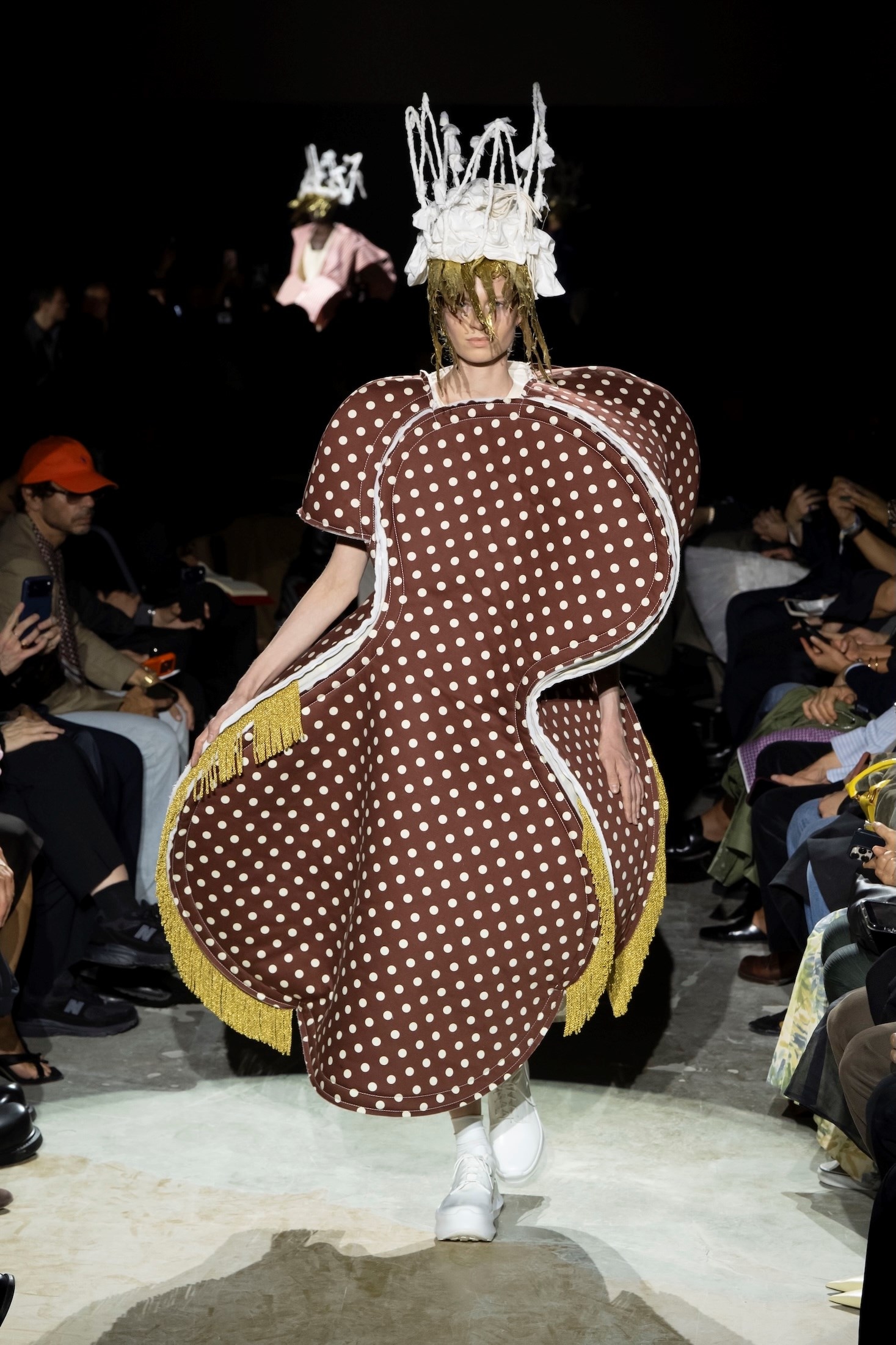
Kawakubo has always considered herself a punk, so denim fits. At the start, she cut it into her bulbous, experimental shapes that question the boundaries of the body and their meanings – Monroe’s curves have nothing on Kawakubo’s. But nothing could prepare you for the shock of the quartet of looks she closed with: four pairs of jeans. Granted, they were blown up, exaggerated beyond recognition, one with bucket cuffs like feeding troughs, another curving into Versailles-defying panniers. Yet, indigo-blue and yellow topstitched, they were immediately recognisable. A few days later, the Comme des Garçons showroom was full of smaller-scale yet equally fabulous examples.


Rei Kawakubo turns 84 next week. Yet she is still shocking and confounding, alarming and upending our expectations. Who ever thought we’d see Comme des Garçons denim?