
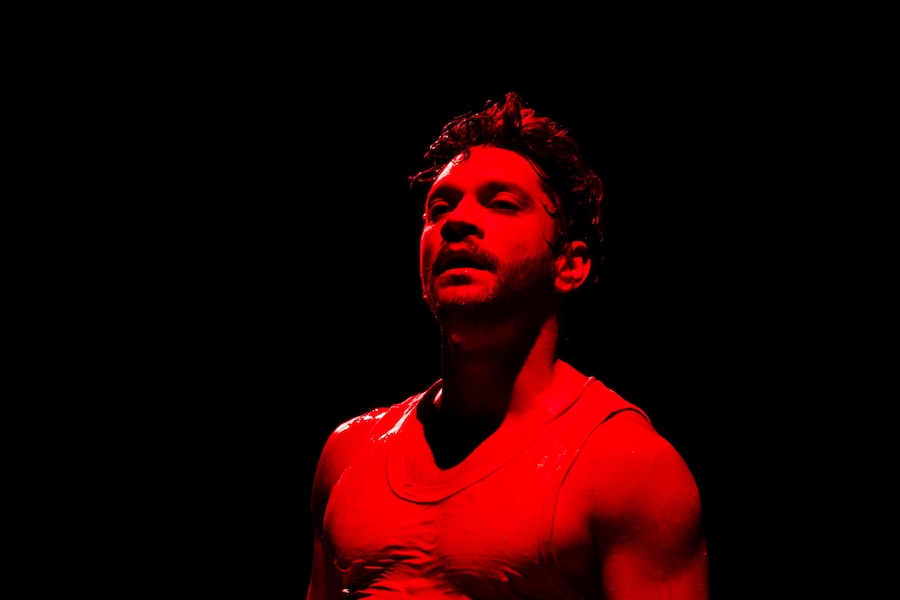
Armando Babaioff spent three and a half years fighting to stage Tom na Fazenda. Now, the Brazilian actor brings his visceral adaptation of Michel Marc Bouchard’s queer thriller to the Barbican
In the preface to his play Tom at the Farm, the playwright Michel Marc Bouchard writes: “Homosexuals learn to lie before they learn to love.” The play was first performed in 2011 and quickly adapted for the screen by Xavier Dolan in 2013. Around the same time, Brazilian actor Armando Babaioff was recommended the play by a friend. As he recalls it now, more than a decade later, in reading that line he suddenly “made sense of [his] existence”.

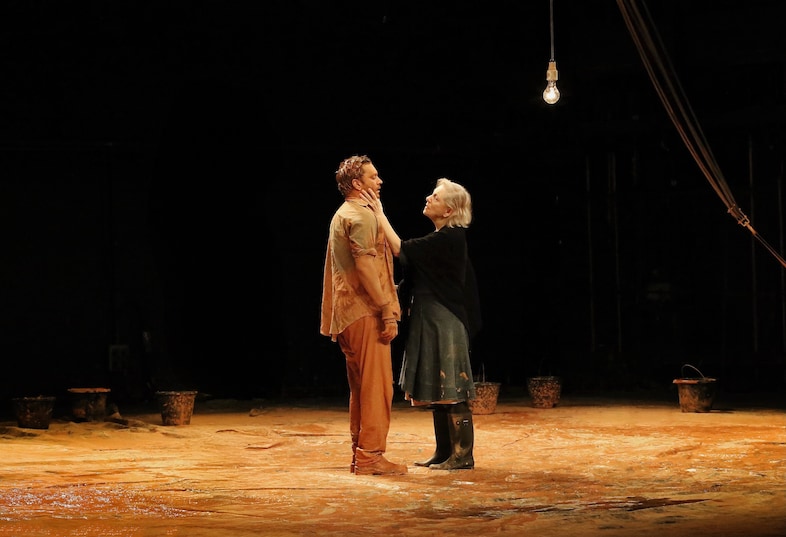
An established theatre actor in Brazil, Babaioff had the means to gather a creative team around him and reimagine Bouchard’s play almost entirely. The original is set in rural Quebec and follows Tom, a young gay man who travels from the city to attend the funeral of his lover, Guillaume. But when he arrives, he discovers that Guillaume’s mother knows nothing about him or about her son’s homosexuality. What follows is a tense power struggle between Tom and Guillaume’s older brother, who knows the truth about his brother’s life and is determined to protect their mother from it.
In Babaioff’s version, the play is renamed Tom na Fazenda, the action is relocated to rural Brazil and is performed entirely in Portuguese. There is no set. Instead, the actors perform on an otherwise bare stage, atop a tarpaulin caked in the dried mud of the farm. The text itself remains unchanged. It is a radical reimagining of Bouchard’s work, but one that leaves the actors with nowhere to hide. For two hours, without an interval or microphones, they are exposed to the full physical demands of the performance. “It’s like CrossFit in the mud,” Babaioff jokes.
In conversation, Babaioff is almost radically earnest. He speaks about Tom na Fazenda in the way religious devotees might speak about the Bible, or hench dudes about protein. It was a hard-won battle. Three and a half years passed between the day Babaioff first read the play and opening night. “This is how hard it is for us to do theatre [in Brazil],” he says. People were excited by his adaptation, but the money never came. Its queer themes were considered too difficult, or simply too risky, by theatremakers and potential sponsors alike. This was Brazil in the 2010s, a country undergoing an increasingly pronounced political shift to the right. For those early performances, much of the funding for Tom na Fazenda came from Babaioff himself.

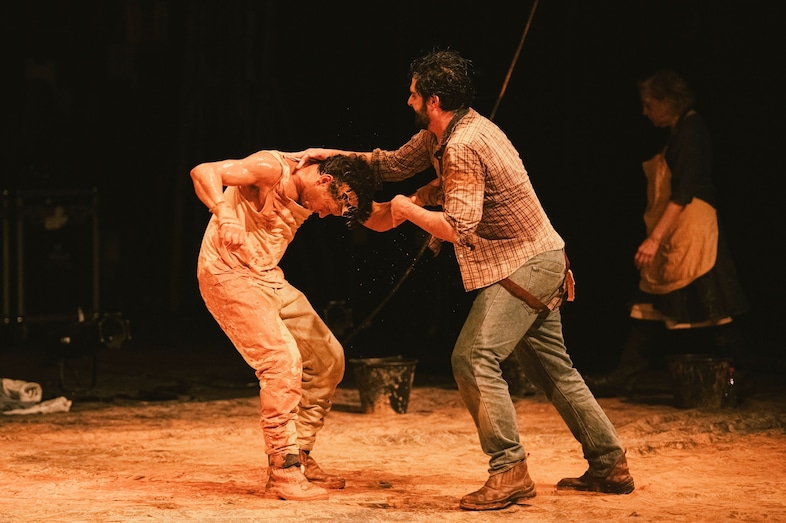
As Babaioff brings Tom na Fazenda to the Barbican this October for its London premiere, he carries with him the muscle memory of more than 600 performances. Despite those initial apprehensions, the play became an instant sell-out when it premiered in 2017. By happy accident, its pared-back scenography made it easy to pack up and transport, which gave Babaioff an idea: to turn it into a travelling play, capable of being performed anywhere with a stage large enough to accommodate its four characters. Babaioff puts it succinctly – “All we need is symbolism and metaphor.”
The worldwide success of Tom na Fazenda is, for Babaioff, a message to be sent back home to Brazil. “It’s been very difficult to convince the government, and even other Brazilian artists, why I am doing this,” he says. “We are at the end of the world. The theatres and the churches are the last places where humanity can see how other people live.” He talks about the death of the traditional cinema experience in Brazil, where cinemas have increasingly retreated into shopping malls, in contrast to the continued cultural presence of municipal theatres and opera houses. For Babaioff, theatre remains one of the few places where people from across society can come together and encounter lives different from their own.
Bringing the play on the road and performing it around the world is a way of showing the world Brazilian theatre, he says: “The rest of the world doesn't know anything about us. The world doesn’t know our theatre. The world doesn’t know what we did with Shakespeare. I think it’s a great opportunity to share with the people that Brazilian theatre is powerful. It’s full of our problems, full of our experience. It’s full of violence, full of pain, full of anger.”


As we finish our conversation, Babaioff recalls a moment when he performed the play in Belém, in northern Brazil. Before a performance, he met two young boys standing outside the theatre. They were selling sweets to raise money to compete in a taekwondo tournament. Babaioff asked if they had ever been inside the theatre they were standing outside. When they replied that they had not, he made sure they had seats for that evening’s performance. Afterwards, he found them again outside, jumping in the air and proclaiming that the play had been “better than Netflix!”
A few weeks later, Babaioff received a letter from the mother of one of the boys, thanking him for the play. Seeing it had given her, for the first time, a way to talk to her son about her own sexuality and to speak openly about her queerness. “Every bit of money I make in my acting, I put it back into the play,” he tells me. “Because it is my mission. All of us on that stage, we share the same motivation. By keeping this work alive, I am keeping myself alive.”
Tom at the Farm (Tom na Fazenda) opens on 13 October at the Barbican Theatre, running until October 17