We spoke to the renowned London-based painter in Texas, on the eve of her show at Ballroom Marfa – a rare public performance of her perverted pop music
I’m deep in West Texas, outside a makeshift-looking structure once used as a marketplace for cattle. You can see Mexico from here, south of the Rio Grande. The mountains in the distance look blue against the apricot sky, the sun is on its descent and the shadows lengthen as trucks and cars congregate in the adjoining field. Despite the flow of margaritas, it’s not a rowdy crowd – the atmosphere is buoyantly good-willed. It doesn’t look like it’s going to be a very eventful night for the one policeman stationed at the door. “Any trouble?” I ask him. “All quiet so far, ma’am,” he assures me, with solemn gallantry.
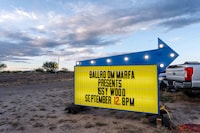



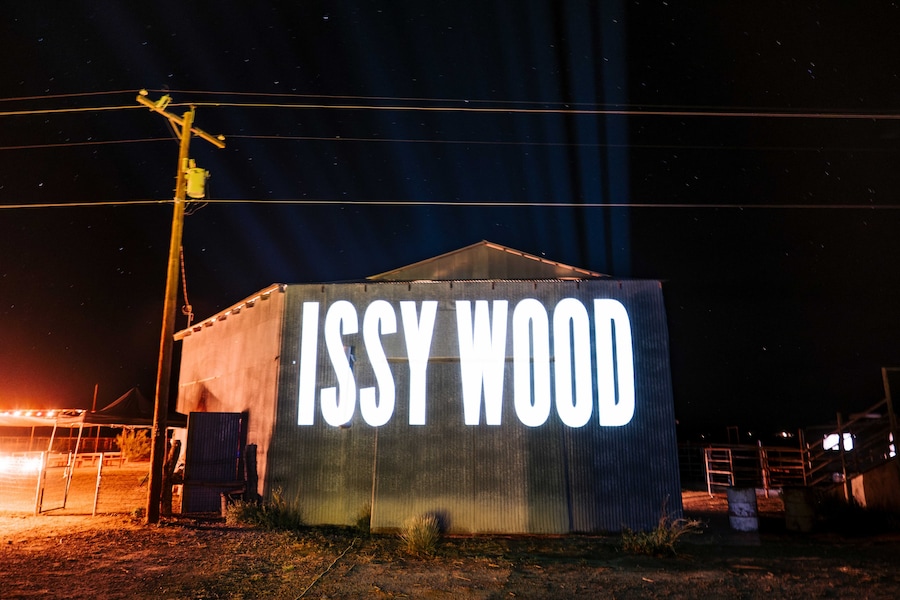
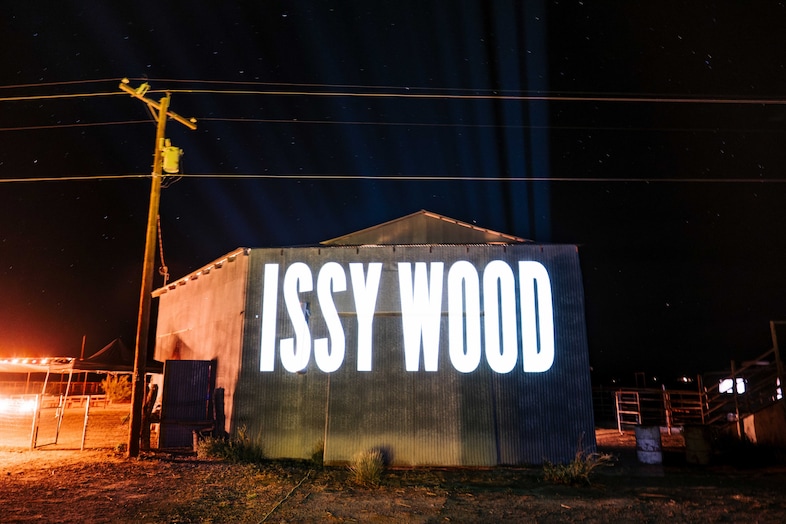
As the light continues to wane, a name projected onto the venue’s corrugated iron facade becomes more visible: Issy Wood. You’ve surely seen Wood’s paintings in one of the many institutions to have acquired her beguiling works of unsettling realism for their permanent collections … Tate, the Louisiana Museum of Modern Art, the Whitney, the Metropolitan Museum of Art, to name a few. A former livestock auction place in the Lone Star State might seem an incongruous destination to encounter this art world darling, but this isn’t any old dot on the map – this is Marfa, the remote desert town visionary artist Donald Judd began transforming into an oasis of dazzling contemporary art in 1971. It’s home to Judd’s Chinati Foundation, the Judd Foundation, and Elmgreen & Dragset's famous Prada Marfa on Route 90, an oft-photographed permanent installation, which appears to be an improbable luxury store in the desert. And it’s not just a random former agricultural building either – this is the Bull Room, recently acquired and renovated by Ballroom Marfa as an extension of their ambitious cultural programming.
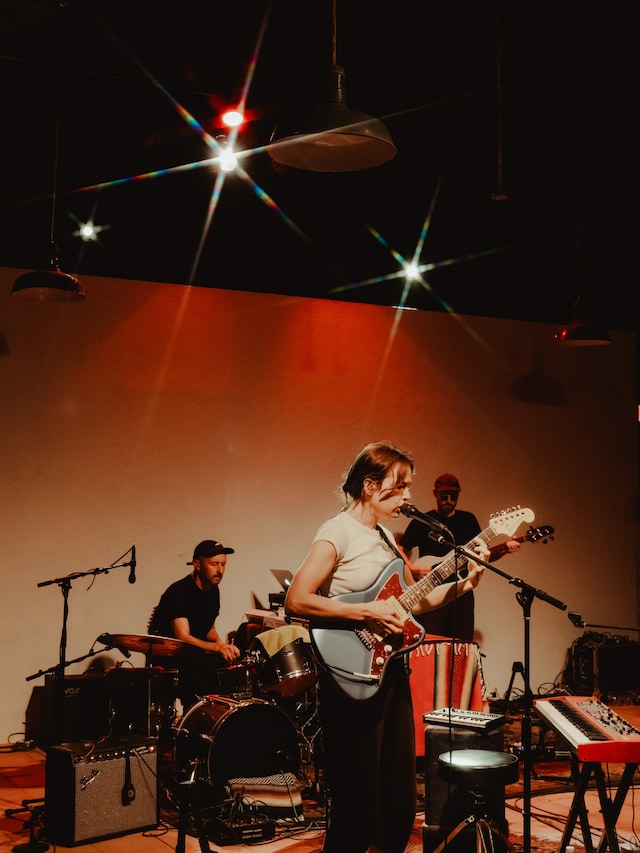
On this occasion, the American-born, London-based artist isn’t showing her paintings; she’s here to sing. This is only the fifth performance of her experimental, dreamy pop, with its irresistible hooks and trenchant, confessional lyrics. She’s been writing, recording and producing her own music at home since 2018, initially at her kitchen table and now in her own “upgraded” basement studio set-up; inconspicuously releasing a stream of EPs, singles and two full-length albums online without seeking fanfare – no campaign, announcements or album launches (My Body Your Choice in 2022 and Accidental America in 2024). Now she’s bringing her live show to Marfa with the help of her multi-instrumentalist band and a trio of vivacious backing singers from Nashville.

“I made all of that music myself, but it can’t be played alone, really, at least not the way that I want it to be played. So I have my band, my two boys, who are both technically proficient, way more than me,” she told me when we met to talk the previous day, at the home of Fairfax Dorn, one of Ballroom’s founders. Translating the processed elements of her sound (“sounds that, as a human, you shouldn’t be able to make with a bass or a guitar”) in a live setting has forced the artist to relinquish a large degree of auteurship, and it’s not a comfortable experience. “I try to design my music-making work to be as close to painting as possible, which is I don't want to outsource any part of that process. I want to do it all myself, and to only blame myself if something goes wrong.”
So far here in Texas, something has already threatened to go wrong. She’s encountered a potential problem that’s certainly beyond her control – if anything, it’s an act of God. Despite the relentless, brutal dry heat, we’ve been caught off guard by a few brief but intense rainstorms. “We had our first day of rehearsal and the rain became so loud on the roof you can’t hear any of the music, so you just have to stop,” she says. “I could spend the next 24 hours panicking about the fact that it might rain tomorrow evening. That’s my worst habit – worrying about the weather. What could be more useless than that?”
“That’s my worst habit – worrying about the weather. What could be more useless than that?” – Issy Wood
The subject of struggling to relinquish control in different areas of her life recurs throughout our conversation. It’s a guiding principle. “I go to these 12-step meetings and we read from a sheet of affirmations. One of them is ‘I embrace change effortlessly’, and I can’t think of anything further off than that for me – for my type of brain – but I’m intent on reaching that truth; to be a more flexible person in my work and also in my personal life,” she says. “I’m getting there. But it takes so long, it’s years-long work.”
For several months as a teenager, Wood was institutionalised in a residential children’s psychiatric ward. “I had anorexia and then it morphed into bulimia. I was intent on dying,” she tells me. “That’s where I got my exams to at least be able to go and do my foundation and make it to art school.” In a very real sense, art school saved Wood’s life. “It was where I had my first boyfriend and my first actual group of friends who I spent time with. I hadn’t experienced that before,” she recalls. “It’s also the place I discovered I wanted to paint every single day of my life from then on. So my world went from the square footage of a bedroom to suddenly, well, at least the whole of London. It was extraordinary.”

I suggest another term for relinquishing control is self-acceptance. She agrees. “Yes, being happy in my body, or at least neutral. I heard accepting your body shape described as understanding you’re a pug rather than wanting to be a chihuahua. You can’t starve yourself into being a greyhound; you can’t get plastic surgery. I mean, you can, but I already know it’s not going to solve anything for me. So I’m trying to resist making any moves out of insecurity or fear – it’s the same with my career. I’m not rushing into anything.”
Like her self-portraiture (due to be the subject of an exhibition at the National Portrait Gallery), in which she resists the instinct of self-flattery (“I have to remind myself, ‘This isn’t a fucking dating app. You are meant to be chronicling your actual face through time.’”), her conversation is disarmingly frank. Similarly, her lyrics are unsparing – archly funny and self-critical, but wholly relatable, as if she is launching her most excruciatingly honest diary entries to music. “It’s so tiring watching my most personal, private feelings be, like, transposed onto real men with their instruments. It’s bizarre,” she says. “And in some ways, that is incredibly uncomfortable because it’s so fucking far away from London. It is a whole trip.”
“I discovered I wanted to paint every single day of my life from then on. So my world went from the square footage of a bedroom to suddenly, well, at least the whole of London. It was extraordinary” – Issy Wood
I wonder if painting is more comfortable for her because she’s autonomous and godlike in her studio; it’s a place she can retain ultimate control, and the only place she never “acted out” with food or substances. “It was always this zone where I wouldn’t entertain a certain line of thinking. I just wouldn’t indulge it in the studio, and that’s always been true, no matter how much of a mess I’ve been outside of my studio.”
While the studio is a zone of safety, the processes of painting and making music still allow space for surprises. “It feels like there are still things that are out of my control,” she reflects. “And thank God, because that’s a crucial part of why it remains interesting. I can somehow tolerate the bit of surrender necessary to be an artist. I guess through practice I’ve learned how to be completely OK with that.”
I’m reminded of something the artist Frank Auerbach said: “Painting is mysterious and I don’t want it demystified.” Does that resonate with Wood? “Yeah, painting still feels magic in that way. I believe in God more and more as I get older – it’s a very strange thing I didn’t expect to happen. But I do feel there’s a three-way business call between me and the painting and God,” she frowns. “I feel like I’m gonna regret having said that because that probably doesn’t make any sense. But, when you’re an addict, you can no longer trust certain parts of your decision-making, and painting is like 2,000 tiny decisions. Sometimes, I just get the sense that some of those decisions are being made for me by someone else or something else.”

Now, at 33, she is starting to find being alive – a reality her teenage self didn’t envisage for her future – slightly easier. “I’m only just loosening up. It feels like having gone around with my fists clenched and my trapezius muscles up to my ears for years and years; finding things so unbearable, even as I watch this dream life happen around me. It’s like something in my body that needs to be let go, and the only way out is through, so I keep challenging myself.”
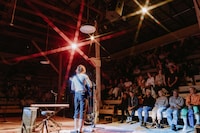
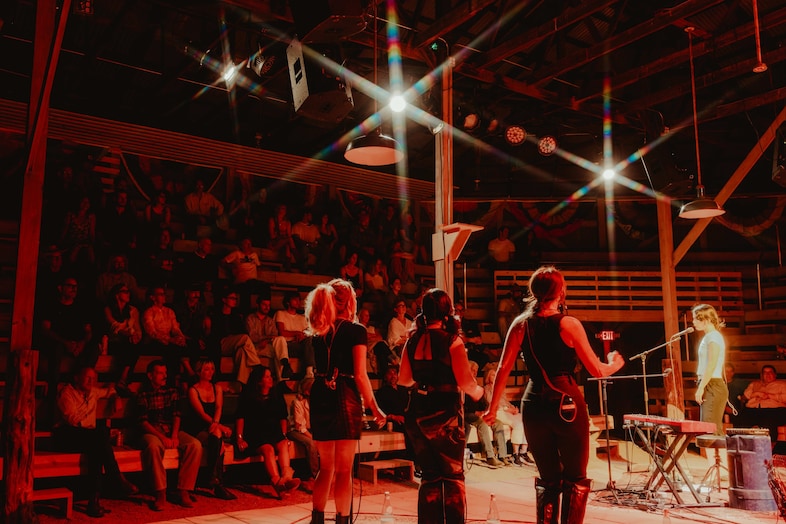
Here in the desert, so far removed from the safety of her studio, translating the confessional, intimate songs she made in her London home into a live performance, collaborating and relying on other people, is a bold act of commitment towards relinquishing control. Back in the Bull Room on the night of the show, people are filing inside and gathering on the bleacher-style seats. I don’t know how many people out here already know and love Wood’s music, but there is a strong feeling that the crowd good-naturedly trust Ballroom’s impeccable programming and everyone is eager and poised to be delighted by her.
“I’m only just loosening up. It feels like having gone around with my fists clenched and my trapezius muscles up to my ears for years and years; finding things so unbearable, even as I watch this dream life happen around me” – Issy Wood
She performs the opening two songs solo. The first, IHS, begins with the lines, “Honey, I don’t know what to say, I think I hate sex. There’s something about it I worry that I just don’t get”, while God in an Emergency (Skit) appeals directly to a disinterested God to assess what “went wrong” creating her and offers him the receipts to prove she’s defective. On stage, Wood is a compelling clash of contradictions. Her stage presence is diffident, yet self-possessed and there’s such courage in the sardonic honesty of her lyrics. Her songs are pathologically, irresistibly catchy on an almost cellular level (writing this, over a week after the event, I still have a montage of her music going round my head, notably the tracks Monica Lewinsky and I’ll Hold).
Wood’s trusted band join her for the rest of the show, along with a trio of impassioned Nashville backing singers. I notice a group of young women sitting high in the bleachers who know every single word of every song, they’re mouthing along. Wood’s unwilling to commit to playing lots of shows because she doesn’t want to stop painting for very long, but I recall something I heard her manager say earlier that day: “If Issy were to go on tour, she would become a huge star,” and, as I sit here in the Bull Room as the Texas night draws in, 5,000 miles from the comfort zone of her studio in east London, I am certain this is true. Needless to say, it didn’t rain.
Visit Ballroom Marfa’s website and Instagram for more information about their upcoming events.