
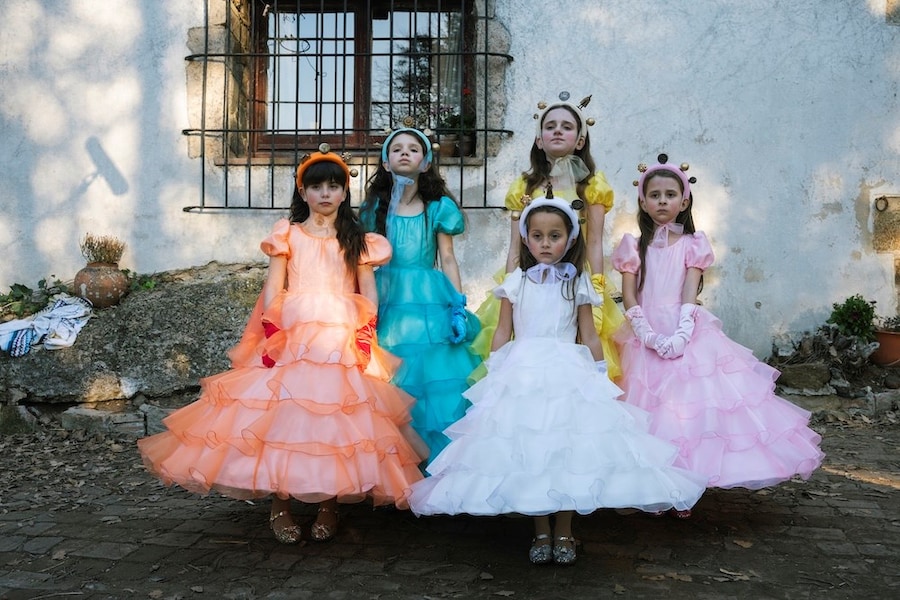
Director duo Javier Ambrossi and Javier Calvo discuss La Mesías, their wild new series blending drama, black comedy, horror – and a sinister girl-group band dubbed “Christ’s Teletubbies”
In today’s streaming landscape, where content has become fodder and no IP ever really dies, true originality is hard to come by. But Spanish thriller La Mesías – a genre-hopping opus from Javier Ambrossi and Javier Calvo, known collectively as “Los Javis” – is audacious enough to stand out. Made a few years before the pair’s upcoming queer triptych La Bola Negra, which bagged them a joint best director prize at this year’s Cannes Film Festival, La Mesías is a sprawling, haunting series that jumps back and forth from the 80s to the present day. Over seven incendiary episodes, Los Javis blend elements of family drama, magical realism, unbearable tragedy, pitch-black humour and supernatural horror. Along the way, there are hints of incest, cameos from Almodóvar icons Cecilia Roth and Rossy de Palma, and spooky music videos made by a catatonic girlband who are dubbed “Christ’s Teletubbies”. In Spain, La Mesías won even more awards than Los Javis’ previous series, Veneno, a flashy but empathetic portrait of trans icon Cristina Ortiz Rodríguez.
La Mesías begins with camera technician Enric (Roger Casamajor) wetting himself in a hotel bar when he sees a TV news story about a Christian group who are huge on YouTube. They are Stella Maris, a stilted and slightly unnerving viral sensation whose lineup comprises six sisters. Soon enough, we learn that they are, in fact, six of Enric’s sisters, who grew up in a creepy quasi-cult led by his domineering mother, Montserrat. Played at different ages by a trio of charismatic actresses – Ana Rujas, Lola Dueñas and Carmen Machi – Montserrat is a Machiavellian monster who believes she can speak directly to God. When La Mesías premiered in Spain in 2023, Calvo says he was “ultra-surprised” by how many people approached him to say: “That was my mother. She was a narcissist.”
Three years on, La Mesías has been acquired by MUBI, which is now streaming it exclusively in several countries including the UK. While overdue, the wider release is well timed to capitalise on the global buzz surrounding La Bola Negra, a melodramatic epic following the interconnected lives of three gay men from different generations. They may be busy promoting their Oscar-tipped film – which opens in Spain later this month, then in the UK in November – but Los Javis are happy to look back at their previous project. Speaking over Zoom from Madrid, Ambrossi notes with an incredulous smile that they managed to cast Glenn Close in La Bola Negra because she was such a fan of La Mesías. “You can see in this series how we were preparing for La Bola Negra. You can see us experimenting, daring to do things we haven’t done before, and really exploring pain,” Calvo adds. “But at the same time, in all the darkness and sadness that we portray, there’s always lightness and humour. I think that’s integral to our work.” Though Montserrat is a cruel oppressor who confines her daughters within the family compound, it’s still jarringly funny when she tries to describe Stella Maris’s sound: it’s “CEDM – Catholic electronic dance music”, apparently.
Calvo says La Mesías is fundamentally a story about “memory, family and trauma”. But it’s also, Ambrossi adds, a cautionary tale exploring “the dangers of dictatorship and being told what to do and how to think”. We meet Montserrat as a young and beautiful mother-of-two whose sexually liberated lifestyle is frowned upon by her family. Later, as she calcifies into a colder and controlling older woman, we see how she continues to damage Enric and his younger sister Irene, who is played as an adult by Macarena García. Though Montserrat is initially submissive towards her pious husband Pep (Albert Pla), who becomes Enric and Irene’s stepfather and sires their six half-sisters who form the family girlband, the matriarch eventually supersedes him as tormentor in chief. Her reign is briefly threatened by Pep’s sensible sister Rosa (Aixa Villagrán), who homeschools the girls, but when Rosa questions Montserrat’s authoritarian ways, she gets banished for good.
In the present-day portion of the narrative, we learn that Rosa, now played by Gracia Olayo, has left Christianity behind and is living happily with another woman. Though La Mesías has fewer LGBTQ+ characters than Veneno or La Bola Negra, Los Javis believe it is deeply rooted in their own queer perspective – Ambrossi and Calvo were once romantic as well as filmmaking partners. “The other day, a straight director said to me that his movie was queer because he had one lesbian character and I was like, ‘You’re wrong. That’s not a queer movie,’” Calvo says bullishly. “But this is a queer show because it has a queer spirit and a queer identity.” Nodding in agreement, Ambrosso picks up the thread. “It’s about something that we in the LGBTQ+ community all share: the need for freedom,” he says. “We’ve all been trapped at some point, like Montserrat’s family, and we’ve all been made to feel like the devil [because of our sexuality].” For Los Javis, this inherent queerness is another thread connecting La Mesías to La Bola Negra. “Because we gave three years of our life to writing and directing this series, we should probably hate it by now,” Calvo says with a laugh. “But we’re still so excited that La Bola Negra is going to help the world discover La Mesías. The first two episodes are super-dark, but we dare people to stay with it because the payoff, at the end, is really vital and full of joy.”
La Mesías is streaming on MUBI now.