

Self portrait 91, 2026, by Issy Wood, at Carlos/Ishikawa, not for sale [lead image]
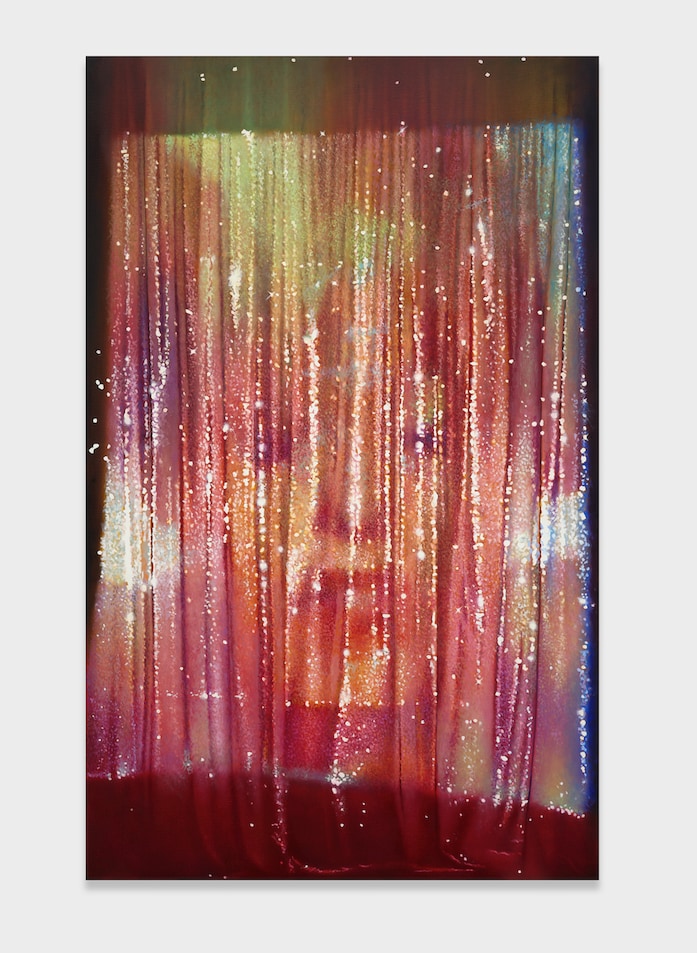
I haven’t yet fully worked out why I’m so drawn to Issy Wood’s paintings, but I am. I love their strange mix of irreverence and wit with grave, deep thought – I suppose you might call that sensibility camp, but the term doesn’t quite cover it. It might look frivolous, but she’s painting as if her life depends on it (because it does). Sometimes she paints surrealist compositions of faces, birds, clocks, and other objects freighted with symbolism. But I most love her photo-realistic paintings that seem like snaps from her iPhone camera roll – selfies, odd toys, clothes, food, car interiors, the kind of image deluge that's normalised in modern life. I covet this large-scale self-portrait of the artist in a sheet facemask. It perfectly embodies the contradictions that draw me to her work – it’s funny and light, but it’s also in dialogue with the weight of art history, like the punchline to a joke that’s taken centuries to tell. Words Emily Dinsdale

Cathexis, 2026, by Louise Giovanelli, at Grimm Gallery, £120,000 (Sold)
I didn’t get to this one in time – SOLD. But I’m not surprised. I love Manchester-based Louise Giovanelli’s oil paintings, which dance somehow between photo-realism (from afar) and impressionism (up close). Glossy, glittery and eerie, they’re endlessly compelling. Giovanelli looks at contemporary modes of worship; her painting of a blue-eyeshadowed Christina Ricci has the reverence and grace of a Renaissance madonna. Both challenging and fulfilling contemporary notions of allure – with the rich luminosity of a Dutch master – her works are irresistible. I can’t wait for In the Light of False Suns, her show at White Cube Mason’s Yard, next month. Words Sophie Bew


Domestic Tail, 2026, by Nicole Wermers, at Herald St, POA
Touching the art at Frieze will get you a slapped wrist from the gallerist, but this piece is just too tempting. Nicole Wermers makes strange sculptural assemblages that bring together fashion, furniture, architecture and consumer culture with a sense of the absurd. Domestic Tail is a 19-metre purple faux-fur animal tail wound around an industrial hose reel, its luxurious appendage spilling across the floor. Like almost all art at Frieze it’s pretty impractical, but I think it would look glorious next to my sofa, perhaps for a cuddle. My landlord doesn’t allow pets so this will have to do. Words George Pistachio


Altich, 1974–2020, by Miriam Cahn, at Galerie Jocelyn Wolff, POA
I’d like this painting on my wall for a few reasons. Firstly, it’s like holding up a mirror to my soul. Secondly, I feel the sensation of her rubbing her naked feet together viscerally and it’s a feeling like no other. And finally, and more seriously, whilst Miriam Cahn is really only working in shades of red and blue in this painting (which is part of an installation of 24 works), there is so much depth and variety to the colour. I’m drawn in by the blues and in looking at the painting I find myself moving through multiple states of emotions as I try to figure out how the woman in this painting is feeling – I feel at once existential, vulnerable, unable to sleep, comfortable, safe, tired, concerned that her duvet might have fallen over the side and that she might be cold. Words Rose Dodd


A Still Life with a Herring, Cheese and other Comestibles on a Table, by Jacob van Hulsdonck (1582-1647), at Johnny Van Haeften, £850,000
I simply cannot resist a still life – though admittedly 99 per cent of my collection exists only in a folder on my desktop. Nature morte – dead nature – is such a joyful paradox: immortalising organic matter in a transient state of fecundity, lacquering it and then placing it on the wall. This one by Jacob van Hulsdonck – an excellent example from Flemish Baroque – really called to me from across the room at Frieze Masters, with its weird and wonderful collection of “comestibles”. Unlike the more elaborate banquet scenes of his contemporaries in the early 17th century, this focuses on a few humbler ingredients. I love that huge tranche of cheese, the sprig of bay, the crudely filleted herring and those corrugated curls of butter. It’s always nice to have a bit of mystery on the table, too: does that silvery bark belong to a pumpkin? And are those salted plums in the dish in the middle? They’re so perfectly rendered you can almost taste their strangeness. Words Sophie Bew
 at the Perrotin Booth)

Exquisite Pain, 88 days ago, 1984–2003, by Sophie Calle, at Perrotin Gallery, POA
In the aftermath of a breakup, French conceptual artist Sophie Calle took a trip to New Delhi (the same journey she’d planned with her boyfriend before he left her). Heartbroken, she asked people she met along the way to share their most painful memories. This series of photographs and texts she called Exquisite Pain. Calle is an amazing storyteller. She spins stories from her real life by embarking on adventures and making artworks of her experiences. Everything can be poetic, romantic, glamorous and even funny. I’d love to live with some of her art to remind me to be brave and to do the same in my own way, whenever I can. Words Emily Dinsdale


Maggi the Magi, 2026, by Sarah Lucas, at Contemporary Fine Arts, £65,000
This is Maggi the Magi by longtime smoker Sarah Lucas – a portrait of her friend, the British artist and fellow longtime smoker Maggi Hambling, fashioned entirely from cigarettes on brown paper. I’m fond of those unruly curls, the expressive face and the rather dapper bow tie, all rendered in fags. “There were moments when I was making the cigarette portrait where I just felt so close to what you were like,” Lucas said of this one. I, for one, also feel seen. When I waft into the AnOther Magazine offices each morning, I wonder if this is how my colleagues see me. Words George Pistachio
)

Bangers, 2021 (massager, artificial plant), by Rachel Youn, at Sargent’s Daughters, $8,000
For me, Frieze London is not complete without a hysterical, wobbling sculpture. They seem to encapsulate the somewhat frenzied, though delightful, ridiculousness of the fair and always stop me in my tracks. (I still refer to a video I took at Frieze 2017 of Paul Chan’s Pillowsophia [After Trinity] – of a goofy dancing windsock in the ominous shape of a black hoodie.) Rachel Youn’s has extra appeal. Reanimating retired massage equipment, with the addition of frilly, exotic flowers, Youn’s gyrating orchids and dancing ferns are both strangely erotic and coldly mechanical, reminiscent of the stock-image decor of a highstreet spa. Both an allegory for AI and devices that imitate human connection and a jolly addition to my orangery, where I’ll obviously keep these, they’re joyous. Words Sophie Bew


Socks, 2026, by Gideon Rubin, at Anat Ebgi, $25,000
Someone came up to me at the fair and asked what themes and undertones I’d noticed. I said I’d seen a lot of bright, optimistic colour palettes which felt reflective of hope in a time of uncertainty and unrest. Irrelevant here, but the point is, there seems to be a theme and undertone to my own preference in art this year: feet, comfort. I like Gideon Rubin’s painting generally – his brush strokes, his use of colour and expression of material and texture, but what I like most about this painting is her stripey socks. I’d like a pair of my own. Words Rose Dodd


Survival: Protect me … , 2018, by Jenny Holzer, Kukje Gallery, $900,000
Jenny Holzer uses the slick apparatus of advertising to propagate empowering and provocative statements of truth – her own potent, positive propaganda. For many years, I’ve lived with her words like a series of mantras in my head (“abuse of power comes as no surprise”, “I’ve been saving while you’ve been spending”, “your oldest fears are your worst ones”, “expiring for love is beautiful but stupid”) and felt emboldened by them. I fell in love with this dark, slightly funereal-looking labradorite bench engraved with her immortal line, “Protect me from what I want.” It’s a beautiful, meaningful object, but it also offers respite and support (quite literally – when I was at the fair, I saw two tired ladies take a seat on it, only to be shooed away by a panicked gallery assistant). Words Emily Dinsdale


Garniture mounted in gilt bronze with a two-branch candelabrum and a pair of miniature swans (c 1745–50), by JJ Kändler, at Trias Art Experts, €32,000
Among the great paintings and museum-worthy antiquities at Frieze Masters, I found myself completely seduced by three little swans. At the stand of Munich-based Trias Art Experts sat this gloriously extravagant 18th-century candelabrum, its porcelain birds modelled by Johann Joachim Kändler for the celebrated Meissen manufactory around 1747. The swans were later united with gilded bronze scrollwork and delicate porcelain flowers in France. Such fanciful creations were all the rage in Louis XV’s France where luxury dealers combined German porcelain with French metalwork to produce elaborate objects for the home. You can look into the eyes of these swans and see their darling expressions – they know they’re terribly expensive. Words George Pistachio


Deltang, 2023, by Sheida Soleimani, at Edel Assanti, $5,500 (excl. tax)
Everywhere you look here you get lost, there’s so many layers to this print. It’s two-dimensional but feels three. The rearview mirror feels symbolic of looking backwards, reflecting on a moment in time, a person, a history, a memory. The partial face we see in front of the verdant green is the artist Sheida Soleimani’s mother. The scorpions are kind of weird – I like them, there’s something industrial about their shadow. I firmly believe this would be a great addition to my ever-growing phantom collection. $5,500. Excluding tax. Sold, to the editorial assistant, in all black. Pleasure doing business with you. Words Rose Dodd