
The Chilean artist’s new exhibition at Whitechapel Gallery, titled Living Threads, untangles six decades of art, activism and radical resistance
For more than half a century, Cecilia Vicuña has confronted the patriarchal, Western-centric systems that have led to our current climate crisis. The Chilean artist has an ongoing series of ‘quipus’: dyed wool sculptures that use intricate knotted patterns informed by the non-alphabetic communication system used in Andean culture. She is also a highly respected poet, writing over a dozen books and frequently using spoken or written language as a partner to her visual work. Now, Whitechapel Gallery is showing Living Threads, bringing together Vicuña’s installation, video, painting, poetry and activism.


“I decided I will work with this imposed colonial material [oil paint], but I will subvert it” – Cecilia Vicuña
When she moved to London in the early 1970s, Vicuña was shocked by the reality of a city she had known so poetically through film and literature. “There was a difference between fantasy and reality,” she smiles. “I had seen Blow Up, by Michelangelo Antonioni. There are amazing aesthetics in the film, and of course it was also the time of girls like Twiggy and Mary Boone … you had the idea that London was an amazing place. I landed and saw the suffering of the people. I saw it was a facade, where all the houses looked really nice but inside was like a tenement.”
Moving to London on a scholarship to study at the Slade, Vicuña didn’t know anyone, and was housed in an arts council building in Stepney Green. She found every door closed, in stark contrast with Chile, where artists shared tea and coffee in a communal atmosphere. “The cultural difference was immense.” Then in 1973, life in Chile was violently dismantled by General Augusto Pinochet’s military coup. She describes learning of horrific brutality through UK news, of friends raped, tortured and disappeared.
“It was like the end of the world. It was a level of violence we could never have dreamed of. It’s like something in me died, like it died in so many people. We had to find the strength to go on and act in solidarity.” England, at the time governed by the Conservative Party, tried to remove scholarship visas from Vicuña and many of her fellow Chilean students. She successfully fought to keep her place and went into exile, later moving to New York.
 Ladilla)
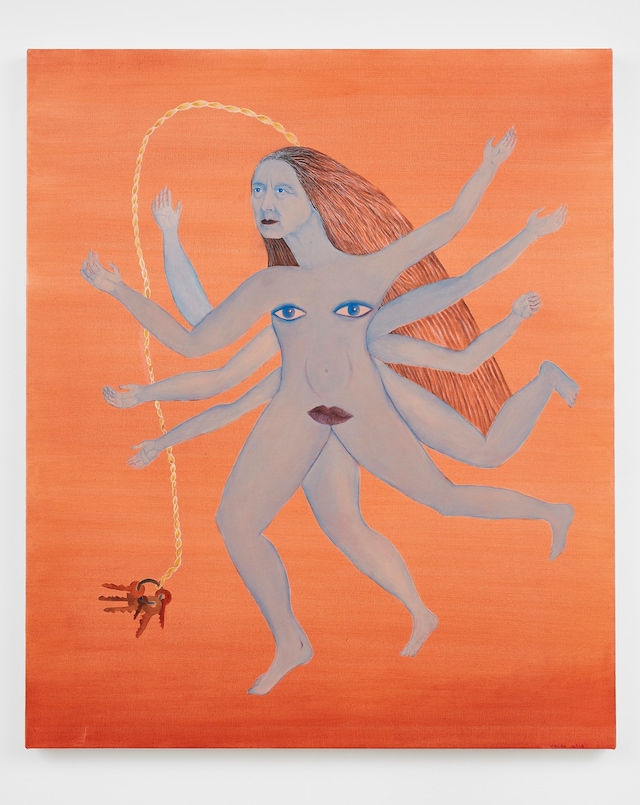
“My policy was to be a bad painter, in the spirit of going against what was perceived as good painting from the colonial perspective” – Cecilia Vicuña
Recreations of her early paintings are included in the exhibition. She started painting in 1969, following a visit to MoMA when one of her poetry books was published. She saw how much work was minimalist, white and male, and was struck by the contrast with a “so-called primitive painting” in the corner of the room. “It made me feel who I was. I decided I will work with this imposed colonial material [oil paint], but I will subvert it.” She was inspired by how indigenous artists altered the imposed religious imagery to create connections between Christian and indigenous ideas.
Her own works are robust and playful. Llaverito (Blue Lady) / Ladilla, Crab (1977/2019) shows a woman/crustacean hybrid. Drenched in bright orange, she clutches a set of keys, referencing Colombian and Chilean nicknames for women as both the keyholder of pleasure and nagging crabs. In this work, the woman is allowed to be multifaceted. Jaguar II (1978/2025) shows a muscular figure with combined human and big cat features, charging powerfully towards the viewer. Vicuña wanted to show the woman merging with a jaguar, becoming one. The work was inspired by seeing a jaguar kept in a hole deep in the forest, pacing like an imprisoned woman. The room is titled Pain Things, a reference to her own conflicted relationship with the medium.
Her Slade professor said her work was “ridiculous, irrelevant and backward. But I know a lot of art history, that’s why I paint the way I do. My policy was to be a bad painter, in the spirit of going against what was perceived as good painting from the colonial perspective.” Many of her original works were destroyed. It was only in 2013, when she was invited to show at England & Co in London, 35 years after she stopped, that she decided to reconstruct a painting.

Since the 1970s, her work has made powerful connections between the female body and the natural world. At the Whitechapel Gallery, her vivid, bloody Quipu Menstrual 1 (unknotted) (2006 / 2024) hangs in the first room. It is one of a number of works that see vast swathes of unspun wool hung from the ceiling, partly inspired by seeing menstrual blood on a pad when she was a teenager. The piece evolved from The Blood of Glaciers (2006) which saw the artist laying red wool threads at the foot of Chile’s straighted El Plomo Glacier.
When she began making work there was little mainstream discussion of the climate crisis, but warnings were already out there. “This message has been ignored since the 60s. Women scientists even in the 19th century were analysing that carbon emissions would cause the planet to heat up to such an extent that human civilisation would not be sustainable anymore.” She sees now that we are living with the consequences of denial, which become stronger as the evidence mounts. “We are headed to a level of destruction and pain that humanity has never endured. And we are going willingly that way.”
Her work calls for an ecofeminism rooted in community care; she is inspired by the matriarchal structures of indigenous communities across Africa, Southern America and Northern Europe. “When I first landed in London, there was a wave of feminism here that denied the body was connected to the earth,” she says. “What is needed is a sort of visionary feminism where women are really in charge because of their sensibility and way of being to care for the continuity of life. To re-orientate the culture towards caring and regeneration, instead of destruction.”


Now aged 78, she is enjoying the wisdom of her years. “I never perceived older women as passé,” she tells me. “I had profound admiration for my two grandmothers, my mother and my aunts. I knew being an old woman, if you had your art, you were whole. I was never afraid of age.” In 2017, she was part of Documenta 14, which she describes as being full of potent women in their 90s. “It was so magnificent to see the power and beauty of their work. I felt such pride being part of the elders. Now I’m really perceived like a grandmother, or an elder, and I think it’s the most delightful thing in the world.”
Living Threads is on at the Whitechapel Gallery exhibition is on until 14 February 2027