
Curated by Mark Sanders, Between Worlds at Kodl Contemporary in Prague explores the alchemy of clay through ideas of destruction and renewal
Between Worlds, a new exhibition at Kodl Contemporary in Prague, delves deep into the alchemy of clay, a material that begins as earth and, transformed by extreme heat, ends entirely elsewhere. It’s this obvious affinity with the alchemical that interested curator Mark Sanders most. Exploring how the history, symbolism and alchemy of ceramics all come to play off one another, the show brings together ceramicists whose work blurs the distinctions often made between conceptual art, craft and sculpture, including Carolein Smit, Bouke de Vries and the artist pair Bertozzi & Casoni.
When considering the connection between ceramics and alchemy, Sanders turned first to history. “Clay, and its ‘altered state’ as a ceramic, has always played an important role in artistic expression,” says Sanders. “This goes right from the first cave man or woman who modelled the Venus of Dolni Věstonice in Moravia in the Czech Republic 29,000 years ago, to Jeff Koons and his Baroque-inspired Michael Jackson and Bubbles from the late 1990s. Clay literally moulds the haptic presence of the artist into an incarnate ceramic form.” He notes the impact of Johann Friederich Böttger, an 18th-century alchemist who discovered the arcanum for porcelain. This fuelled the launch of the Meissen Factory, which drove ceramics production in Europe. Sanders notes that many contemporary artists also focus on this same “transformation of base matter into something marvellous”.
“The artists in Between Worlds employ seemingly grotesque imagery but as a way of confronting their and our collective shadow,” says Sanders. “As a medium, ceramics offer the perfect expression of this psychological process as transformation lies at the heart of its material composition.” Here, an introduction to the artists.

Bertozzi & Casoni
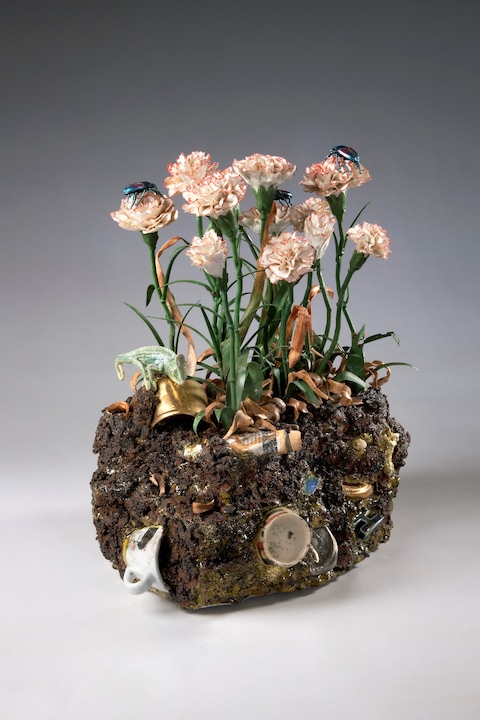
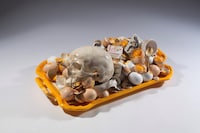
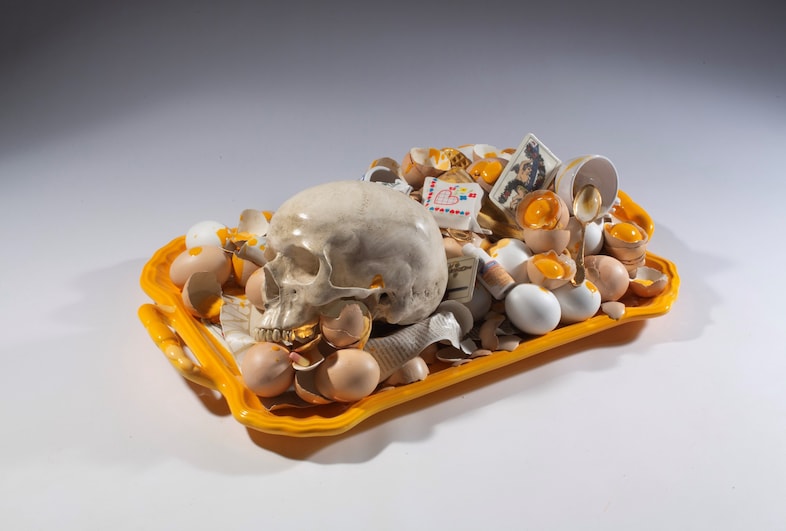
The Italian duo Giampaolo Bertozzi and Stefano Dal Monte Casoni began working together in 1980, creating mounds of items, often in polychrome majolica for a bold array of colours, that channelled the memento mori tradition. Vibrant flowers, skulls and broken eggs come together in their works as heaps of both life and death in one. The alchemical is explored through ideas of transience and renewal in their work, with waste seen as a symbol of human existence. They explore excess, which at times becomes overtly political; 2024’s Oracolo, for example, shows a turtle tangled in a mass of fishing nets. “They employ a trompe l’oeil aesthetic but with a very subversive edge,” says Sanders. “Their work often references ideas surrounding ‘destruction’ and ‘regeneration’ and as such they question the human condition and our relationship to the natural world.”

Carolein Smit
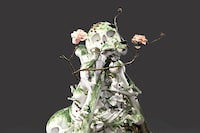
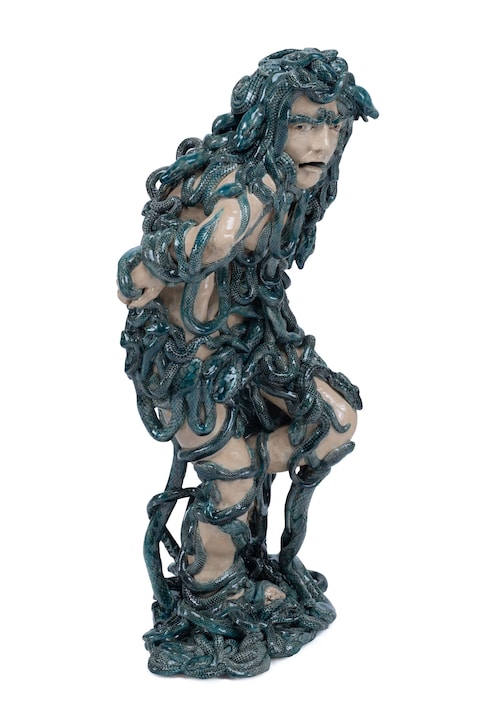
Dutch artist Carolein Smit has a background in drawing and lithography. She has also worked with clay for three decades, making sculptures that blend opulent and degraded aesthetics. Like Bertozzi & Casoni, she is drawn to the idea of transience and decay, inspired by vanitas works that were intended to remind the viewer of their own mortality. “Smit’s work delves deep into our collective psyche by tapping into fairy tales or folkloric creatures from dancing skeletons to fantastical animals,” says Sanders. “Her art has a very defined sense of beauty through the grotesque.” Her 2025 Standing Medusa sculpture, for example, shows a nude female figure bound up by writhing snakes. It complicates the terrifying power of Medusa, showing her also as a casualty of her tale. Smit uses innovative techniques to bring her works to life: 2026’s Man of Sorrow appears to melt over a volcanic centre, while Knight in Shining Armour (2024), sees a skeletal, beastly figure covered in metallic glaze.

Bouke de Vries
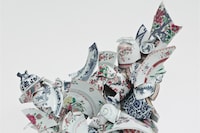
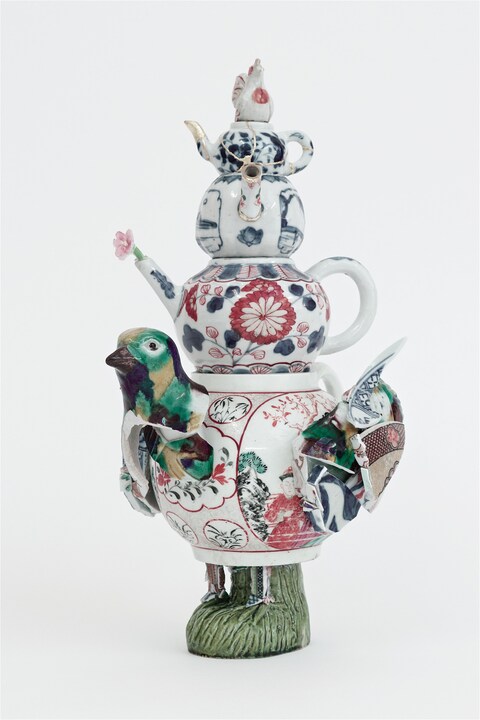
“Bouke de Vries doesn’t make ceramic art as such but rather takes broken pottery and creates new embodiments from the pieces,” says Sanders. “His work is a form of ‘renewal’ or ‘rebirth’ which celebrates the creative potential at the core of all destructive forces.” The Dutch artist De Vries studied textile design in the 1980s, working with iconic fashion names such as John Galliano and Stephen Jones before later learning ceramic conservation and restoration, which became the basis of his artistic practice.
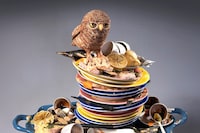
His work brings life to pieces that have been accidentally damaged, finding new narratives and connotations along the way as towers of broken pieces create vast new shapes. In his 2023 work Accumulation, a mass of 17th- to 20th-century porcelain vessels from China are stacked in an open circle above a single vase. Meanwhile his 2026 work Delft Imari Teapot with Butterflies features an 18th-century ceramic, smashed into pieces that are suspended in a shape similar to that of the original, at once coming together and being torn apart.
Between Worlds is on show at Kodl Contemporary from 4 September until 1 November 2026.