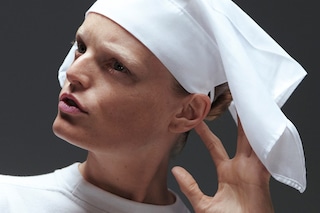
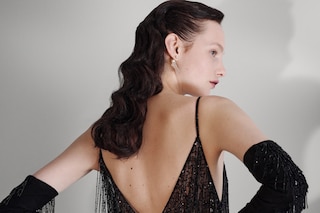
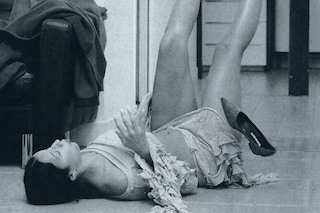
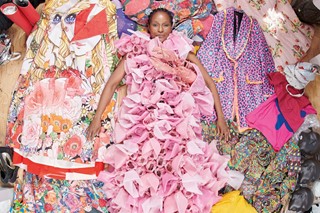
For
the past three years that Isterografo Fashion Issue is breathing, one of the main points we set as “Must Task”
was to include Maison Martin Margiela in our pages.

It
wasn’t an easy one, as proved repeatedly, since I tried so many times to get
though and finally manage to even have a response back. The mystery around MMM
was growing bigger and bigger each time thanks to silence..but I wouldn’t give
up.. What
makes Maison Martin Margiela so intriguing really? MMM has almost a
self-masochistic behavior compared to how other Houses function.


There is a
syntactic order somehow, that leads to a completely individual outcome each
time. After twenty years the House was first launched, it remains a pure inspiration
both in fashion, art and literature.A
conceptual label that keeps on going, with no boundaries set by the changes of
society or the world or even the market itself.MMM
is continually overexposed, as the collections routinely reveal the designer's
techniques and interests in their very construction. Bearing visible stitches,
exposed hems, tailor's markings, and external shoulder pads, the collections
never fail to intrigue, shock or delight.


Martin
Margiela was born in Belgium in 1957. Early in his career, he became part of
the Antwerp Six, the group that put Belgium as a solid member on the map of
Fashion and its members included, Dirk Van
Saene , Dirk
Bikkembergs , Marina Yee, Dries van Noten, Ann Demeulemeester, and
Walter Van Beirendonck , at the time all graduate students of Antewerps Royal
Academy of Fine Arts.


In
1984 he joined Jean-Paul Gaultier's design team, an experience that would
profoundly shape his fashion sense. Leaving Gaultier in 1988, Margiela launched
his own label, which soon became known for his theme-oriented collections.
His
"Flat Collection" moved sleeves and armholes to the front, so
garments would lie perfectly flat when not worn. His 1996 "Photoprint
Collection" consisted of crepe garments printed with images of fur coats
and heavy sweaters. Other collections have used broken dishes and bacterial
mold; still others have featured no new designs, only favourite pieces from
previous collections that have all been re-dyed in gray color.
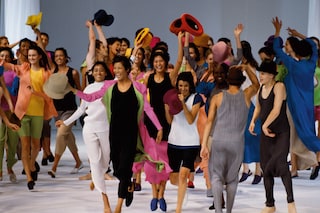
Margiela
always puts on a show, using vacant lots and old subway cars as runways, and
marionettes and hangers as models. In 1997, Margiela was hired to design the
women's ready-to-wear line for Hermes. His first Hermes collection proved he
could color inside the lines when required to;

In
late 2009, Martin Margiela quietly left the House he founded without a
replacement.
Since
then, his dedicated team took over, stepping on the worries of failure the
press spread around the world.


The
Margiela brand remains vibrant and vital without one creative force and its
initiative will be studied by the many historic brands trying to stay relevant
in the 21st century.
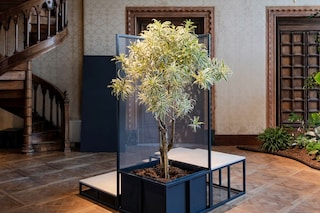
Starting
on June 3rd until 5th September 2010
Somerset House of London ,hosts Maison Martin Margiela ’20’ The Exhibition;celebrating the 20 years of
one of contemporary fashion’s most influential and enigmatic designers.
Following the success of recent exhibitions
‘SHOWstudio: fashion revolution’ and ‘Skin and Bones: parallel practices in
fashion and architecture’ this unique exhibition will explore the designer’s
artistic and conceptual approach to fashion and continues Somerset House’s
commitment to showcasing the world’s most celebrated creative talents across
fashion, art and design.

Conceived in close collaboration with Maison Martin Margiela and curated by the
Mode Museum, Antwerp, this exciting show makes its London debut where it will
be specially reconfigured for the Embankment Galleries at Somerset House,
following critical acclaim at the MoMu, Antwerp and Haus der Kunst, Munich last
year.
This is our recent conversation, proudly
featured in Isterografo’s 7th Fashion Issue.

20 years of Martin Margiela. What was the goal of
the House, when it first started out and how it has changed in comparison with
today?
We view our work as a
proposition to wear what we feel at any given moment.


How difficult it was for a Belgian brand to break
into the Parisian bourgeoisie considering that the Margiela heroine is far from
bourgeois?
At the beginning, it was just Martin and Jenny
(Jenny Meirens was the co-founder of MMM) starting a company in Paris. Then,
the team started to grow as the company developed. Today, Maison Martin
Margiela is a team of more than 70 persons from 19 nationalities in Paris’
headquarters only. Does that make MMM a Belgian brand?


Martin Margiela dresses in the past ten years
evolved into something more than ready-to-wear. What motivated the team into
conquering couture, menswear and design objects?
We leave the interpretation
of our work to others. As for ‘couture’, we have always shown handmade garments
as part of our ‘Artisanal’ collection (line 0) where we rework/transform
vintage and used garments of many varied époques to form unique pieces that are
made available to our customers around the world. Though certainly not to be
considered ‘Haute-Couture’ as it is understood today - our Artisanal production
can maintain certain crafts involved in the production of hand made individual
garments that have been alive for many centuries and that are difficult to keep
within the industrial methods of clothing manufacture today.
Over the years, all the other lines (please see our
flyer as per attached) came naturally as a complement to the original ones as
the company was developing.


In the early years the brand tag on Margiela
items was less visible than it is today. Could you please analyze the
transformation and the importance of the signature visibility.
The four white stitches only appear on
unlined garments. They were devised so as to, realistically and ideally, offer
the option to those confronting the garments for the first time to react to
their form and energy, and not just the idea of “brand” as expressed via a
label.

What most people consider as our logo – the four
stitches in the back with the white label inside the garment - had in fact the
opposite purpose: it was meant to be cut off so the garment would be without a
label and logo!
It has not changed at all except that before the
label was completely white and with the creation of new lines, we added the
numbers and circled the appropriate number of the line the garment is part of.


Why is the Margiela team and boutique staff
dressed in white?
Original idea: Unity. An
expression of team. A reference to the working ‘Atelier’/Studio’s of the past
and present, those ‘blouse d’essayage’ that models wear between fittings at
couture Ateliers.
Accidental plus point: A way of quickly recognizing
each other amid the fray of a fashion show.
We approach white as an expression of our union as
a team and also as an evidence of option, an option of expression, be that ours
or that of those who choose to wear the clothes we propose.
What is the philosophy of a MMM boutique?
That it represents as best it
can the spirit of our work and home. We wish our shops bring an atmosphere of
intimacy, calm, encouragement, stimulation and ease. We want that those who
visit any of our stores feel as at home there as we do.
Though all spaces inhabited by the Maison share
common themes, no two are alike in form, theme or decoration. Great care is
taken to respect each building's unique structure and original use. The
atmosphere of each shop, adapted and decorated by Maison Martin Margiela, also
draws on the prolific and iconographic use of whites – of furniture, objects,
fabrics and textures, old and new - typical of the spirit of the Maison Martin
Margiela's Paris premises, a former school of industrial design. Furniture and
architectural elements salvaged from shops and houses across the world are
brought to build on the space’s personality.


What has MMM achieved in its 20 years of
existence?
You are in a better position
to answer this question than we are.

The Artisanal line brought a whole new chapter in
Fashion, What was the main idea behind it?
Line 0 is Collection
« Artisanal » for women & men. Since its beginnings in 1988,
Maison Martin Margiela has been gathering garments, accessories, used and
sometimes new objects across the globe. That these garments and objects may be
given a second life whilst respecting and maintaining the traces of the passage
of time and use remains one of the keystones of the creative expression of the
Maison.


Each garment is reworked entirely by hand in the
atelier of the Maison in Paris. The complexity and specificity of each step of
such a creative process of transformation will naturally limit the quantity of
garments produced. The individuality of the materials used to create each
garment ensures that each is as unique as that which was used to create it. The
label, numbered 0, is sewn, embossed or stamped depending on the material used
to create the garment or accessory.

How important is for MMM to feel connected with
its customers considering the fact that the House itself is a mystery?
Crucial! We hope that they
are convinced that they can be completely ‘at one’ with a garment and be happy
wearing it and that a garment can reply to the needs and emotions of the person
wearing it is a beautiful thing.
We are lucky enough to have a very wide group of
men and women who wear our garments. From our point of view we have always paid
particular attention to designing for as large a cross section of women and men
as possible. We are lucky in that so many people of different ages, shapes, social
role and background are following our work! For us femininity is all embracing
and is not just limited to one body form or one attitude. Since our beginning
our fashion shows have reflected this reality of our collections in that we
have always chosen to show our collections on women of varying ages and from
varying walks of life. We feel that we are lucky in that this approach is also
reflected in those who wear our garments.

To what extent is MMM connected to ART?
We prefer not to interpret
our work, preferring to leave that up to others better placed to place our work
in an overall context. We all have work that we love, though, possibly
regrettably, as a team we have no real connection to the Art world.
Fashion is a craft, a technical know-how and not an
art. Each world shares an expression through creativity though through very
divergent media and processes.


Paris radiates its own platform when it comes to
fashion. Why is the city of light so relevantly fashionable?
At this stage, the inertia
that this town has amassed over the years. An inertia that draws creativity and
those attracted to it into its core. Yet Paris is not essentially different
from any other great city ‘of personality’.
It stands as itself in much and the same way as New
York, London, etc. Almost a ‘brand’, its ‘branding’ is of a town that embraces
a more individualistic creative expression. Those wishing to begin in fashion
tend to start and show here because of the concentration of fashion
professionals passing through town throughout the year (that inertia again!).


Would the House wish to link again with another
like the past connection you had with HERMES?
Such collaboration was a
personal project of Martin Margiela, not of Maison Martin Margiela.


Today there is a blossom of pseudo couture, a lot
of designer get credibility without actually deserving it. Many faces come and
go in a glimpse of an eye…Everything is moving so fast.. What does it take for
a HOUSE to remain in charge in such times?
Courage and instinct.

What are the differences between your men and
women customers?
Gender!

How is sex appealing in the MMM collections?
It is to others to interpret.

Has MMM experienced relevant tragedies like the
recent worlds financial crisis?
No!

MMM is a result of teamwork. How do new members
enter the team and to what extent is the difficulty for a member to leave the
House?
We suppose just as easy
and/or difficult as in any other team. More generally, there are over 70 people
at the Paris HQ. We often compare our way of working to the building of a wall:
everyone brings a stone and eventually the wall is built. And everyone needs to
bring the stone, otherwise the wall collapses. Everyone has a role within the
team, but everyone also has a voice within that team… This is one of the
reasons why Martin never appeared publicly, as we all know that if he would
have, the light would have been on him, and without him in the light, the
message would be different: the work is the collaboration of a team and not
just about one single individual.
What is the most valuable moment in the History
of Fashion and why?
More often than not we are so
close to our work it is genuinely impossible for us to define the ‘how or why’
and especially, experience tells us, to predict the ‘buttons it will push’ in
those who are confronted by it. This is as true of the reaction any individual
will have to a garment hanging in a store as it is for the professionals of our
industry to a fashion show.
What serves to inspire you the most?
Our main inspiration has
always has been the extremities and changes of daily life. Our work is solely a
proposition to wear what it is we like to create, a presentation of a way in
which we see things at a given moment.
As a team we all share so many interests and
sources of inspiration, these are all very varied and would take far too long
to list here. It is often hard to quantify or describe inspiration. It is often
more by osmosis than an active decision.
Each member of our team seeks to explore their own
stimulation, be that visual or another. Such stimulation and dialogue varies in
direction and importance for each of us.

What are the morals of MMM?
Such notions are not part of
our vocabulary.
MMM suffers from a lack of self exposure. Does it
happen out of modesty and if not, why is the House hidden in shade from the
Glossies?
Even though people tend to
think we do not communicate, we feel we are. But we do not use any physical
image of a designer to promote our work. If people are touched and like to wear
what we propose they are free to buy and wear it. What our designer looks like
has, for us, little or nothing to do with this process. We prefer that people
react to a garment through their taste and own personal style and not their
impression of the individual and group of people who created it as translated
and hyped by the press. Unlike actors or singers we do not need any physical
form to express our work.

What is modern?
An abused notion that became
meaningless…
What is old?
Our headquarters’ building.
How will MMM be on its 30th anniversary?
Let’s speak again in 2018.
A final quote on SEX.
Sex is good.
A conversation with MAISON MARTIN MARGIELA
and FILEP MOTWARY
22 April 2010
View original post